Illustration: Xia Qing/GT
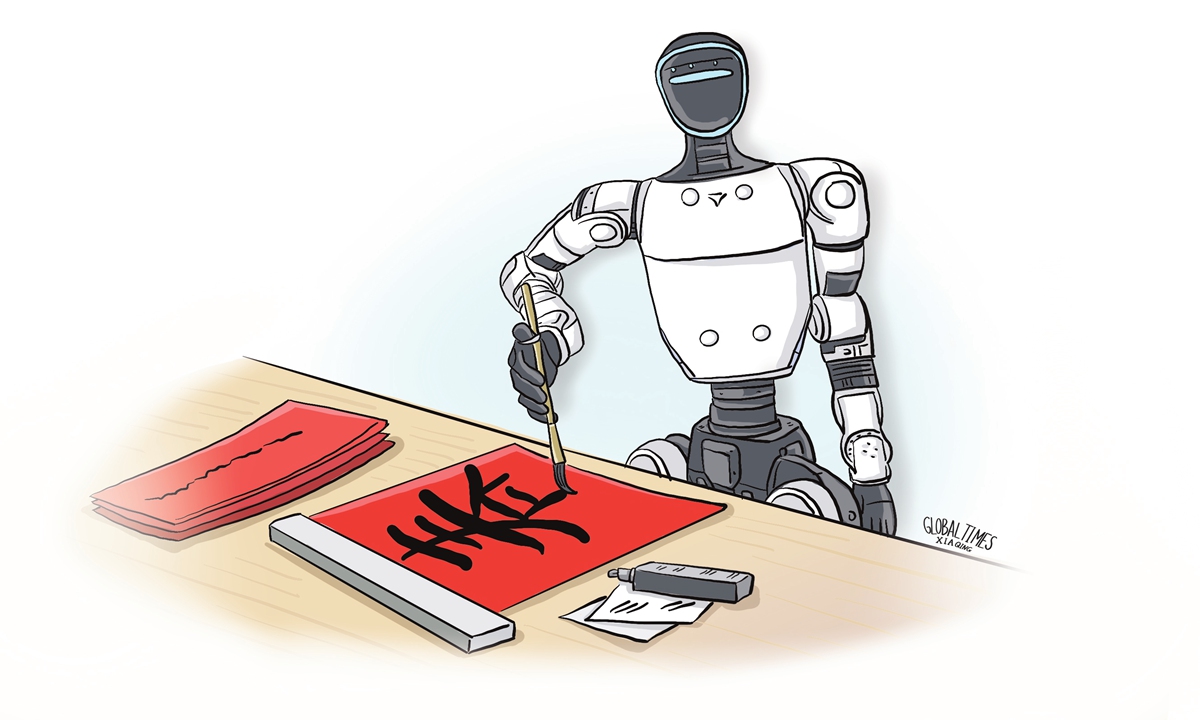
During the Spring Festival, Chinese households customarily paste on their front doors a red paper inscribed with the character fu, for "good fortune," rendered in brush calligraphy as a gesture of hope for the year ahead. This year, in some cities, that tradition has taken an unexpected turn: robots have begun wielding the calligraphy brush in public spaces. The episode may seem minor, but it offers a telling glimpse into the early contours of China's consumer robotics market.A video report by CCTV.com on Wednesday showed a humanoid robot, dressed in traditional Chinese attire, writing the character for "good fortune" on a city street, attracting the attention of passers-by. The Sanxiang Metropolis Daily reported on Tuesday that in a metro station in Changsha, Central China's Hunan Province, visitors could watch both human calligraphers and an intelligent calligraphy robot produce Spring Festival couplets on site. The robot's mechanical arm held the brush steadily, producing evenly inked, precisely formed lines, while adults and children paused to watch. The appeal lies less in the artistic quality of the robot's work than in the novelty of witnessing machines gradually enter everyday life in China.
As the Spring Festival approaches, displaying couplets and characters for "good fortune" remains a long-standing tradition. This year, the enthusiasm for robot-produced calligraphy points to a broader curiosity among ordinary consumers about the role of humanoid robots in daily life. While China's consumer humanoid robotics market is still in a nascent phase, public interest suggests that it could see significant growth over time.
The trend extends beyond calligraphy robots. Ahead of this Spring Festival, a wider range of intelligent machines - both humanoid and non-humanoid - was visible in everyday settings. Information-query robots were deployed at transportation hubs, artificial intelligence security robots operated at airports, and delivery and cleaning robots were in use at restaurants and communities, running around the clock and helping to ease peak demand for services.
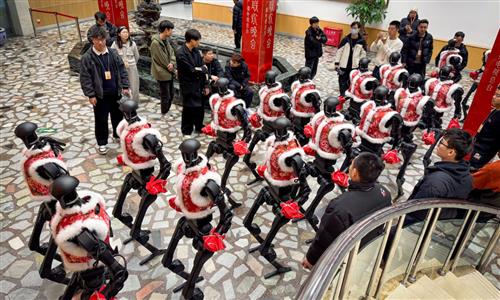
The lens can now be focused more closely. During the ongoing peak of China's Spring Festival travel rush, an increasing number of robots have been deployed to provide services at train stations and airports. According to local media reports, the G1 humanoid robot produced by Chinese manufacturer Unitree began performing crew duties this year on trains in Hangzhou, East China's Zhejiang Province, during the Spring Festival travel period.
The surge in demand for intelligent service robotics over the Spring Festival has even given rise to a budding rental market. Observers have noted that performances by robots at festival and holiday events, corporate year-end gatherings, and cultural-tourism activities have driven a noticeable uptick in short-term rentals. Data from Shanghai-based robotics firm AgiBot's rental platform called Qingtian Rent showed that, starting from two weeks before the Spring Festival, robot rental orders on the platform began to show a clear upward trend. In the first week of February, the number of robot rental orders increased by about 30 percent week-on-week, the Shanghai Securities News reported.
The fascination with robots writing calligraphy, combined with the growing presence of intelligent machines this Spring Festival, point to emerging opportunities in China's consumer robotics market. Ordinary consumers' curiosity, readiness to engage with new technologies, and attention to market developments indicate that demand is both substantial and on the rise.
At present, the market appears driven by robust consumer demand. There is a keen appetite among consumers for new technologies and products, and even experimental offerings draw attention and elicit feedback. These signals suggest that China's consumer market for intelligent service robots may be on the verge of a significant expansion, with successive waves of new products likely to drive further growth.
This high level of demand presents opportunities for both domestic firms and international companies. From a domestic perspective, Chinese technology companies are racing to meet this demand and capture potential profits. Overall, the development of China's technological capabilities is closely linked to market forces.
However, some Western observers mistakenly interpret China's technological progress through a geopolitical lens, framing it as a matter of international competition. Such an overemphasis on competition is unnecessary. Considering China's domestic market demand alongside technological advancement offers a more accurate and complete perspective on the country's current development.
This Spring Festival, robots producing calligraphy may offer an early indication of rising market demand. China's market for new technologies is both large and open, creating opportunities for domestic firms to further develop their capabilities, while also presenting potential avenues for international companies seeking to engage with this fast-evolving sector.
The author is a reporter with the Global Times. bizopinion@globaltimes.com.cn
RELATED ARTICLES