China to add AI, low-altitude economy majors in vocational education reform to train skilled workers for emerging technologies
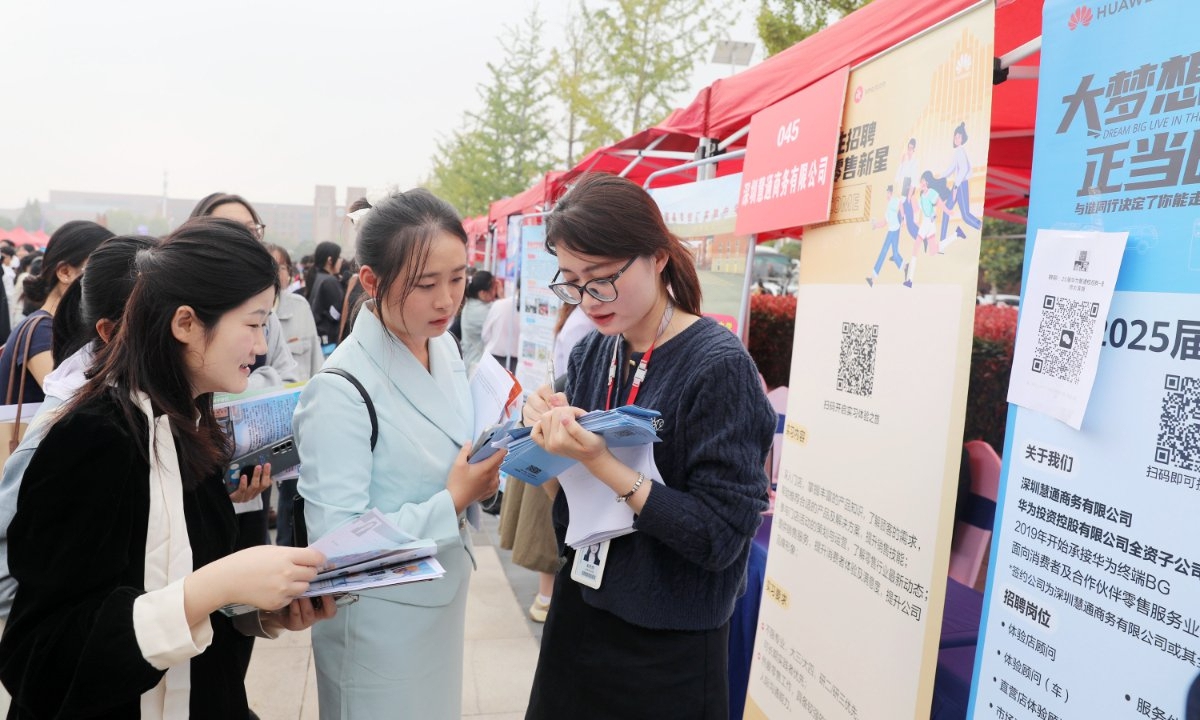
College students look for jobs at an employment fair held on the campus of the Huaibei Normal University in Huaibei, East China's Anhui Province on October 16, 2024. The job fair attracted more than 183 companies offering more than 10,000 positions. The year 2024 is expected to see 11.79 million students graduating from colleges, an increase of 210,000 from 2023. Photo: VCG
China's education authority will prioritize the creation of new majors in low-altitude economy, artificial intelligence and high-end equipment manufacturing, as part of a broader push to deepen vocational education reform and better align talent training with emerging and future industries, the Ministry of Education (MOE) said on Thursday.
In a guideline on advancing teaching reform in vocational education seen on its website, the MOE outlined a comprehensive overhaul of key elements of the vocational education system, including majors, curricula, teaching materials, faculty development and internship training.
At the core of the reform, authorities will step up adjustments to major offerings by adding programs in line with market demand, phasing out oversupplied ones and upgrading existing disciplines. Priority will go to areas such as the low-altitude economy, AI, high-end equipment, urban renewal and other sectors facing acute public service shortages, according to the guideline.
The guideline calls for leveraging big data and AI to more accurately forecast supply and demand in key talent segments, providing a scientific basis for vocational education system reform.
In parallel, existing majors will be upgraded along the pace of digitalization, green transformation and industrial integration, with continuous iteration of training plans to ensure graduates possess comprehensive and adaptable skills.
To strengthen coordination, the document calls for the establishment of regular consultation mechanisms among provincial-level departments. These mechanisms will periodically release lists of urgently needed majors, programs requiring upgrading or cancellation.
China has ramped up the development of strategic new growth drivers, adjusting vocational programs to better align with real-economy demand that will help reduce skill mismatches, ease structural talent shortage and support industrial upgrading, Wang Peng, an associate research fellow at the Beijing Academy of Social Sciences, told the Global Times on Thursday.
The new guideline also comes amid growing emphasis on "investing in human capital" in official policy discourse, a term that has featured prominently in the 2025 government work report, long-term development plans and a high-level economic meeting last month that set priorities for 2026.
In July 2025, authorities had expanded "micro-major" and vocational training programs in AI and low-altitude economy, covering 12 urgently needed fields and 60 key directions. Universities have introduced 2,654 micro-majors for the class of 2025, with about 74,000 students enrolled, according to MOE.
The guideline prioritizes the cultivation of high-skilled workers and sets out five major reform tasks: dynamically adjusting major offerings, scientifically designing curriculum combinations, optimizing the presentation of teaching materials, refining competency requirements for teachers, and building internship and training bases through deeper industry-education integration.
The goal is to shift talent training from a traditional focus on knowledge transmission toward the enhancement of comprehensive capabilities, promote systemic upgrading of the vocational education system, and foster an ecosystem conducive to nurturing high-skilled professionals.
Through these efforts, China aims by 2027 to establish an advanced standards system for vocational education and build a number of high-level hubs for talent cultivation; by 2035, it plans to develop a vocational education model with Chinese characteristics, significantly enhancing the sector's capacity to serve national strategies and industrial development, according to MOE.
On implementation, the guideline outlines measures including requiring provincial education authorities to take the lead in formulating detailed action plans and securing support from major national programs and funding channels. It also calls for stronger coordination of regional resources, with selected institutions playing a demonstrative role in building high-level clusters of specialized majors.
Global Times
RELATED ARTICLES