Auto exports hit record high for January, signaling global competitiveness: CPCA official
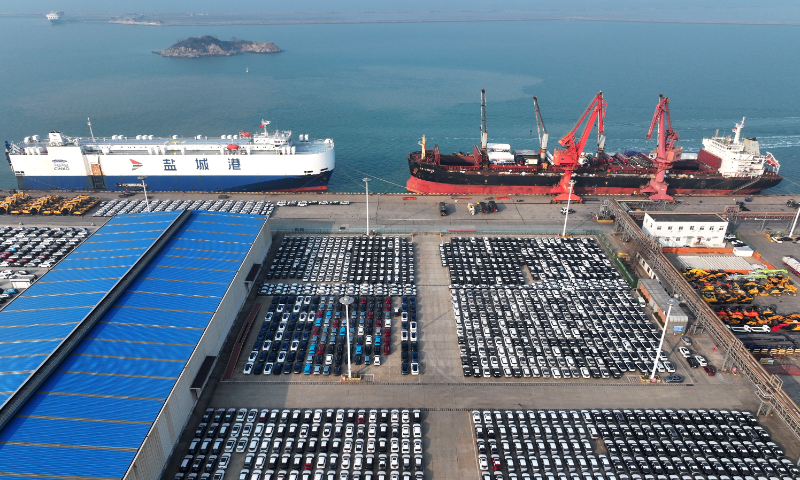
A large number of new-energy vehicles waiting to be exported are parked at Lianyungang Port, East China's Jiangsu Province, on February 11, 2026. Photo: VCG
Chinese passenger car exports reached a historic peak for any January in the first month of 2026, with exports of new-energy vehicles (NEVs) also reaching a new high for January, underscoring the industry's mounting competitiveness abroad amid robust overseas demand, Cui Dongshu, secretary-general of the China Passenger Car Association (CPCA), wrote on the CPCA's WeChat account on Thursday.
With progress in China-EU and China-Canada automotive tariff negotiations, NEV exports are evolving from "simply selling cars" to "going global with full industrial chains." Future export growth is expected to shift from high-speed quantitative expansion to a qualitative leap and upgrade, said Cui.
Carmakers shipped 576,000 passenger vehicles overseas in January, up 52 percent year-on-year. NEV exports stood at 286,000 units, up 103.6 percent year-on-year, accounting for 49.6 percent of total exports, according to CPCA data.
The figures reflect sustained foreign appetite for Chinese vehicles, particularly in Europe and Southeast Asia, where NEV brands are rapidly gaining share, said Cui, adding that this trend has laid a solid foundation for future export growth.
Among domestic brands, independent Chinese manufacturers exported 250,000 conventional fuel passenger cars, up 17 percent year-on-year, and 226,000 NEVs, up 115 percent.
Self-developed NEVs comprised 47.5 percent of total overseas shipments of independent Chinese automakers, which increased by 49 percent year-on-year, CPCA data showed.
Joint venture and luxury brand exports reached 100,000 units, a year-on-year increase of 65 percent.
Cui said that January exports continued China's better-than-expected NEV export performance in 2025.
In 2025, China accounted for 68.4 percent of the world's NEV passenger market, and Chinese carmakers' share of the global automotive market reached 35.6 percent, according to the CPCA.
In the domestic retail market in January, conventional fuel vehicles outperformed NEVs in the pre-Spring Festival rush, continuing a long-standing seasonal pattern. As December's policy-driven pull-forward effect fades, Cui said that domestic NEV sales would return to growth in the coming months.
According to CPCA data, retail sales of passenger vehicles totaled 1.544 million in January, and 596,000 NEVs were sold domestically, with a retail penetration rate of 38.6 percent.
In the NEV retail market, brands such as XPeng, Leapmotor, and Xiaomi saw their share rise by 10 percentage points year-on-year. Tesla's share, however, stood at 3.1 percent, down 1.5 percentage points from the previous year, CPCA data showed.
Global Times
RELATED ARTICLES