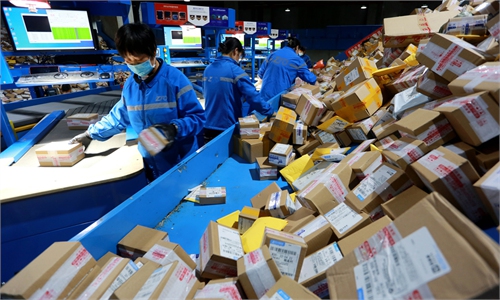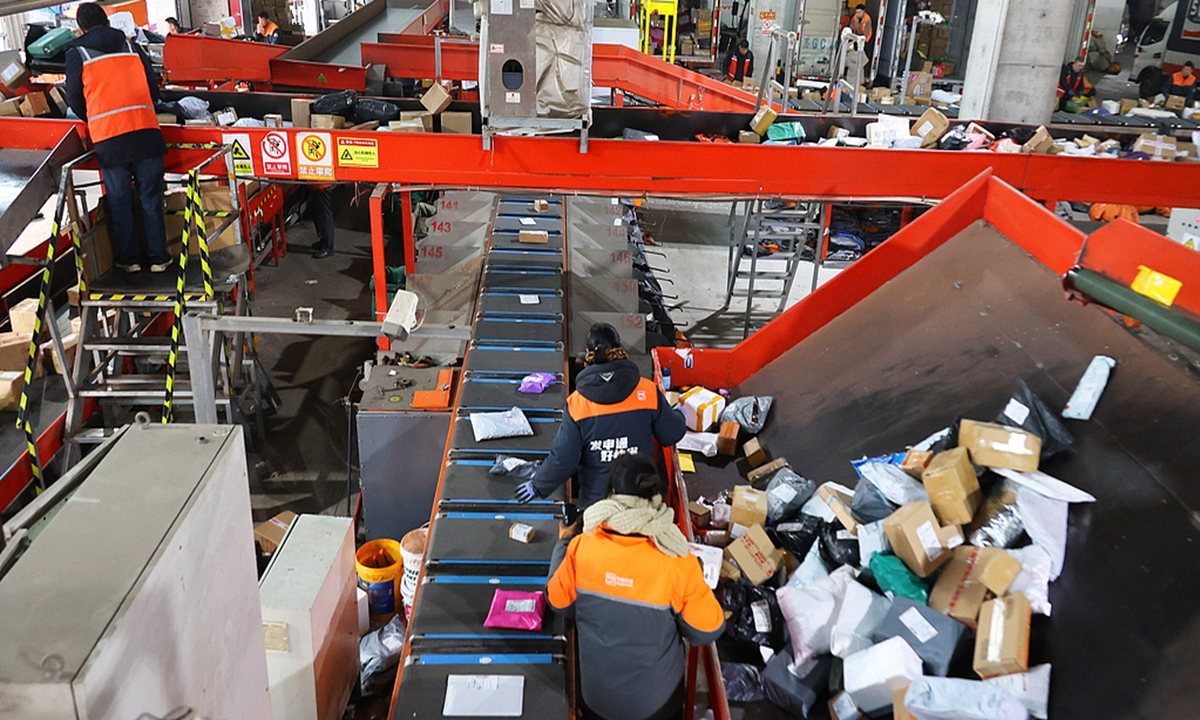
Workers sort holiday delivery parcels at a public distribution center in Lianyungang, East China's Jiangsu Province, on February 12, 2026.
As the Spring Festival rapidly approaches, China's postal and courier industry has entered a peak "New Year goods" peak season. Data from the State Post Bureau (SPB) showed that from February 2 to February 8, nationwide courier parcel volume reached 4.686 billion items, up 3.19 percent week-on-week, with average daily throughput nearing 670 million, the People's Daily reported on Thursday.
The surge, building since mid-to-late January, reflects robust consumer demand and the broader economy's resilience, industry observers said.
"Since the peak began, I've been packing more than 200 boxes of cherries a day," Kang Hongshan, a delivery worker for SF Express in Jiaxing, East China's Zhejiang Province, told the Global Times on Thursday.
Shipments of imported fruits, such as cherries, have become a major driver of seasonal volume, with consignments moving across Jiangsu, Zhejiang and Shanghai, and extending northward, Kang said.
In Kunming's Dounan flower market, Southwest China's Yunnan Province, which is known as Asia's flower capital, the demand for New Year blooms has also climbed. Couriers including ZTO and JD Logistics reported roughly 20 percent week-on-week increases in packing and dispatching volumes over the past week, according to the People's Daily report.
The 2026 Spring Festival falls on February 17, and consumers have already started stocking up New Year supplies - with red Chinese knots, lanterns and other festive ornaments flooding the market.
China's e-commerce platform JD.com said that this year's New Year purchases reflect a blend of tradition and novelty. Sales and search trends indicate strong interest in red-themed items, which are associated with good luck, with searches for such products on JD up more than 80 percent month-on-month.
Besides, traditional decorations such as paper window-cuts, spring couplets, fu (good luck) characters, lanterns and Chinese knots account for about 39.2 percent of the demand, while red fruits such as strawberries and cherries make up roughly 26.7 percent, JD.com told the Global Times.
Logistics services and innovations have been key to meeting demand and supporting consumption.
"We are now in the height of New Year parceling, and daily shipments of our large Shandong-style steamed buns increased fivefold," Jiang Zhenxing, a ZTO courier in Qingdao, Shandong Province, told the Global Times. To keep pace, couriers have set up neighborhood pick-up stations and increased the frequency of street-level collections to three times a day, with flexible scheduling for shop owners.
"Courier companies' fast and efficient support for multi-platform promotions that span long periods drive consumption upgrading and real economic growth," said Liu Jiang, director of the strategic planning department at the Development and Research Center of the SPB.
He added that technology and operational innovations are accelerating response times and sharpening service accuracy, bringing global goods to Chinese consumers and energizing the holiday economy.
According to data released by the China Federation of Logistics and Purchasing on Tuesday, China's logistics sector generated total revenue of 14.3 trillion yuan ($2.07 trillion) in 2025, up 4.1 percent year-on-year. The logistics prosperity index averaged 50.8 during the year, a reading that analysts interpreted as continued, moderate sectoral health, the china.news.com reported.
As families shop and send gifts for the holiday, the logistics network's capacity to scale up in a short period remains central to keeping retail activity flowing and reinforcing signs of economic vitality as China heads into the Spring Festival holidays, Liu said.
RELATED ARTICLES