IN-DEPTH / IN-DEPTH
New Year on the Frontlines: ‘Guardians of Mt. Qomolangma’ embrace Spring Festival with warm hearts, high-altitude vigilance
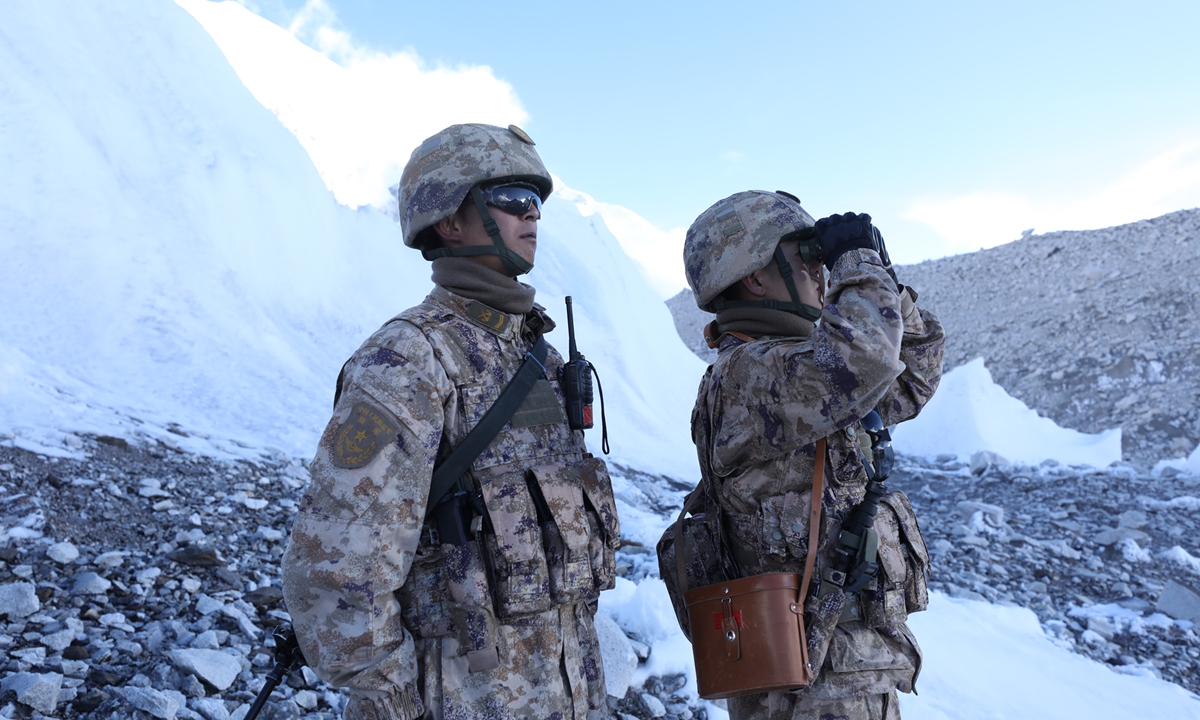
Soldiers of the Gangga defense company patrol on the snow-capped mountains and glaciers. Photo: Courtesy of Xigaze Military Sub-command under the Chinese PLA Xizang Military Command
Editor's Note:"We joined hands to build a better life and enjoyed it together," Chinese President Xi Jinping noted. "When the happy hum of daily life fills every home, the big family of our nation will go from strength to strength."
During the Spring Festival (Chinese New Year), when families come together, it is those who stay at their posts who make that quiet warmth all the more tender.
As the 2026 Spring Festival approaches, the Global Times launches a series of feature stories themed "New Year on the Frontlines: Perseverance and Warmth Across Mountains and Seas." From a 5,000-meter icebound outpost in the Qinghai-Xizang Plateau to a tropical port on the shores on the South China Sea; from high-speed trains that carry the scent of home to the craftsmanship shared along the Belt and Road partner countries - countless ordinary yet remarkable individuals, standing firm together at their posts during this most cherished Chinese festival, paint the truest portrait of an open, hospitable big family of the Chinese nation.
In this installment, Global Times reporters journeyed to the foot of Mount Qomolangma in Xigaze, Southwest China's Xizang Autonomous Region, uncovering the frontline stories of the "Guardians of Mount Qomolangma" at the Gangga defense company.
With Spring Festival drawing near, there are no decorative lanterns and colored streamers at the Gangga border defense company, located at the foot of Mount Qomolangma in Xigaze, Southwest China's Xizang Autonomous Region.
Known as the "Guardians of Mount Qomolangma," the border defense company is stationed near the world's highest peak in an extreme high-altitude environment - 4,380 meters above sea level - at the foot of the Himalayas. The region has an average annual temperature of only 2-4 C, with winter temperatures often dropping below the -30 C. Its 156-kilometer border line also winds through snow-capped peaks and icy ridges. Despite these harsh conditions, the soldiers in the company adhere to an unshakable principle: "Never neglect combat readiness during festivals."
Their unwavering dedication on the high‑altitude frontier was nurtured under the consistent care and expectations from the nation's leadership for frontline service members.
Chinese President Xi Jinping on February 10 reviewed the armed forces' combat readiness and ongoing operations and extended Spring Festival greetings to all service members of the country via video link in Beijing, the Xinhua News Agency reported.
"Maintaining combat readiness during holidays is a fine tradition of our armed forces," Xi said, urging the military to stay vigilant and safeguard both national peace and the well-being of the people, according to Xinhua.
From 'adapting' to 'keeping ahead'
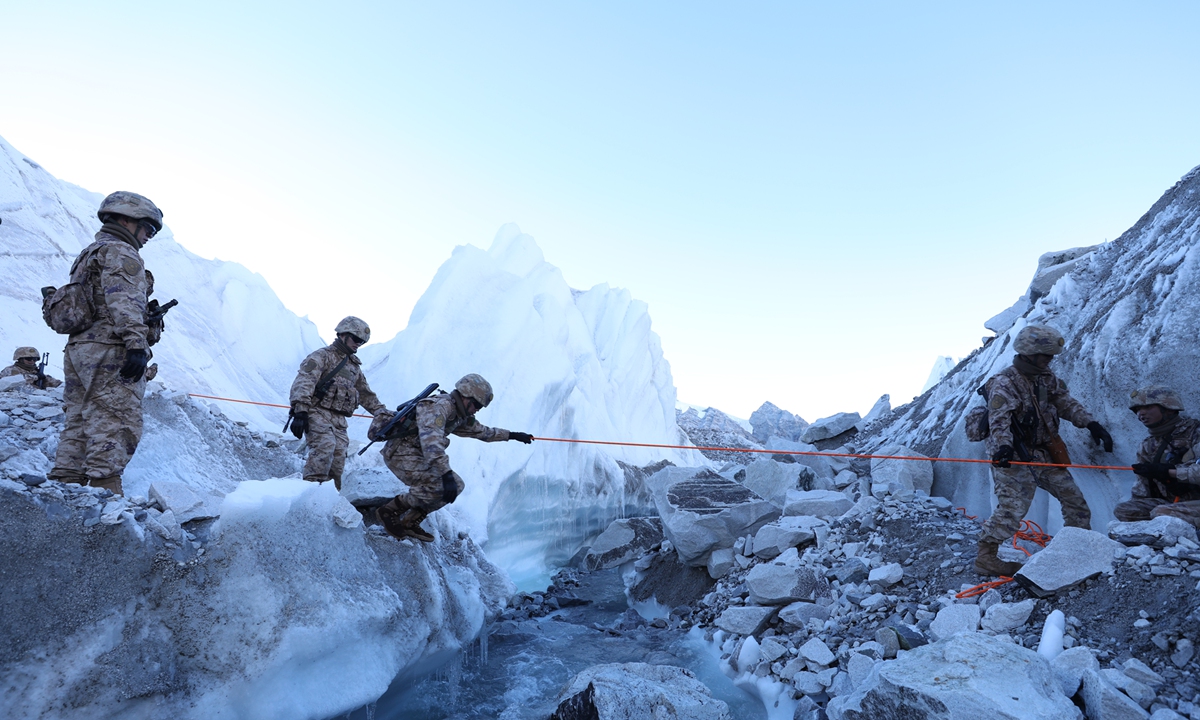
Soldiers of the Gangga defense company rely on ropes to cross glaciers while on patrol. Photo: Courtesy of Xigaze Military Sub-command under the Chinese PLA Xizang Military Command
Inside the operations room at the Gangga border defense company, political instructor Jiang Xian and on-duty personnel fix their attention on electronic screens that beam high-definition real-time footage updates from key mountain passes and border crossings. One corner of the screen focuses on the Banong Zhuokang Outpost. In Tibetan, "Banong Zhuokang" means "inn at the edge of the sky," a fitting name for this critical deployment site. This has earned its garrison the affectionate title "soldiers stationed at the edge of the sky" from local Tibetan residents.Behind this warm nickname lies an almost unimaginable level of dedication. At 5,501 meters above sea level, Banong Zhuokang is one of the military's highest outposts, a frigid, oxygen-deprived outpost surrounded by glaciers and perpetual snow.
Swiping his screen, Jiang showed Global Times reporters the 30-kilometer patrol route from the outpost to border marker No.62. The path includes the steep slopes dubbed "Despair Slope," hidden crevasses, and loose rocks that could fall at any moment, which were once the deadly hazards the "Guardians of Mount Qomolangma" faced head-on.
"But now, the Despair Slope isn't so desperate after all," Tsewang Rigzin, deputy chief of staff of the border defense regiment overseeing the company, told the Global Times. As a veteran with two decades of experience, he explained that the old model of patrolling on foot has evolved into an integrated system combining human, physical, and technological measures. Drones, high-resolution cameras, and thermal sensors now form a tech-savvy defense line, reducing the need to challenge nature with sheer physical endurance.
For scout Guo Jiacheng, the drone he operates embodies this technological empowerment. "Technology makes up for human limitations in extreme environments," he noted. Severe cold, avalanches, and road collapses are common in the Himalayas during winter, making some passes impassable. Drones help fill the gap by conducting patrols, assessing hazards, and supporting reconnaissance.
The new equipment has also boosted the soldiers' enthusiasm for learning. Even as the holidays near, Guo, who has spent several Spring Festivals on duty, is deepening his tactical knowledge.
"Rapid technological advances mean we have more to learn, but the equipment is also more user-friendly," Guo said.
Similarly, Cui Chuanwei, a soldier responsible for communications, emphasizes the need to stay alert. Cui said that the rapid update of military communication technology has led the troops at the foot of Mount Qomolangma to undergo a transformation from "adapting" to "keeping ahead."
"In the past, our biggest challenge was struggling against the natural environment," Cui explained. "Now, even amid the snow-capped mountains, we must continue learning vigorously to keep pace with technological advancements and never fall behind."
"Communications are the military's 'nerves' - its eyes and ears," Cui said. For him, "keeping ahead" means "staying 'competent at all times' to quickly establish stable and reliable communication links under any circumstances."
'Wish list' comes to life
When Global Times reporters arrived at the Gangga border defense company in late January, expecting to have spartan experience, they were instead met with a bustling scene. At 11 am, a refrigerated truck rolled into the camp. Soldiers quickly lined up to unload supplies in relays.
"Fresh shrimp!" "Two crates of strawberries!" "One crate of flowering cabbage!" Loud calls announcing the supplies echoed back and forth, mixing with the patter of soldiers' footsteps and the rustle of supply lists in the wind to create a vivid rhythm on the cold day. The list was complete, with fresh vegetables, fruit, seafood, and meat - specialties from across the country that had made their way to this snowy plateau in time.
Tang Guoqiang, chief of the kitchen squad, stood aside, flipping through the "suggestion book" in the hall. "This book is no longer just for comments; it's the soldiers' wish list," he said with a smile.
Today, refrigerated trucks make direct trips from Lhasa, the regional capital, to the camp twice a week, making sure fresh ingredients are no longer a luxury.
"Especially as the Spring Festival approaches, we strive to fulfill the wish list soldiers write down - dishes that satisfy their craving for the flavors of their hometowns," Tang said.
Talking about the changes at the border, Tsewang Rigzin was filled with emotion. "When I first arrived at the border outpost 20 years ago, canned food and dried vegetables made up most of our daily meals. Fresh food was a rarity," he recalled.
Now, the company has not only fully resolved the six major challenges of power, water, heating, medical care, oxygen supply, and sanitation, but the camp has also built its own sports facilities like basketball and badminton courts are fully equipped, Tsewang Rigzin noted.
This will be Jiang's third Chinses New Year at the foot of Mount Qomolangma. "Young soldiers may not fully grasp the tremendous changes the older generations had experienced, but they can truly feel the border becoming more and more like home," he said.
While the camp hasn't yet been decorated for the Spring Festival, Jiang has already planned collective activities for the holidays: making dumplings with the soldiers, holding a company gala, organizing group movie screenings, and basketball matches.
"We want everyone to have a lively New Year while guarding the border," he said.
Jiang noted that the camp's hyperbaric oxygen chambers can simulate the oxygen concentration and partial pressure of the soldiers' hometowns in lowland areas. Meanwhile, the "plant factories" - integrated green energy supply cabins - can replicate specific environments to grow specialty vegetables from the soldiers' home regions.
At the same time, with the development of plateau highways, even high mountains and deep valleys can no longer block the soldiers' reunions with their families.
Jiang said soldiers returning from leave often share their travel experiences with him. "Journeying along National Highway 318, they are greeted by the sight of flourishing towns, marked by their broad roads and lively market scenes."
National Highway 318 is from East China's Shanghai to Xizang.
Soldiers often said they want to bring their families to Xigaze during their next leave. They want their families to see where they defend the motherland and understand the hardships of this perseverance, Jiang noted.
"More importantly, they want their loved ones to witness firsthand how China's magnificent rivers and mountains are becoming better and better," he told the Global Times.
Even in winter, the Mount Qomolangma National Park remains popular with tourists. Dressed in thick down jackets, they come Xigaze to wait quietly for the breathtaking "Golden Peak at Sunrise"-when the sun's rays bathe the world's highest peak in golden light-and silently make their wishes.
Gazing out at the endless snowy ridges, Jiang said firmly: "Spring comes early at Mount Qomolangma."
"It's not the spring of melting snow outside, but the warmth in our soldiers' hearts. Guarding our posts during the Spring Festival - this is the most ceremonial way to celebrate," Jiang said with sincere pride.
Shen Jie also contributed to this story
RELATED ARTICLES