Chinese travel to BRI partner countries surges during Spring Festival, showing stronger ties, growing synergy
By and Zhang Weilan Published: Feb 13, 2026 08:52 PM

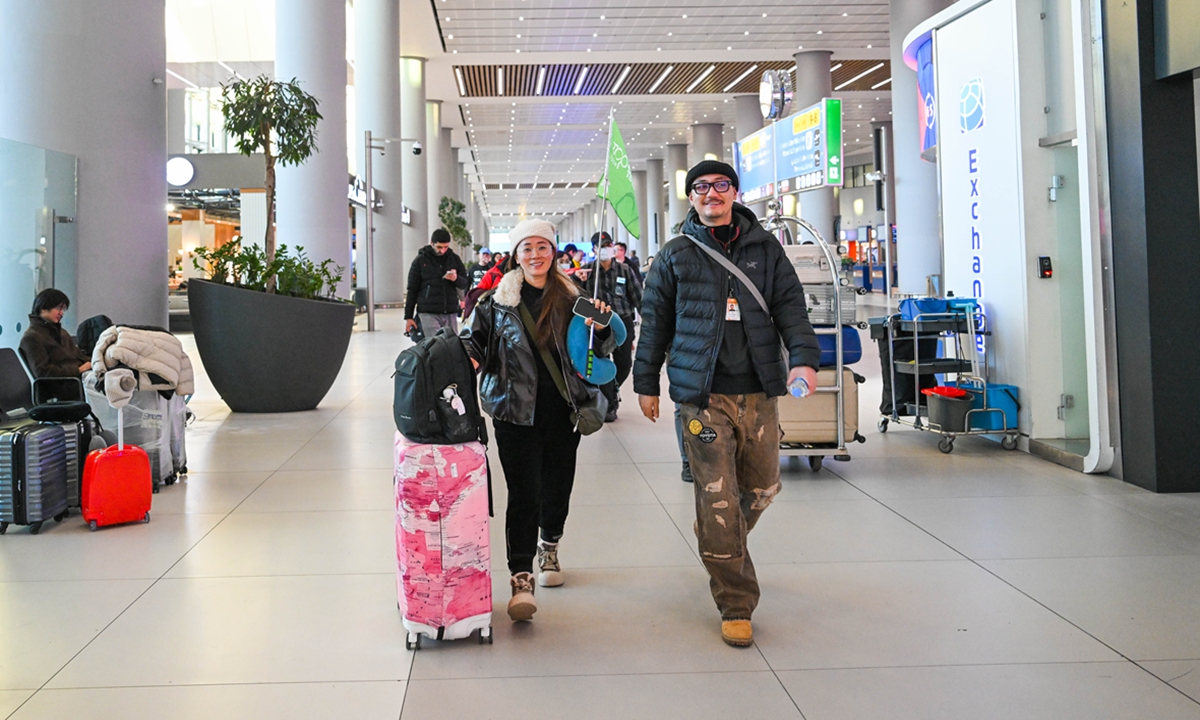
The first batch of Chinese tourists eligible for Turkey's visa-free policy arrives at Istanbul Airport on January 2, 2026. Photo: Xinhua
The upcoming Spring Festival is expected to see a surge in Chinese citizens' travel to destinations in Belt and Road Initiative (BRI) partner countries, according to data released by various travel platforms. Observers attributed this trend to closer people-to-people ties under the BRI, expanded visa-free access, and improved infrastructure connectivity.
A number of BRI partner countries - including Turkey, Sri Lanka, Russia, New Zealand, Egypt and the United Arab Emirates (UAE) - are among the top 10 overseas long-haul travel destinations for the nine-day Spring Festival holidays, which begins on Sunday and will be the longest in recent years, according to a report that travel service provider Tongcheng sent to the Global Times on Thursday.
Among them, Turkey leads the list with a 320 percent year-on-year surge in search popularity, benefiting from streamlined visa procedures and easier travel access. At the same time, the classic Turkey grand loop group tour that lasts 10 days and 7 nights has ranked highly among Spring Festival outbound vacation products in terms of sales, according to Tongcheng data.
Starting from January 2, Chinese travelers will be exempt from visa requirements for stays of up to 90 days within any 180-day period in Turkey, according to a Xinhua news report. As a strong supporter of the BRI, Turkey signed a memorandum of understanding with China in 2015 to align its Middle Corridor (MC) plan linking Turkey and Europe with China via a Trans-Caspian transport route.
A report sent by travel agency qunar.com to the Global Times also showed that hotel bookings in Turkey during the Spring Festival rose 150 percent year-on-year, ranking second among outbound destinations. Istanbul saw hotel bookings more than double during the period, while those in Antalya nearly doubled, with both cities ranking in the global top 10 for the fastest-growing hotel demand.
The qunar report also highlighted a significant surge in hotel bookings in another BRI partner country, Uzbekistan, which also grants visa-free entry to Chinese tourists. Reservations for hotels in the Central Asia country during the Spring Festival holidays have quadrupled year-on-year, topping the leaderboard for growth. Hotel bookings in Egypt and Saudi Arabia also rose 150 percent year-on-year on the platform.
Southeast Asian countries, most of which have signed cooperation agreements with China on jointly building BRI and feature a vibrant festive atmosphere, also remain popular overseas travel destinations for the Spring Festival holidays among Chinese tourists. According to data from Tongcheng, as of January 12, Southeast Asian countries account for half of the top 10 most popular international flight booking destinations for the Spring Festival holiday, with Singapore, Kuala Lumpur, and Bali among the leading choices.
BRI-driven travel growth
The BRI has played a key role in facilitating travel between China and other BRI partner countries. It has not only helped expand air traffic rights and improve infrastructure connectivity, but has also advanced people-to-people understanding, for example, through exchanges in Chinese traditional culture, Wang Jiazheng, chief representative of the Guangdong Economic and Trade Representative Office in New Zealand, told the Global Times on Thursday.
Wang said that New Zealand is bracing for a sharp increase in the arrival of Chinese tourists in the upcoming Spring Festival holidays. The office learned from local hotels and car rental member companies that orders have risen nearly 50 percent compared with the same period last year, with peak-season booking rates in popular cities remaining above 90 percent during the holidays.
As cultural exchanges accelerated under BRI, an increasing number of partner countries beyond Southeast Asia are now hosting Spring Festival celebrations, with the festival highlighting the global appeal of Chinese cultural heritage.
The Dubai Department of Economy and Tourism said in a statement sent to the Global Times on Thursday that the Dubai tourism authority will launch a series of vibrant, festival activities featuring traditional Chinese cultural elements during the Spring Festival, including a special Spring Festival light show on the landmark Burj Khalifa, the world's tallest building, a live broadcast of the Spring Festival Gala at Dubai International Airport, exclusive discounts via Alipay and WeChat Pay, and traditional Chinese opera performances at UAE shopping center .
In the first ten months of 2025, Dubai has welcomed 15.7 million international visitors, up 5 percent year-on-year and the contribution from the Chinese market "stands out prominently," the statement noted.
In addition to the UAE, other BRI partner countries such as Peru, Cuba, Sri Lanka, Nigeria, Poland and Russia have also hosted a diverse array of Spring Festival celebrations, a trend that analysts said reflects growing cultural connectivity under the BRI.
Festive spirit across borders
"It is clear that in recent years, BRI countries have become a prominent growth driver for outbound tourism among Chinese citizens - whether measured by the number of travelers, geographic coverage, or diversity of destinations. In particular, destinations in Central Asia, the Middle East and North Africa, and Central and Eastern Europe have become increasingly popular among Chinese tourists," Xu Xiaolei, marketing manager at CYTS Tours Holding Co, told the Global Times on Thursday.
According to Xu, in line with Chinese tourists' rising interests, the supply of tourism products to destinations along the BRI by various travel agencies has at least doubled, significantly expanding the range of options available to travelers.
While Chinese travelers are jetting off to various BRI partner countries, more visitors from those countries are also traveling to China to experience Chinese Lunar New Year celebrations firsthand.
In terms of inbound source markets, the top countries sending the most visitors to China for the Spring Festival include some BRI partners, such as Vietnam, Singapore, Indonesia, Thailand, and Malaysia, data from qunar.com showed.
The BRI has gained broad recognition and strong support from the international community after years of development. The initiative's tangible results have allowed people to directly experience its impact, sparking growing interest in "China Travel," Xu said.
Industry insiders said this two-way surge reflects more than a decade of deepening cooperation under the BRI, contributing to deeper people-to-people ties, expanded cultural exchange, and mutually beneficial economic partnerships.
RELATED ARTICLES