ARTS / ART
Chinese researchers decode the cause of the world’s largest underwater wooden shipwreck’s sinking
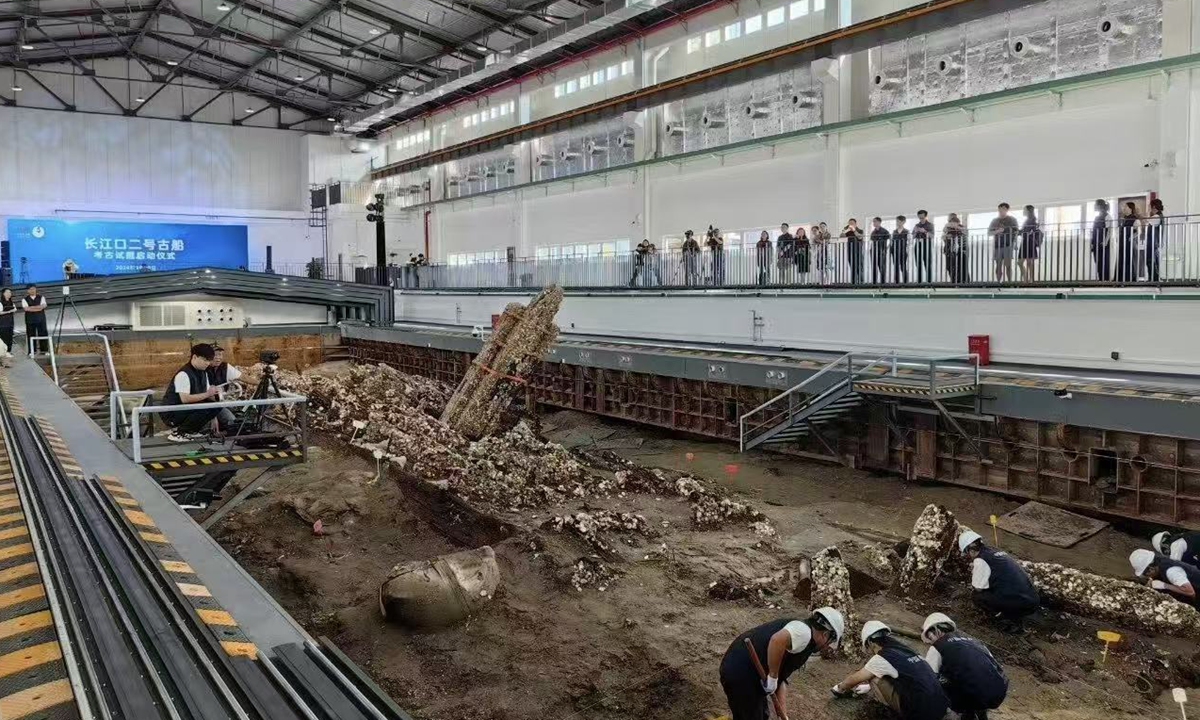
The excavation site of the Yangtze River Estuary No. 2 ancient shipwreck that was buried underwater in Shanghai for around 150 years. Photo: VCG
Through DNA analysis ofunderwatersoil sediments, Chinese researchers have recently made several new discoveries related to the Yangtze River Estuary No.2 ancient shipwreck. Buried underwater in Shanghai for around 150 years, the shipwreck is one of the largest and best-preserved ancient wooden shipwrecks discovered in China and even globally.Researchers found sediments preserved inside a blue-and-white double-handled vase recovered from the shipwreck. Analysis revealed a distinct boundary formed at approximately 30centimeterswithin the sediment layer. The findings indicate that during the initial stage of the sinking, external sediment surged into the vase, sealing the original rice husks and straw inside, thereby preserving DNA signals of rice remnants and other terrestrial organisms.
DNA analysis of the rice remains, combined with seasonal records showing that the rice species is harvested in summer, indicates that the ship's final voyage likely occurred in summer or early autumn.
This finding also supports researchers' earlier proposal that the ship sank due to a typhoon.
"The Yangtze River Estuary experiences typhoons almost every year. We previously discovered traces of intense wind-wave scouring on the ship's bottom. Based on sediment analysis, there is a strong correlation between the shipwreck and typhoons or other disastrous weather conditions," said Wang Zhanghua, a key researcher on the ancient shipwreck.
In further sediment analysis of the vase, the research teamdetected DNA signals of bamboo. The bamboo products have been documented in historical records as materials used for packaging porcelain,archaeologist Wang Meng told the Global Times.
"This discovery reveals, on one hand, the packaging techniques of porcelain in the Qing Dynasty(1644-1911), and on the other hand, provides clues for studying the production and supply chain of porcelain at that time," Wang noted.
Including the blue-and-white double-handled vase, the abundant porcelain remains discovered from the shipwreck exhibit distinct characteristics of Jingdezhen porcelain in East China's Jiangxi Province.
Packaging materials such as bamboo products were typically sourced locally at the site where goods were packaged. Thus, the researchers inferred that these porcelain remains were not only produced in Jingdezhen, but were also packaged and shipped from there.
"This, once again,gives us a glimpse into the production chain of ancient Chinese porcelain, which is key to understanding how these porcelainsbecame praised commodities along the Maritime Silk Road,"Wang Mengnoted.
The Yangtze River Estuary No.2 shipwreck, also known as the Changjiangkou No.2 shipwreck,is significant physical evidence of the Maritime Silk Road and a testament to Shanghai's historical role as a global trade and shipping center.
The vessel was first discoveredduring a national underwater cultural heritage survey in 2010. It is awooden sailing vessel. Due to the unique environment in which it was situated, as well as the vessel's structural integrity and fragility,it was salvaged in 2022 using a globally pioneering integrated relocation technique invented by China.
Later in 2024,the trial excavation of the ancient shipwreck had begun. It was housed in a 48-meter-long intelligent preservation chamber, and a dedicated archaeological workstation was established, including advanced facilities such as an intelligent protective chamber, and a comprehensive excavation platform.
"Its excavation and protection mechanisms reveal China's innovation capacity in the field of underwater archaeology, which is worthy of reference globally," Wang remarked. He also added that the ancient shipwreck holds not only archaeological value, but also provides important clues for "the study of China's modern economic and trade history."
RELATED ARTICLES