US announces new 10 pct global tariff after Supreme Court rules sweeping tariffs illegal; experts warn of turmoil in tariff policy
By Published: Feb 21, 2026 02:02 PM

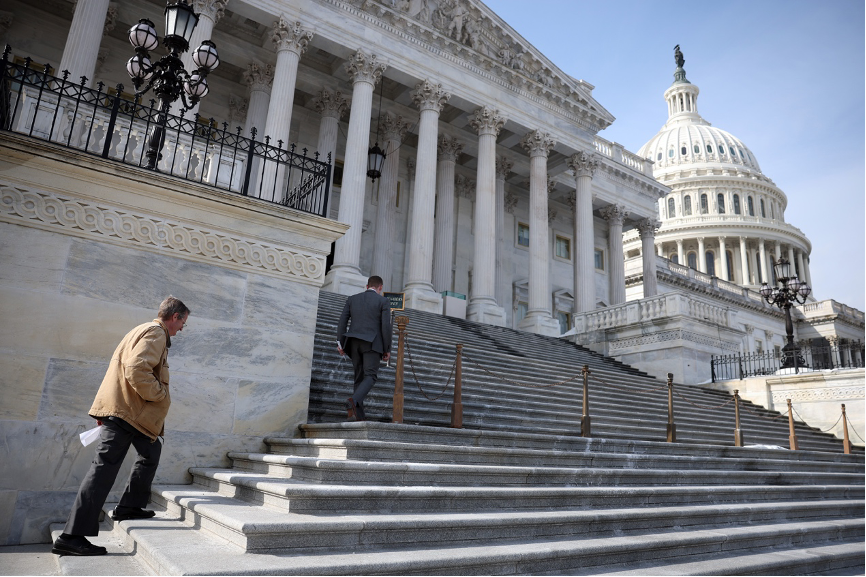
The US Capitol Photo: VCG
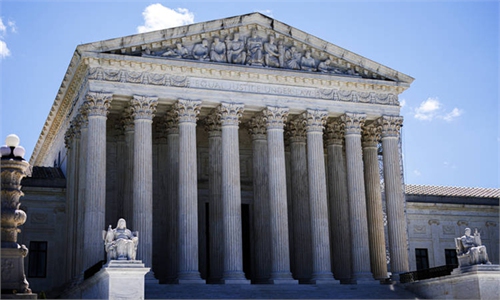
In a ruling with deep significance for global trade, companies and the pocketbook of every US citizen, the US Supreme Court ruled on Friday that US President Donald Trump's sweeping tariffs under a law meant for use in national emergencies are illegal,according to local media.
A Chinese expert said the ruling has fundamentally and irrevocably rendered the Trump administration's so-called reciprocal tariffs unlawful, sending an encouraging signal to the world and to some extent bolstering multilateralism, which has been severely challenged by rising unilateralism and protectionism since last year. However, he also warned that the issue of the Trump administration's broad tariffs will remain complex and is unlikely to be resolved in the short term as the administration seeks to prolong its tariffs measures by any means it can find.
Following the Supreme Court ruling, President Donald Trump said he would sign an order imposing a 10 percent global tariff to replace some of the emergency duties the Court ruled illegal, according to the Xinhua News Agency.
On Friday evening, the White House said it will impose a temporary import surcharge of 10 percent on goods imported into the US through an executive order, for a period of 150 days and effective February 24, 2026. The new tax measure exempts a number of goods such as critical minerals and pharmaceuticals.
The executive order was based on federal law, including section 122 of the Trade Act of 1974 (section 122), according to the White House.
In a 6-3 ruling, the Supreme Court said the tariff policies under the International Emergency Economic Powers Act (IEEPA) are unconstitutional, officially striking down the global tariffs Trump has introduced since April, per Xinhua.
The justices ruled that the president did not have the authority under IEEPA to impose import tariffs on goods from nearly all the US trading partners.
The voting upheld that it is the right of Congress to impose taxes, not the president.
He Weiwen, a senior fellow at the Center for China and Globalization, told the Global Times on Saturday that the ruling could be considered as a win for the US legal system as the US Supreme Court upheld the US Constitution, which maintains that the right of imposing tariffs lies within the Congress.
Trump announced on April 2, 2025 that the US has established a "minimum baseline tariff" of 10 percent on practically all imported goods, plus even higher rates on certain trading partners, claiming that higher tariffs would help bring in revenue for the government and revitalize US manufacturing.
A coalition of 12 US states subsequently sued over the decision, and the Court of International Trade ruled against the administration. The Trump administration appealed to the Supreme Court in September.
International markets reacted positively to the ruling by the US Supreme Court.
The Dow, S&P 500, Nasdaq jumped to post weekly gains as the Supreme Court stroke down the Trump administration tariffs, according to industry portal yahoo.com. South Korean equities advanced on Friday, with the benchmark KOSPI closing at 5,808.53, up 131.28 points, or 2.31 percent, according to Business Today.
The ruling was also welcomed by US small-business groups, with some calling for refunds for their tariff payments, according to NBC.
Responding to a Global Times inquiry, the US National Retail Federation (NRF) said the ruling provides "much-needed certainty for US businesses and manufacturers, enabling global supply chains to operate without ambiguity."
"We urge the lower court to ensure a seamless process to refund the tariffs to US importers. The refunds will serve as an economic boost," the NRF said in its statement.
Michael Pearce, chief US economist at Oxford Economics, said in a research note to the Global Times on Saturday that the Supreme Court ruling on tariffs immediately lowers the effective tariff rate down sharply, from 12.8 percent to 8.3 percent.
However, Pearce said any boost to the economy from lowering tariffs in the near term is likely to be partly offset by a prolonged period of uncertainty. With the administration likely to rebuild tariffs through other, more durable, means, the overall tariffs rate may yet end up settling close to current levels, the expert said.
US President Trump on Friday blasted the US Supreme Court after it struck down his signature tariff policy, calling the decision "ridiculous." "To show you how ridiculous the opinion is, however, the court said that I'm not allowed to charge even one dollar," Trump told reporters, according to a video footage released by the NBC.
Following the Supreme Court ruling, Trump responded by saying on Truth Social that "Today I will sign an Order to impose a 10% GLOBAL TARIFF, under Section 122 (of the 1974 Trade Act), over and above our normal TARIFFS already being charged, and we are also initiating several Section 301 and other Investigations to protect our Country from unfair Trading practices."
He Weiwen said the new tariff move reflects the US administration's stubbornness in clinging to unilateral tariff measures despite the Supreme Court ruling against most of its tariffs. He predicted that any across-the-board tariffs will be subject to litigation by various entities in the US and a period of turmoil in US tariff policy is highly likely.
The Supreme Court ruling on Friday did not specify whether tariffs that have been paid under the higher rates will be refunded, according to Xinhua.
The amount of the IEEPA-specific tariffs equates to about $129 billion as of December 10, according to Xinhua.
Trump noted that issue, saying he believes the matter will be litigated for years.
He, the Chinese expert, said the question of refund should be something that "goes without saying" as the premise of the tariffs is nullified by the Supreme Court ruling but the real problem is that the Trump administration may have spent the money.
A Federal Reserve Bank of New York report released on February 12, using data from the US Census Bureau through November 2025, found US consumers and firms paid for nearly 90 percent of the tariffs in 2025.
RELATED ARTICLES