ARTS / CULTURE & LEISURE
Optimism and creativity rewrite Spring Festival travel rush
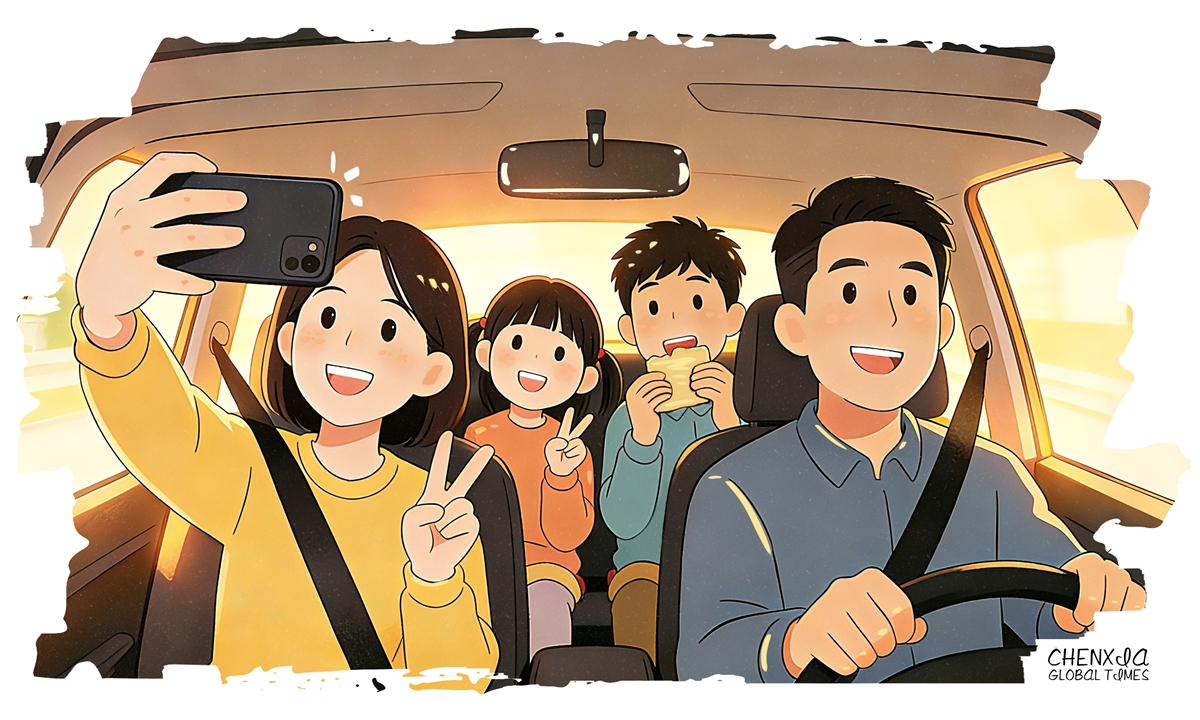
Illustration: Chen Xia/GT
As the Spring Festival holiday drew to a close in China, many places across the country has seen a concentrated peak in return travel starting on Sunday. Unlike those catching trains or planes, people who chose to travel by car have, without exception, experienced one of the most "grinding" tasks of the holiday - dealing with the dreaded traffic jams on the highway.For instance, from Central China's Hunan Province to Hangzhou in East China's Zhejiang Province, a journey that usually takes 10 hours by car took a full 15 hours during the holiday return. "We purposely set off at 4 in the morning, thinking there would be fewer people, but we still ended up getting stuck in traffic," Wang Hongying, a traveler driving from Kunming, Yunnan Province, to Chengdu, Sichuan Province, told the Global Times.
The frayed nerves from waiting in traffic, combined with the thought of the looming return to work, seemed to gradually erode the relaxing and happy memories of the Spring Festival holiday with every mile along the journey home. But unlike the past, many people on this year's return journey broke up the boredom stemming from the endless waiting with a little bit of creativity.
On platforms like Sina Weibo and Xiaohongshu, some netizens posted about their "Spring holiday highway meals." Some netizens plugged power strips into their EVs' charging port to run microwaves and cook on the spot, while others used rice cookers to prepare pots of pumpkin and cured sausage rice.
"We had already cooked the minced meat sauce and peas and kept them hot in a thermos. Once we reached the rest area, all we had to do was to pour it over pre-boiled noodles, and we had our iconic meal 'wanza mian' [noodles with minced pork and mashed peas]," Huang Yang, a native Chongqing traveler, told the Global Times. He also added that they arrived at the rest area in the morning and "nothing starts a day for a Chongqing local better than a bowl of wanza mian."
Though taking various forms, such "highway meals" not only filled travelers' stomachs but also allowed the memories and flavors of a hometown Spring Festival to linger a little longer.
That is to say, one may have driven far from home, but a warm meal that tastes like home in the car elevates a simple roadside bite into a Spring Festival meal full of feelings. These meals also prove that the spirit of the Spring Festival can transcend time and distance, staying alive in people's hearts through creativity.
Compared with the traditional scene of snacking on cookies, complaining about traffic, and even getting into arguments with fellow drivers on the road, it's clear that more and more people are starting to face this inevitable holiday delay with optimism and grace.
On the Kunming-Mohan highway in Yunnan Province, a fruit seller stuck in traffic with a truck full of sugarcane started selling it on the spot for 10 yuan ($1.45) per stalk, well below the market price. The scene brought a warm and amusing interlude to the congested highway.
While whether the sugarcane was sweet or not remains unknown, what's clear is that people are keeping a positive mindset and a sense of relaxation - finding joy in hardship - to ease the physical and psychological pressures of Spring Festival travel. On the one hand, this philosophy that "since we can't change the situation, let's enjoy the moment" sets a positive tone for the start of the new year.
On the other hand, this relaxed attitude can indeed help avoid potential accidents on the road such as rear-end collisions or scrapes caused by road rage, crashes resulting from aggressive lane changes due to impatience, and even operational errors caused by distraction from prolonged anxiety.
Actually, the travel rush has become an optimistic road trip not only due to the travelers themselves, but also the continuously improved travel safety measures and the kindness of strangers along the way.
Take a highway in Hangzhou for example. On Sunday, a car suddenly rolled over after taking a sharp turn. Within moments, not only did local police arrive to handle the situation, but more than a dozen vehicles and dozens of unrelated passengers rushed to help push the overturned car back upright. Meanwhile, the cars backed up behind them chose to wait in silence rather than honk their horns.
Traditionally, the return journey at the end of Spring Festival serves as the final ritual of the holiday. It is typically associated with concepts such as "tiredness," "nostalgia," and "uncertain circumstances." But now, thanks to people's optimism and creativity, the Spring Festival travel rush is being rewritten - not as an ordeal, but as a shared experience where connection, humor, and humanity shine through, even in the longest traffic jam.
The author is a reporter with the Global Times. life@globaltimes.com.cn
RELATED ARTICLES