ARTS / CULTURE & LEISURE
Chinese-Egyptian mission finds millennia-old Pharaoh Apries’ temple, five sphinx statues
By Published: Feb 24, 2026 10:25 PM

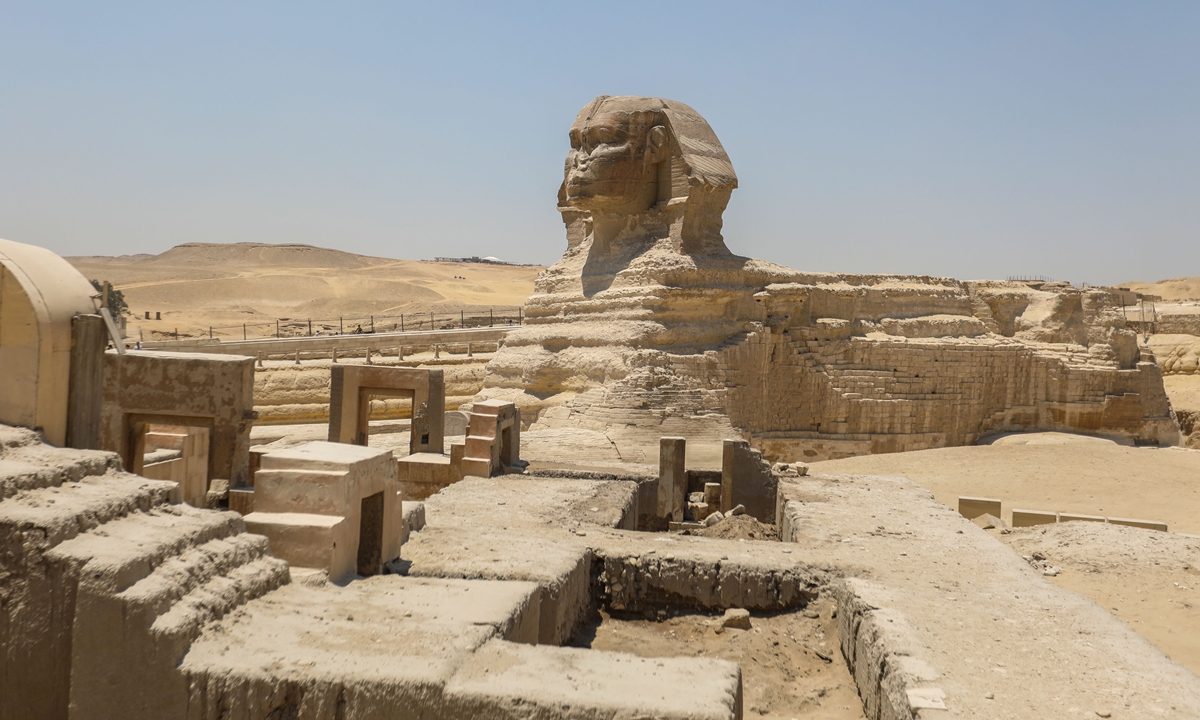
The sphinx statue in Giza, Egypt on July 21, 2024 Photo: VCG
A significant archaeological breakthrough has emerged from Mit Rahina in Giza, the site of ancient Memphis in Egypt, where a joint Chinese-Egyptian mission has uncovered a limestone structure believed to be connected to the temple of King Pharaoh Apries from Egypt's 26th Dynasty (664-525 BC), according to the Xinhua News Agency.
The announcement came from Egypt's Ministry of Tourism and Antiquities. The finding highlights fresh insights into the city's urban layout, religious practices, and centuries-long occupation.
Zhang Hai, head of the Chinese team and an archaeologist from Peking University, told the Global Times that these remains are vital for understanding Memphis from the Late Period through to the Greco-Roman era (up to AD 395).
"The findings help resolve longstanding questions about the city's core structure and sacred spaces," he said.
The mission has brought together Egypt's Supreme Council of Antiquities, Peking University, and the Shandong Institute of Cultural Relics and Archaeology. Excavations at Tel Aziz site had already revealed temple fragments during previous excavations, but the southern section of the site - unlike the better-explored northern area - had seen limited attention until now.
Awaking the ancient temple
The newly discovered structure has contributed significantly to ongoing research in the southern sector of the site, known as Tel Aziz, where Zhang and other team members predicted was a possible location for "an important function site of the core area, as it was close to the ancient Nile River."
Earlier digs in the north uncovered King Apries' palace and a nearby military encampment, confirming that the zone was part of Memphis' central hub. In contrast, the southern part had received less archaeological attention.
The Chinese-led effort targeted the south, guided by the hypothesis that a true capital needed more than just royal residences and fortifications.
"A major city like Memphis must have had key religious institutions nearby, especially as it was close to the ancient Nile branch," Zhang noted.
Drawing on China's experience with large-scale site archaeology, which combines systematic surveying, geophysical prospecting, and targeted excavation, the team zeroed in on this promising area.
The work progressed steadily. "Within weeks, we exposed a relatively well-preserved limestone structure," recalled Xu Shen from the Shandong Institute of Cultural Relics and Archaeology.
Excavations have uncovered five headless sphinx statues, along with limestone blocks and slabs inscribed with hieroglyphics dedicated to the god Ptah, the principal deity of Memphis, according to Zhang.
Cartouches bearing the name Apries were also found, strengthening the attribution of the structure to his reign. Combined with other discoveries such as ceramics, glassware, and copper coins, this stone structure was preliminarily identified to be the remains of a temple that existed for hundreds of years from the 26th Dynasty to the Roman Period. Ground-penetrating radar surveys hint at an even larger temple complex buried nearby.
"We will continue further excavation after the groundwater level recedes," said Zhang.
Beyond the building itself, the site preserves layered sediments outside the eastern temple wall, alternating between Nile flood deposits and human activity. These sequences offer valuable data on environmental shifts, river dynamics, site selection rationale, construction adaptations, and how the mound accumulated over time.
Flanked by deserts, Memphis owed its prominence to its position at the Nile Valley-Delta junction. For nearly 3,000 years, it served as Egypt's political, administrative, and spiritual heart, with the cult of Ptah at its core.
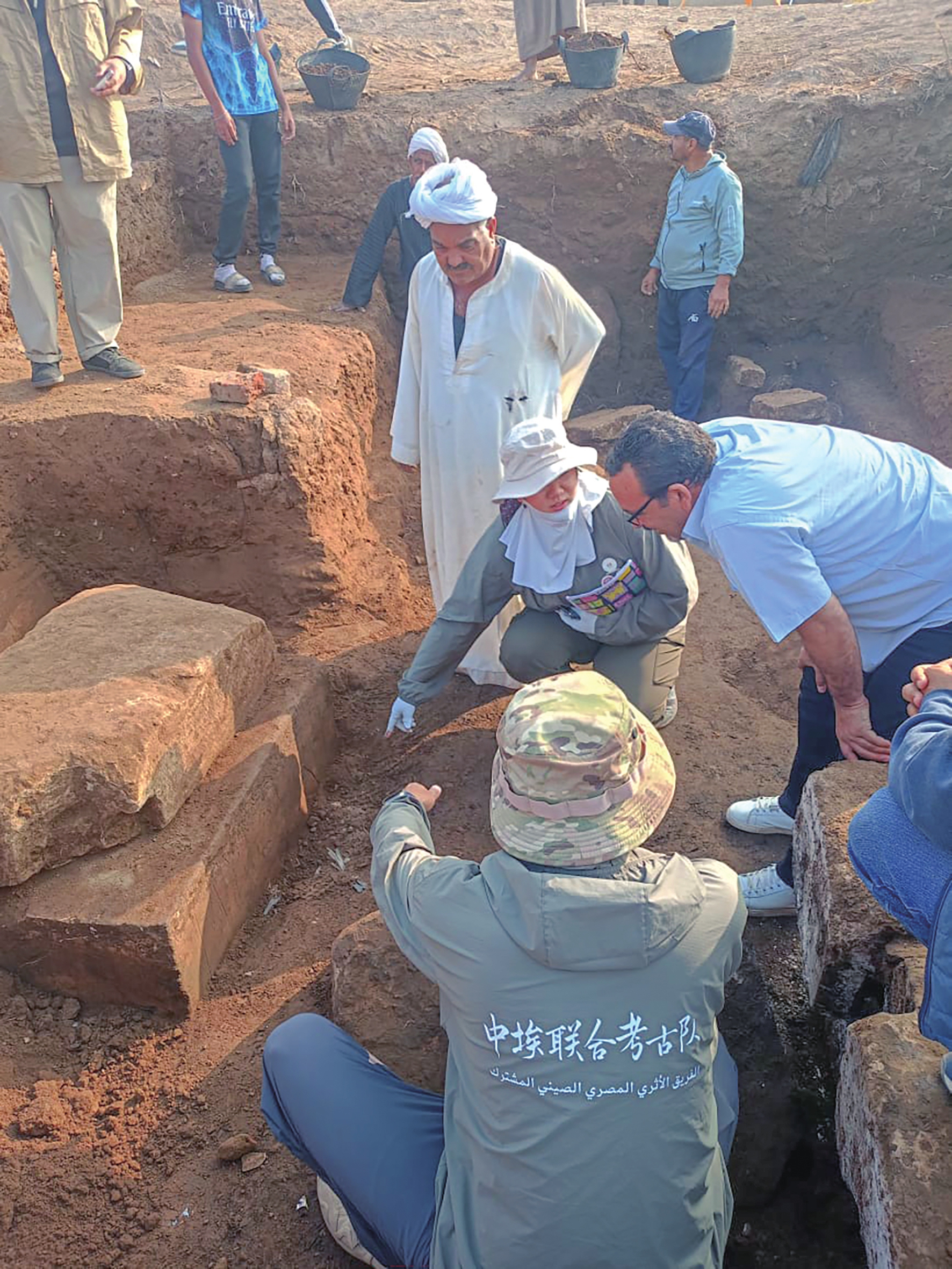
Archaeological team members work at the Tel Aziz site in Egypt. Photo: Courtesy of Chinese team of Chinese-Egyptian mission
Enhanced China-Egypt cooperation
Egyptian officials welcomed the breakthrough. Minister of Tourism and Antiquities Sherif Fathy described the discovery as an important addition to ongoing archaeological research in Mit Rahina. He noted that it sheds further light on one of the most significant historical sites linked to the ancient city of Memphis.
He also praised "the fruitful scientific cooperation between the Egyptian and Chinese sides in the field of archaeological work," according to Xinhua.
Hisham El-Leithy, secretary-general of the Supreme Council of Antiquities, said the discovery has significantly contributed to a deeper understanding of the urban planning of the ancient city, as well as its religious practices during the period.
The Chinese-Egyptian mission represents a growing trend toward international cooperation in Egyptian archaeology. Researchers from both countries emphasized the importance of combining advanced documentation technologies with traditional excavation methods.
The collaboration exemplifies rising international teamwork in Egyptian digs, blending traditional fieldwork with modern tools. The Chinese contingent applied distinctive methods for documenting and recording finds, while deploying Chinese-developed technologies such as the "4D kankan Meta" 3D scanner for precise, real-time topographic and sectional modeling, plus specialized software for capturing dislocated stone elements in 3D to aid future digital restoration and preservation.
Egyptian conservation specialists joined the on-site efforts to stabilize the sphinxes and inscribed stones, ensuring proper care. These joint practices have built expertise for ongoing Chinese-Egyptian projects and advanced digital heritage management in Egypt.
The mission stands as a model of cultural exchanges rooted in equality, openness, and mutual benefit. It strengthens people-to-people ties, expands long-term cooperation between China and Egypt, and advances Chinese archaeology's global presence with its characteristic approaches and ethos, as noted by Kong Shengli, deputy party chief at the Shandong Institute of Cultural Relics and Archaeology.
Looking ahead, the team plans additional missions to expose more architecture and artifacts. Researchers aim to piece together the temple's role in Memphis' wider landscape, while a deeper study of inscriptions and everyday items could reveal more about Late Period rituals, beliefs, and urban life.
RELATED ARTICLES