Provinces kick off post-Chinese New Year work with ‘first meetings,’ focusing on AI, innovation and high-quality growth
Moves aim to prioritize high-quality growth: analysts
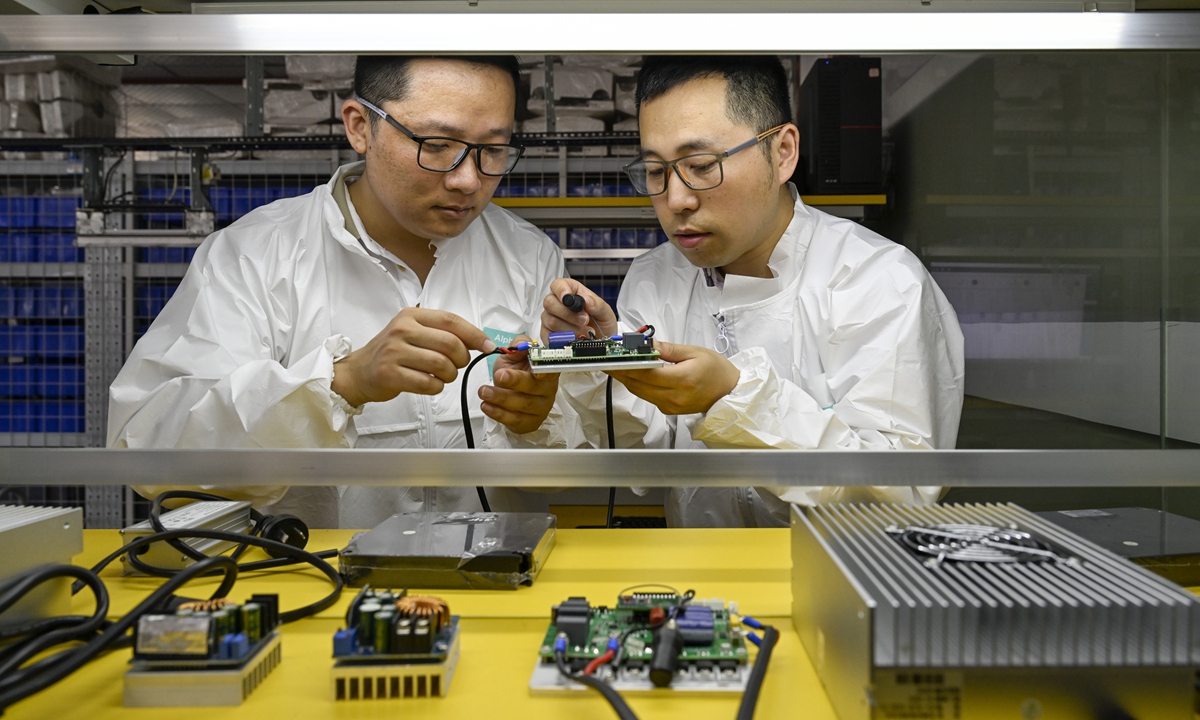
Technicians configure parameters for the sensors of an intelligent inspection robot on May 20, 2025, in the Luyang Economic Development Zone of Hefei, East China's Anhui Province. Amid the nation's efforts to develop new quality productive forces, the zone has focused on developing the intelligent sensing industry, continuously expanding its scale and accelerating efforts to build Hefei into a leading hub for smart sensor innovation. Photo: VCG
On the first working day after the Spring Festival holiday in the Year of the Horse, multiple Chinese provinces held their "first meetings," setting the tone for economic development, with artificial intelligence (AI), innovation and quantum technology high on their agendas. As the opening year of China's 15th Five-Year Plan (2026-30) period, these sessions underscored a consistent focus on high-quality growth, innovation-driven productivity, industrial upgrading, and stable governance amid global uncertainties, analysts said.
This trend signals a profound shift in China's economy from sheer scale expansion to sophisticated system integration, Wang Peng, an associate research fellow at the Beijing Academy of Social Sciences, told the Global Times on Tuesday.
"By prioritizing high-quality development, provinces are no longer chasing single-digit GDP growth at all costs, but engineering a fundamental transformation in total factor productivity," Wang said, adding that new quality productive forces have decisively moved out of the "conceptual phase" and entered full construction mode.
In South China's Guangdong Province, which has had the country's largest provincial economy for 37 years, a provincial high-quality development conference convened on Tuesday, marking the fourth consecutive year for such an event for the first working day in the Chinese New Year. This year's theme is centered on synergistic development between manufacturing and services.
Frontier technologies such as AI, bio-manufacturing, and quantum communications are erupting in clusters and converging across multiple fields. This creates both an urgent need and strong support for deeper synergy between manufacturing and services, Huang Kunming, secretary of the Communist Party of China Guangdong Provincial Committee, said during the conference, according to a report published on the Guangdong provincial government's official website on Tuesday.
The synergy will drive gains in the capability and efficiency of both sectors, when traditional factories become smart or unmanned, AI powers disease screening and drug development, and robots work on production lines and in homes, according to Huang.
Huang pointed to real-world examples such as Huawei's Qiankun "hardware + software" ecosystem powering intelligent electric vehicles and Shein's "small-batch, fast-reaction" flexible supply chain bridging production and demand. "Guangdong should leverage its strengths as both a manufacturing and services powerhouse to build a modern industrial system."
Guangdong has a strong base, as it accounts for one-eighth of the national industrial scale, ranking first nationwide in output for more than 100 product types. It is also a powerhouse in services, with the sector's added value accounting for 10.5 percent of the national total in 2025, and holding the top spot for 41 consecutive years, official data showed.
"Guangdong's path of synergistic manufacturing-services development could be used nationwide. Most provinces face not 'creating from nothing' but 'optimizing existing industries.' Empowering traditional manufacturing through advanced services represents the lowest-cost, fastest-to-implement transformation route for manufacturing-heavy regions," said Wang.
Wang noted that AI's application in services is no longer just forward-looking - it's the "second battlefield" in great-power competition. While AI in manufacturing focuses on cost reduction and efficiency gains, in services, such as cross-border e-commerce and intellectual property management, it creates value.
East China's Anhui Province stressed a similar emphasis on innovation on Tuesday. Its capital Hefei also held an independent first-day meeting, focusing on scientific and technological innovation leading new quality productive forces, the third straight year for this theme, according to local media outlets.
Hefei is already racing ahead to become one of China's premier innovation powerhouses and tech heavyweights. It holds three hardcore industrial trump cards: quantum information, fusion energy and deep-space exploration. Hefei is home to nearly one-third of China's quantum technology enterprises, official statistics showed.
As for Central China, the first meeting of Hubei Province vowed to ramp up infrastructure and emerging-sector investments, including in integrated circuits, industrial machine tools, and embodied intelligence.
Wuhan, the capital of Hubei, is one of China's three major intelligent technology hubs and is actively participating in global technological competition in cutting-edge fields. For example, the Hubei Humanoid Robot Innovation Center, located in the Optics Valley of China, has established the country's largest and most scenario-rich professional training platform for humanoid robots.
Other provinces, including East China's Shandong Province, South China's Guangxi Zhuang Autonomous Region and Central China's Hunan Province, also convened provincial meetings on Tuesday.
Across these gatherings, common threads emerged: alignment with national priorities such as new quality productive forces, industrial modernization, the expansion of domestic demand, and stable governance.
As provinces mobilize resources, these "first meetings" signal China's determination to navigate external headwinds through internal strength, innovation, and coordinated development, said Wang.
RELATED ARTICLES