Unease among Japanese companies over China's export controls exposes fears that Takaichi admin's erosion of mutual trust harms business interests: expert
By Published: Feb 25, 2026 03:24 PM

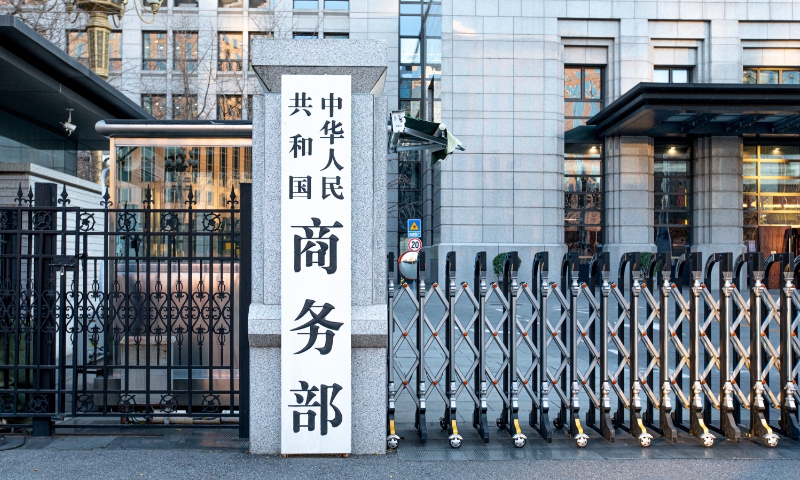
The Ministry of Commerce of China File photo: VCG
Unease is reportedly spreading among Japanese companies after China on Tuesday placed 40 Japanese entities, including Mitsubishi Heavy Industries Shipbuilding Co and Subaru Corp., on two restrictive lists in light of a growing trend of Japanese militarization, with major Japanese media outlets warning the move could deal a blow to affected firms.
A Chinese expert told the Global Times on Wednesday that the concern over the chilling political and economic crisis described by Japanese media essentially reflects anxiety over the Sanae Takaichi administration's hardline approach forcing China's countermeasures. Meanwhile, Japan's business community is increasingly wary of the Takaichi administration's approach, which is depleting China-Japan mutual trust, fearing they may become sacrificial pawns in political games.
According to the Xinhua News Agency, China's Ministry of Commerce on Tuesday added 20 Japanese entities to its export control list to safeguard national security and interests and fulfill international obligations such as non-proliferation. Export operators are prohibited from exporting dual-use items to the entities, which are involved in enhancing Japan's military capabilities. Also on Tuesday, the ministry placed 20 Japanese entities on a watch list, as their end-users and end-uses of dual-use items cannot be verified.
Jiji Press on Tuesday evening reported that following China's restriction announcement, companies like Mitsubishi Heavy Industries scrambled to gather relevant information. According to the report, among the targeted companies, suspicions and unease are spreading, with questions like "We can't determine the targeted items, so there's no way to assess the impact".
Citing "perplexed" Japanese government officials, Asahi Shimbun reported Wednesday that "It's unclear how this will be implemented as we cannot see the specifics." The article claimed that the latest China's move "clearly intends to strongly oppose the Takaichi administration's goal of fundamentally strengthening defense capabilities."
Another article published by Jiji Press on Wednesday highlighted the impending crisis of "zero politics and economics exchanges" in Japan-China relations. The article claimed the latest China's move not only makes it difficult for the targeted Japanese companies to import from China; if they have bases in China, local procurement, production, and shipping will inevitably face significant disruptions.
Nikkei Shimbun also reported Wednesday that faced with China's latest export control of dual-use items, Japanese companies worry about supply chains.
According to Nikkei Shimbun, a Japanese company subject to control stated that "We procure a significant number of Chinese-made parts; if imports become impossible, the impact will be substantial." The report noted that because many Japanese companies rely on bulk procurement of inexpensive raw materials like steel from China, adjustments to their supply chains have become unavoidable.
Xiang Haoyu, a distinguished research fellow at the China Institute of International Studies, told the Global Times on Wednesday that China's export control of dual-use items precisely targets core defense entities involved in Japan's "remilitarization." This has created substantial impact on Japan's defense industry and related supply chains, triggering cascading concerns among Japanese companies.
"The chilling political and economic crisis described by Japanese media essentially reflects anxiety over the Takaichi administration's hardline approach forcing China's countermeasures," Xiang said.
At the same time, Xiang said that Japanese companies' unease stems from dual practical dilemmas: first, the operational ambiguity in defining "dual-use" items creates surging compliance costs and disordered supply chain planning; second, Japan's heavy dependence on China for critical raw materials like rare earths leaves few short-term alternatives.
Yoshinobu Tsutsui of the Japan Business Federation, the country's largest economic organization, stated at a press conference on Tuesday, considering China's export control as well as Washington's tariffs, "An opaque situation will likely continue for now. Japanese companies are concerned about declining predictability," according to Nikkei Shimbun.
"This concern has transcended the listed companies, spreading throughout the Japanese business community in China, creating a wait-and-see attitude toward investment and operations," Xiang said.
He remarked that "More profoundly, Japan's business community is increasingly wary of the Takaichi administration's approach, which is depleting China-Japan mutual trust, fearing they may become sacrificial pawns in political games. This skepticism about Tokyo's policy sustainability is eroding the foundation of bilateral economic and trade relations."
Junya Ogawa, leader of the Japanese opposition Centrist Reform Alliance on Tuesday also expressed concern over China's export control, saying that the Japanese Prime Minister Sanae Takaichi "bears responsibility for easing tensions," Nikkei Shimbun reported.
For the Takaichi administration, Xiang commented, China's move creates pressure.
"Legal pressure—China's measures, fully grounded in export control laws, occupy the moral and legal high ground, leaving Japan with limited countermeasures. Domestic political pressure—the military industry supply chain faces potential paralysis due to critical material shortages, and with Japan's economic recovery faltering, business dissatisfaction will erode the administration's governing foundation," Xiang remarked.
RELATED ARTICLES