German firms reaffirm China as key to growth, saying that ignoring its market means missing out
By and Ma Jingjing Published: Feb 25, 2026 09:31 PM

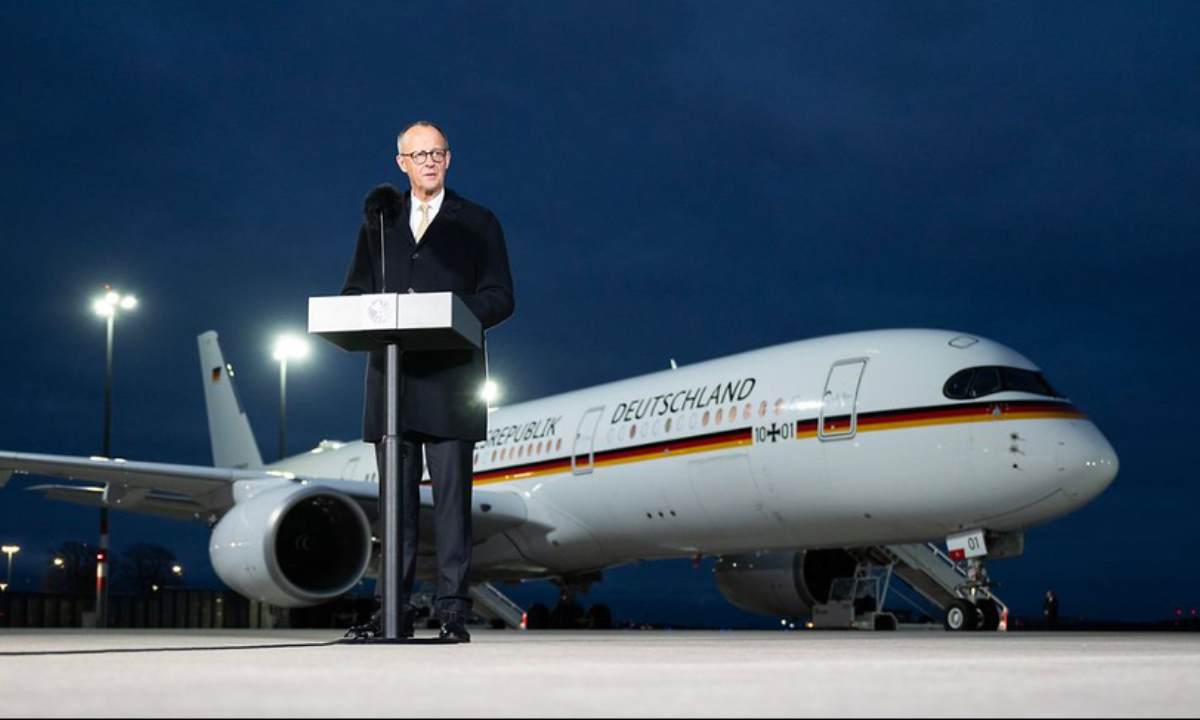
German Chancellor Friedrich Merz speaks at the airport on February 24, 2026 before setting off his inaugural trip to China Photo: German government website
German companies have expressed their strong commitment to the Chinese market, viewing it as vital for innovation and global trade. They have underlined the importance of Chinese market, stressing that overlooking its market scale and innovative strength means missing out on key drivers of global growth.
Such remarks came as German Chancellor Friedrich Merz is visiting China, his first trip to the country since taking office.
On Tuesday, China's Ministry of Foreign Affairs and Ministry of Commerce released details of Merz's visit, confirming his meetings with Chinese leaders and the participation of around 30 senior executives from top German firms. The delegation covers sectors including automotive, chemicals, biopharmaceuticals, machinery and the circular economy.
Bloomberg reported that he'll travel on to tech hub Hangzhou in East China's Zhejiang Province for a tour of facilities operated by Chinese robotics firm Unitree and Germany's Siemens Energy AG.
The BMW Group Chairman Oliver Zipse accompanied Merz on his visit to China. During the visit, the BMW Group and Contemporary Amperex Technology Co signed a Memorandum of Understanding in Beijing, according to information shared by the company with the Global Times on Wednesday.
"Looking ahead, this is more important than ever: those who disregard China's vast market and innovation potential will miss major opportunities for global growth and economic success," Zipse said.
In 2025, China regained its position as Germany's largest trading partner, highlighting the resilience and complementarity of bilateral economic relations. If economic cooperation is the anchor of Germany-China relations, automotive cooperation is its core pillar.
Zipse highlighted the importance of Chinese market, which he said that China, as a global innovation engine, has become a crucial strategic pillar in BMW's future development.
"We must be aware: Success will only come if we work closely together on a global level - with Germany and China as important drivers of innovation and technology," he added.
In an increasingly turbulent global environment, Merz's visit to China sends an important signal of stability, dialogue and economic pragmatism. As Europe's largest economy, Germany plays a pivotal role in shaping the continent's strategic economic engagement with China, said Chairman and CEO of Volkswagen Group China Ralf Brandstätter.
Today, China is far more than a sales market for the Volkswagen Group - and for German and European industry overall. It is a hub of innovation, key technology partner and pillar of global value creation. Few places move as fast in areas such as electromobility, software, artificial intelligence and battery technology - China is setting the pace and shaping standards, he added.
"Anyone who is serious about driving transformation in key sectors - from mobility to renewable energy - cannot look past China," he said.
According to Chinese customs statistics released on Wednesday, the total value of goods imported and exported between China and Germany in 2025 reached 1.51 trillion yuan ($217.8 billion), representing a year-on-year increase of 5.2 percent.
Germany remained China's largest trading partner in Europe, while China regained its position as Germany's largest trading partner after a one-year interval.
In terms of specific product categories, the import and export of mechanical and electrical products between China and Germany reached 1.07 trillion yuan in 2025, an increase of 5.8 percent compared to 2024, accounting for 70.8 percent of the total bilateral trade volume. Among these, the trade in automobiles and auto parts represent 12.3 percent of the total trade in mechanical and electrical products between the two countries.
The German Chamber of Commerce in China said in its 2025-26 business confidence survey that 93 percent of respondents intend to remain engaged in the Chinese market, reflecting greater optimism than a year ago. About 65 percent said they are confident about China's economic development over the next five years, while most of the remainder maintained a neutral view.
"Most German companies invested and operating in China are doubling down on China, to increase their competitiveness through localization, but increasingly to tap onto Chinese unique ecosystem of innovation, fast, reliable and quick design and engineering, and ability to quickly test and turn around new products and services," Denis Depoux, global managing director of Germany's strategy consulting firm Roland Berger, told the Global Times on Wednesday.
In the automotive, chemicals or electronics sector, we see even more German investment to improve competitiveness, resilience and improve products. This also is meant to gradually bring lessons learned from China into products sold elsewhere in the world, including in Europe and Germany.
As for the visit of German Chancellor following other Western leaders since the beginning of 2026, Depoux said that Germany, like Canada, the UK or France, are taking stock of the new uncertain world order and are seeking new economic alliances and partnerships.
"Global supply chains are reconfiguring to reduce dependence, not to China, but to a more unpredictable and sometimes vindicative US. China in this context appears more stable," he said.
DHL Express Global CEO John Pearson told the Global Times that German-Chinese economic cooperation remains a cornerstone of global trade stability. Both nations are manufacturing powerhouses with complementary strengths — German engineering and innovation paired with China's huge consumption market, industrial scale, digital transformation and green development momentum.
This synergy has fostered supply chain diversification, technological collaboration and joint efforts toward decarbonization. In an era of global uncertainty, such strong bilateral ties act as a stabilizing force, he added.
RELATED ARTICLES