ARTS / CULTURE & LEISURE
Attraction in full bloom: Qingdao emerges as new inbound tourism hot spot during Spring Festival
Attraction in full bloom
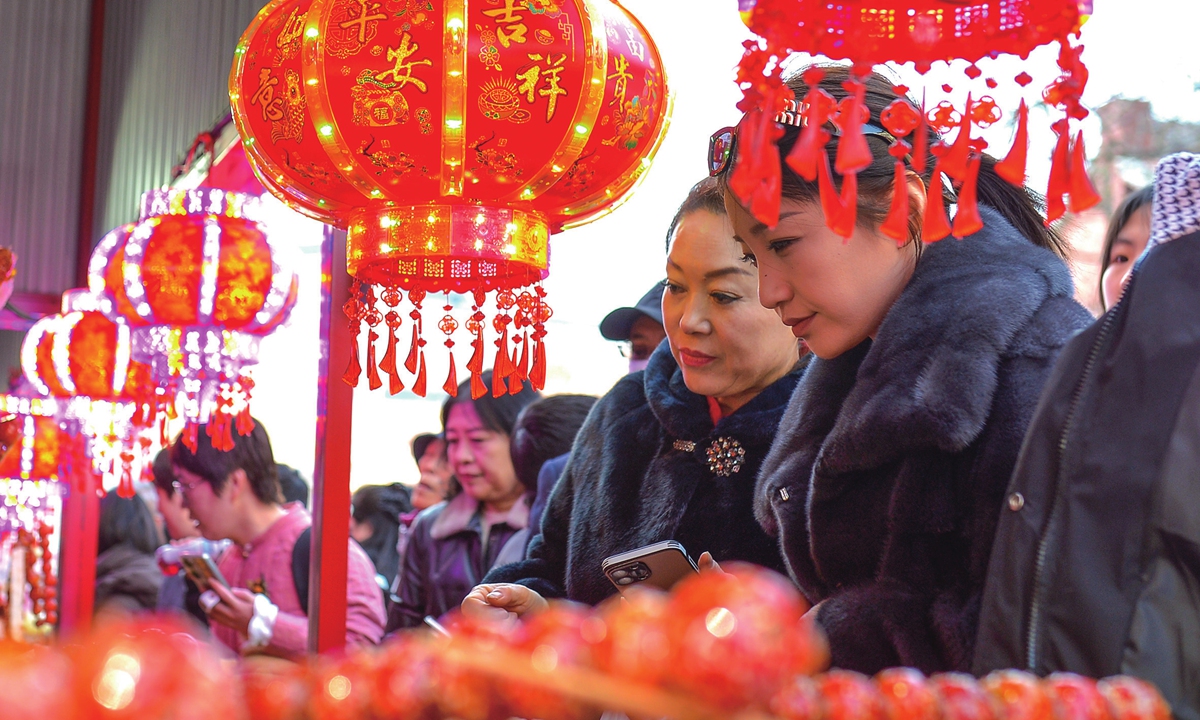
Visitors explore a food market in Qingdao's Shibei district on February 18, 2026. Photos: VCG
At dawn, the sea off Zhanqiao Pier in Qingdao, East China's Shandong Province, is a muted gray-blue. Wind sweeps in from the water, and red lanterns sway gently in the breeze. Several foreign visitors pulling suitcases pause at the pier to take photos: some tighten their scarves; others raise their phones to capture the red accents against the meeting line of sea and sky.This year, Qingdao was named one of the cities foreign travelers consider "most worth visiting during the Spring Festival" on 2026 list of top inbound destinations for experiencing Chinese New Year by a leading global travel service provider. Many describe Qingdao's celebrations as a "Spring Festival atmosphere set amid mountains and sea."
"Located between mountains and sea and characterized by diverse architectural styles, Qingdao naturally provides a sense of openness, which is reflected in the festive elements distributed throughout the city," Wang Deyan, a Qingdao native and associate professor at North China University of Technology who studies aesthetics and cultural industries, told the Global Times.
Wang believes that compared with high-density festival cities marked by strong ritualistic celebrations, Qingdao offers a more breathable atmosphere.
"It does not deliberately manufacture bustle. Instead, it preserves festive symbols within everyday life. For inbound visitors, this sense of ease is easier to accept and more comfortable to immerse themselves in."
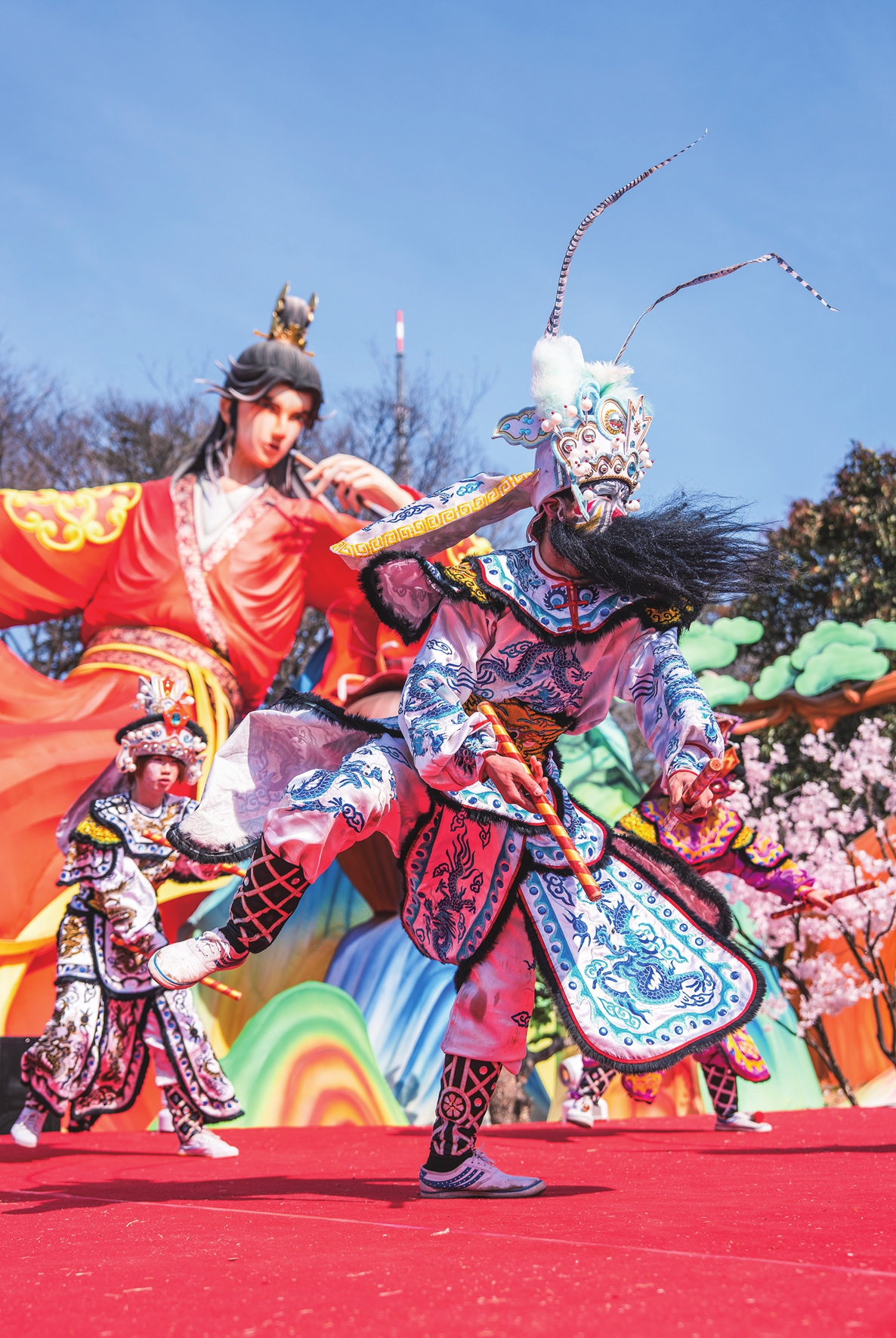
A Yingge dance performance in Zhongshan Park in Qingdao on February 16, 2026
Footsteps and breezeZhanqiao Pier sits along the southern shoreline of downtown Qingdao, a 440-meter promenade stretching from land into the sea. First built in 1892 during the Guangxu reign of the Qing Dynasty (1644-1911), it has stood for more than a century and is widely regarded as a symbol of the city. At its far end rises Huilan Pavilion, a witness to Qingdao's modern history, according to the leading global travel service provider.
Today, iron chain railings line both sides of the pier, and lotus-shaped street lamps illuminate the walkway as visitors stroll along the waterfront. When the sea is calm, gulls glide and circle overhead. At high tide, waves crash against the breakwater; at low tide, ocher reefs and stretches of sand emerge, and people descend the steps to forage for shellfish.
Resident Li Baile told the Global Times that she grew up by the sea and still visits the pier every Spring Festival. "It used to feel like an ordinary place for daily walks," she said. "Only after seeing so many foreign visitors taking photos, did I realize that this is what 'sea charm' looks like for them."
Qingdao's appeal lies not only in its waters, but also in its mountains. The Laoshan Scenic Area is located about 40 kilometers east of the city center. Rising along the coast of the Yellow Sea, where mountains meet the ocean, it was designated as one of China's first group of national key scenic areas by the State Council, according to the Laoshan district government website.
Holiday travel data released by the Laoshan Scenic Area administration shows that during the Spring Festival break, the area received more than 300,000 visits, showing an increase of 49.8 percent year on year.
"The Rain Water solar term has just passed. The east wind thaws the ice and turns it into rain. In this season, plants begin to sprout all around Laoshan, and the pleasant weather makes it the perfect time to climb the mountains and take in the view," scenic area staff member Zhang Tianjun told the Global Times.
"If you enter the mountains now, you can stroll along the Nine Waters stream and listen to the murmuring spring, or ascend to the summit of Jufeng Peak to witness the seamless meeting of mountain and sea, where the world suddenly feels vast and open," Zhang said.
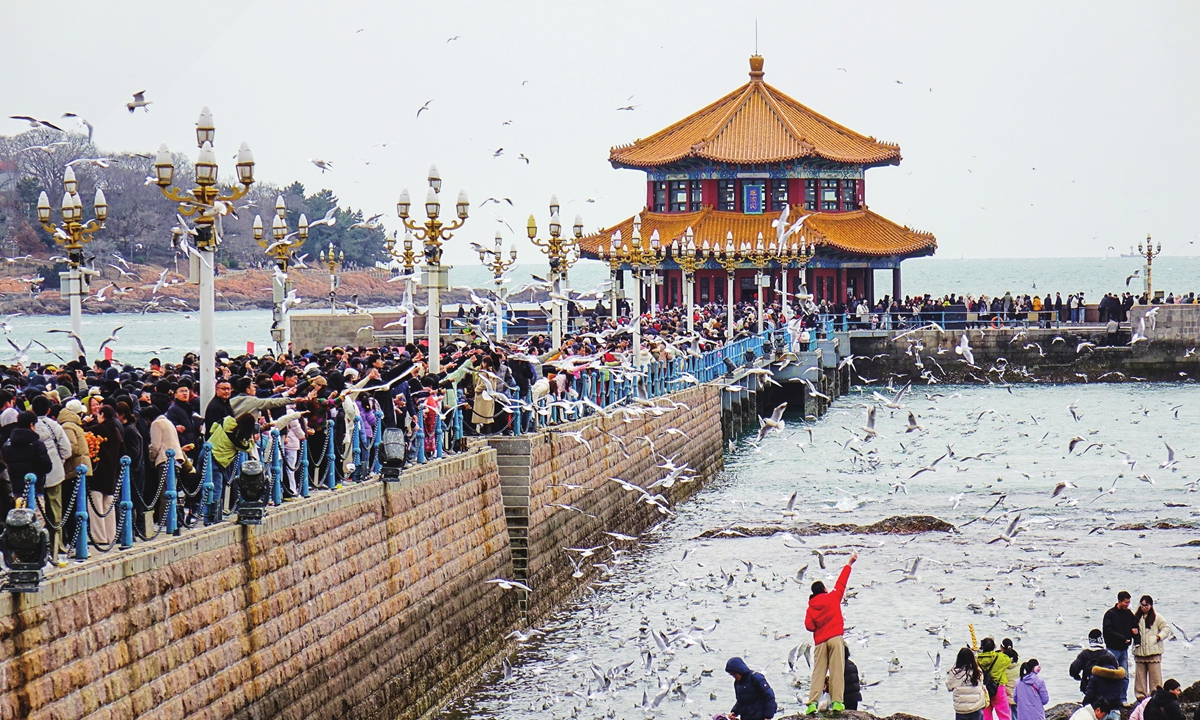
Visitors feed the seagulls at the Zhanqiao Pier scenic spot in Qingdao, East China's Shandong Province, on February 23, 2026.
Paths of leisureIn Laoshan district, a massive naked-eye 3D screen became a focal point during the holiday. Against a backdrop of rolling waves, the iconic green bottle of Tsingtao Brewery seemed to rise from the sea itself, bubbles appearing to spill beyond the screen.
As one of Qingdao's most recognizable cultural symbols, Tsingtao Brewery's century-old history has long intertwined with the city's collective memory. During the holiday, this urban icon was not deliberately amplified, but instead blended naturally into the mountain-and-sea landscape.
Li said Qingdao's emergence as a new choice for inbound travelers is not simply the result of festive decorations, but of the city's inherent rhythm. "This isn't a stage built specifically for a holiday. The city is already in motion. Visitors can just step into its rhythm and enjoy a Chinese New Year carried under the sea breeze."
Wang also believes inbound tourism once centered more on checking off landmarks, but now places greater emphasis on experiencing a city's temperament. "Qingdao's mountain-and-sea layout, its everyday pace of life, combined with restrained festive touches, create an Eastern urban aesthetic that international visitors can intuitively grasp," he said.
Wang noted that Qingdao's distinctiveness lies not in the scale of its celebrations, but in how they are embedded into daily life. "Red lanterns hanging by the sea, a beer brand appearing between mountains and water. They grow organically from its existing spatial structure. This kind of natural integration is itself a form of cultural expression."
For a growing number of foreign visitors spending the Chinese New Year in China, Qingdao may not be a traditional "must-see," yet it becomes an unexpectedly comfortable pause along the journey. Sea breeze, lanterns, mountain views and everyday city life overlap, turning the holiday into a lived-in scene one can slowly walk into. "When a city no longer feels the need to prove it has a festive atmosphere, but simply invites people to linger, it shows that it has found its own unique path," Wang said.
RELATED ARTICLES