SPORT / MISCELLANY
Will the Chinese basketball team grasp a chance for redemption?
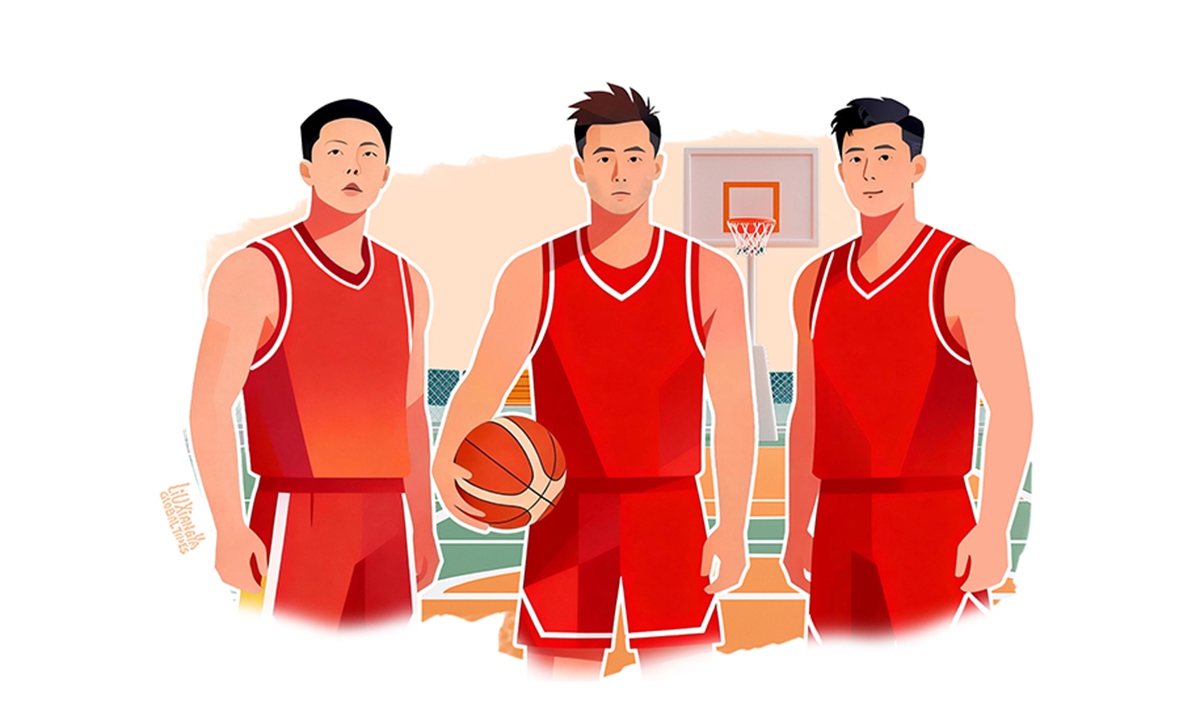
Illustration: Liu Xiangya/GT
China's men's basketball team has an opportunity for redemption as the second window for the 2027 FIBA World Cup Asian Qualifiers looms. They will compete in an away game against Japan on Thursday, followed by a home matchup against Chinese Taipei on Sunday.After a disappointing start in the first window, where the team suffered back-to-back losses to the South Korean team, the Chinese team now sits in third place in the four-team group with just two points, tied with Chinese Taipei. Japan and South Korea lead the pack with straight wins. Only the top three teams will advance to the next stage, making the two upcoming battles essential for China's World Cup aspirations.
Historically, Chinese basketball has been a powerhouse in Asia. From the 1970s through the early 2000s, the Chinese team dominated the continent, securing multiple FIBA Asia Cups and earning consistent berths in global tournaments. The Yao Ming era elevated China to new heights, with memorable performances at the Olympics and World Championships, showcasing a blend of size, skill, and national fervor.
However, recent years have marked a noticeable slump. The team has struggled to maintain its regional supremacy, missing out on the Tokyo Olympics and faltering in the 2019 and 2023 World Cups. Losses to emerging rivals like Japan and inconsistent showings against traditional foes have highlighted systemic issues, from youth development gaps to injuries plaguing key players. This downturn has sparked introspection within Chinese basketball, but it's still the current squad's response that will define the future.
Shifting focus to the present, coach Guo Shiqiang's team enters this window under immense pressure, yet armed with determination forged in adversity. The first window's double defeat to South Korea exposed vulnerabilities, particularly in defensive cohesion and rebounding. Those losses dropped China to the group's lower tier, amplifying the urgency of the upcoming fixtures.
A win against Japan, the group leaders, would not only boost the standings but also serve as psychological redemption. Japan has risen rapidly, bolstered by NBA talent like Rui Hachimura and Yuta Watanabe, though their qualifier roster may lean on domestic stars. Similarly, the game against Chinese Taipei, while seemingly more winnable on paper, carries emotional weight. For the Chinese team, these matches are about more than just points; they're a test for resilience in the face of setbacks.
Preparation has been intense and unyielding. The Chinese team underwent a grueling 19-day closed training camp, sacrificing family time to hone their craft during the Spring Festival. This commitment underscores the players' dedication to turning the tide. However, the roster has been hit hard by injuries, testing the squad's depth like never before. Star center Zhou Qi, a linchpin in both offense and defense, is sidelined with an eye injury and recurring back issues. His absence is a massive blow, as his rim protection and scoring inside have been central to the team's strategies. Adding to the woes, promising young talents such as Yang Hansen, Xu Jie, and Zeng Fanbo are out for various reasons, thinning the lineup and forcing tactical overhauls. Their absences have particularly strained the interior, where height and physicality are paramount against teams like Japan, known for their athleticism.
In response, coach Guo has adopted an unconventional approach, fielding a guard-focused lineup to emphasize speed, perimeter defense, and quick transitions. Veterans like Zhao Jiwei, Zhao Rui, and Hu Mingxuan will shoulder the bulk of the responsibilities, using their agility to disrupt opponents' rhythms and generate fast-break opportunities. This strategy aims to compensate for the lack of traditional big men by pressuring the ball full-court and forcing turnovers. It's a high-risk, high-reward tactic, but it also places enormous demand on conditioning and execution, as any lapses could expose the paint to easy buckets.
To bolster the depleted front court, Guo has called upon Yu Jiahao, a Chinese center currently playing in Spain's second division. His emergency return adds much-needed size and international experience, as he has developed his skills abroad. Paired with Hu Jinqiu, a reliable scorer and rebounder from the CBA champions Zhejiang Lions, and the versatile Jiao Boqiao, this trio forms the core of China's interior defense. Together, they must shoulder the "entire burden" of protecting the basket and securing rebounds, as emphasized by the coaching staff.
The losses to South Korea stung, but they served as a wake-up call, exposing flaws that the training camp has sought to address through rigorous drills on transition defense and ball movement. Beating Japan on their home soil would send shockwaves through Asia, reaffirming China's status as a contender. Even a split, winning against Chinese Taipei while competing fiercely against Japan, could secure the points needed for advancement. Critics may point to the roster's inexperience; let's wait and see whether the Chinese basketball team could grasp the opportunity for redemption.
The author is a reporter with the Global Times. life@globaltimes.com.cn
RELATED ARTICLES