IN-DEPTH / IN-DEPTH
From bubble tea to Labubu, how China’s pop culture reshapes what is ‘cool’ worldwide
By and Liang Rui Published: Feb 25, 2026 10:34 PM

Editor's Note:
In early 2026, the phrase "Very Chinese Time" went viral on global social media platforms. Content centered around China's everyday life has been widely viewed and discussed, bringing the Chinese experience into the international public sphere in a highly accessible way. However, this phenomenon goes beyond mere online popularity - it is unfolding amid the ongoing reshaping of the global order and the accumulation of anxiety in Western societies. A deeper transformation is underway as China's lifestyle, pop culture and technological practices are increasingly recognized, discussed, and adopted worldwide.
This series uses "Very Chinese Time" as an observation lens to go beyond a single internet trend and systematically showcase how the Chinese experience is entering global everyday life. This is the second installment of the series.
Tom Felton posted a red paper bearing his own - or Draco Malfoy's - cool, stern face and a Chinese character "fu" ("blessing" in English) on his dressing room door. It was upside down.
He later shared another photo of himself standing in front of a full set of Spring Festival couplets, captioned "Happy Chinese New Year."
The two posts in the past two weeks garnered more than 1 million likes for the British actor, who has been known since the age of 12 for playing the young Slytherin antagonist in the Harry Potter series.
Those in the know smiled - "I'm so glad he found out about this" - while others wondered what exactly had happened.
It became one of the most talked-about cultural moments of the 2026 Chinese New Year. The frenzy began with a Chinese wordplay: the Chinese translation of "Malfoy" carries the meaning of "May you be blessed in the Year of the Horse," tapping neatly into zodiac symbolism. Soon, red "fu" papers printed with his portrait, horse-riding refrigerator magnets promising "instant blessings," and even Malfoy-themed couplets flooded social media.
The joke crossed borders and was eventually embraced by the actor himself, who joined in online. Western outlets including the BBC took note, dubbing him an "unlikely mascot" for the lunar year.
Playful as it seemed, the episode reflected a broader shift. Chinese culture is no longer circulating abroad through formal, one-directional promotion but through participatory, internet-native exchanges that blur the line between producer and audience. Increasingly, some Chinese elements are moving beyond the labels of "Asian" or "niche" culture and entering the everyday consumption and aesthetic routines of young people in the West.
As cultural observer Shi Wenxue observes, this marks a transition from "representation" to "embeddedness." Chinese cultural products are no longer distant symbols interpreted through Western frameworks; they are becoming experiential tools woven into daily life. In his view, this shift signals not a passing trend, but a structural rebalancing of global pop culture's production logic and aesthetic coordinates.
New sensory experiences enter daily life
In New York, 24-year-old university student Natalie stood in line outside a newly opened Mixue boba shop. The queue was long, but she seemed unsurprised.
"A Chinese friend recommended it to me, and I've seen it frequently on TikTok," she told the Global Times. "Mixue's refreshing flavors definitely didn't disappoint."
Bubble tea has gone from a viral drink to a global business worth billions, according to CNBC. As an example, Mixue has more than 53,000 stores worldwide. The lion's share are in China, but the company also has 4,700 locations across Australia, Japan, South Korea, Thailand, Malaysia and Singapore, reported the Los Angeles Times on January 24.
Edward Wang, a Chinese student who has lived in the US for many years and recommended Mixue to Natalie, told the Global Times that his most immediate impression was people no longer ask, "What is bubble tea?" Instead, they ask, "Which store are you getting it from?"
Wang sees this shift as signaling that Chinese tea beverages abroad no longer carry a cultural explanatory function, they have entered a state of "default acceptance."
"And it's not just bubble tea. Chinese 'cool culture' is spreading into the social skin of Gen Z globally," Wang added.
Over the past few years, media reports and social media videos show that similar scenes have appeared in North America, Europe, and other countries' university towns and youth hubs. Bubble tea, collectible toys, short videos, mobile games - these cultural products, once considered "regional trends," are now highly visible in the daily lives of young people overseas.
In London, a recent pop-up event featuring Pop Mart's "Twinkle Twinkle" ceramic collectibles drew many young local participants.
"While Twinkle Twinkle is popular, everyone really knows Labubu better. Many international celebrities have boosted its visibility, and Labubu was recently featured in an exhibit at the V&A Museum. People recognize that these characters come from China, find them especially cute, and they're just incredibly popular right now," Reve, the event's co-organizer, told the Global Times.
On screens, Chinese content is also prominent. On TikTok, makeup transformation videos and short drama clips from China frequently appear in users' recommended feeds. Natalie told the Global Times that she doesn't always know where the videos originate, but she can feel that they move at a fast pace and don't require any buildup.
Games and online literature offer a longer, more immersive experience.
For example, German vlogger Maik Gramalla, inspired by Chinese games such as Moonlight Blade and Genshin Impact, traveled across China seeking real-world echoes of ancient legends brought to life through digital storytelling.
In London, Sophie Lange, a European artist working in the creative sector, is a devoted fan of Chinese romantic fiction. She showed the Global Times reporters that her phone, which contained a list of novels she had read, each carefully annotated with ratings and personal notes.
"These stories are really fun," she said, scrolling through her notes. "They're fast, dramatic, and full of surprises. I end up thinking about them all the time, even when I'm doing other things. They've become part of my daily routine, almost like a lifestyle choice rather than just entertainment."
Structural shift
If Malfoy posting the character "fu" was a lighthearted interaction at the level of symbols, what truly underpins this wave is a deeper structural transformation.
For decades, the Western world's imagination of Chinese culture largely took the form of "representation." Whether in Mulan, Kung Fu Panda, or various Orientalist visual motifs, the effort was to "translate" and "consume" distant Eastern symbols, Shi told the Global Times.
Today's bubble tea, designer toys and short dramas, however, represent a form of "embedding" - no longer spectacles to be gazed at but everyday objects that can be directly "used" and "experienced," Shi said.
Meanwhile, the center of attraction has also shifted. The structure of Chinese elements' appeal to the global Generation Z is undergoing profound change - they are no longer satisfied with romanticized imaginings of Eastern narratives but are more willing to embrace contemporary China's real-life expressions.
Shi believes this shift is no coincidence. In recent years, China's digital culture - including micro-dramas, adaptations of online literature and designer toy IPs - has developed large-scale industrial clusters and sustained output capacity. It is no longer defined by sporadic viral hits, but by a steady stream of production and dissemination.
In contrast, Western mainstream film and music industries have entered a relatively formulaic and even rigid cycle in recent years. IP recycling, risk-averse storytelling and aesthetic conservatism have made global pop culture production increasingly repetitive.
For example, The Guardian noted that Hollywood has been grappling with "big structural shifts in the technology and corporate structure of entertainment," with shooting days in Los Angeles falling more than 20 percent year-on-year and the industry no longer "the idyllic and charmed" system it once was.
Meanwhile, major international film festivals and the review platform Deadline.com have suggested that Hollywood's "symbolic value" is being lost.
Against this backdrop, internet-native, fast-moving and decentralized digital culture has offered global youth a new template for emotional expression. Micro-dramas satisfy fragmented attention spans, designer toys provide companionship, and lifestyle videos project a gentler alternative to efficiency-driven anxiety, Shi said.
"So this is not simply about 'filling a gap,' but rather resembles a structural reshaping of the logic of global pop culture production and dissemination. China's digital cultural practices have happened to land precisely on the beat of this new logic," Shi said.
Truly crossing borders
As Wang has observed, the authority to define what is "cool" and what is "modern" is loosening, and modern lifestyles are no longer synonymous with Western ones. Global pop culture is entering what can be called a "resonance era."
The term "Very Chinese Time" emerged precisely in this process of cultural resonance. Shi explained that in the past, "cool" was often tied to Western - especially American - street culture, rebellious spirit, or specific fashion trends. At the same time, Western-led notions of "modernity" were often accompanied by a linear developmental narrative and a specific aesthetic of living.
"The core of 'Very Chinese Time'," Shi said, "is that Chinese content has made the thrilling leap from being 'observed' to being actively 'used.' The depth and breadth of this embedded presence surpasses any previous wave of Chinese cultural exports."
Zhu Wei, a profess or from the China University of Political Science and Law, added that this form of Chinese pop culture does not require grand narratives of value confrontation or systemic critique; rather, it intervenes in individual lives through highly accessible, everyday, low-barrier practices.
The 2025 Report on the International Communication of Chinese Culture also highlighted that a new paradigm of Chinese cultural dissemination focuses on creating global youth cultural spaces based on the logic of social currency. Taking Labubu as an example, its viral success stems from precisely embedding itself in the full social chain of celebrity posts, KOL recommendations, fan unboxing, and secondary creations. Every share, every unboxing video, transforms Labubu from a collectible toy into a "hard currency" in youth social interactions, achieving spontaneous, viral circulation through social platforms.
This makes content-centered on short videos, fan creations and community interactions - a vehicle through which Chinese culture becomes a topic young people are willing to actively share, engage with, and co-create. Its global penetration is driven by the self-reinforcing dynamics of social group propagation, said the report.
"Perhaps the change is happening in such details," Wang said. "When culture is no longer treated as something solemn to be discussed but is naturally used, that's when it truly crosses borders."
In early 2026, the phrase "Very Chinese Time" went viral on global social media platforms. Content centered around China's everyday life has been widely viewed and discussed, bringing the Chinese experience into the international public sphere in a highly accessible way. However, this phenomenon goes beyond mere online popularity - it is unfolding amid the ongoing reshaping of the global order and the accumulation of anxiety in Western societies. A deeper transformation is underway as China's lifestyle, pop culture and technological practices are increasingly recognized, discussed, and adopted worldwide.
This series uses "Very Chinese Time" as an observation lens to go beyond a single internet trend and systematically showcase how the Chinese experience is entering global everyday life. This is the second installment of the series.
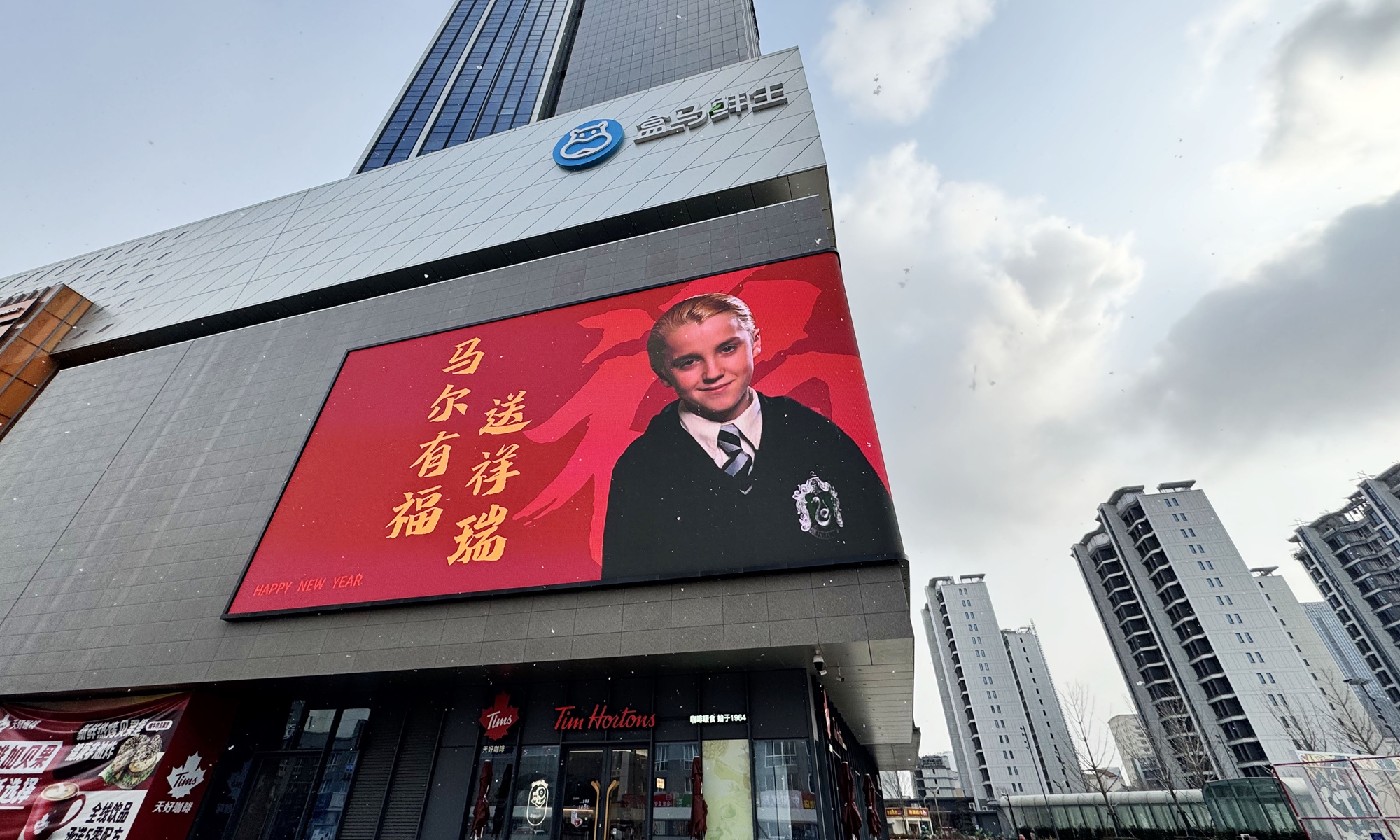
An outdoor big screen at a shopping mall displays a portrait of Draco Malfoy from Harry Potter movies sending Spring Festival greetings in Weifang, East China's Shandong Province, on February 6, 2026.
Tom Felton posted a red paper bearing his own - or Draco Malfoy's - cool, stern face and a Chinese character "fu" ("blessing" in English) on his dressing room door. It was upside down.
He later shared another photo of himself standing in front of a full set of Spring Festival couplets, captioned "Happy Chinese New Year."
The two posts in the past two weeks garnered more than 1 million likes for the British actor, who has been known since the age of 12 for playing the young Slytherin antagonist in the Harry Potter series.
Those in the know smiled - "I'm so glad he found out about this" - while others wondered what exactly had happened.
It became one of the most talked-about cultural moments of the 2026 Chinese New Year. The frenzy began with a Chinese wordplay: the Chinese translation of "Malfoy" carries the meaning of "May you be blessed in the Year of the Horse," tapping neatly into zodiac symbolism. Soon, red "fu" papers printed with his portrait, horse-riding refrigerator magnets promising "instant blessings," and even Malfoy-themed couplets flooded social media.
The joke crossed borders and was eventually embraced by the actor himself, who joined in online. Western outlets including the BBC took note, dubbing him an "unlikely mascot" for the lunar year.
Playful as it seemed, the episode reflected a broader shift. Chinese culture is no longer circulating abroad through formal, one-directional promotion but through participatory, internet-native exchanges that blur the line between producer and audience. Increasingly, some Chinese elements are moving beyond the labels of "Asian" or "niche" culture and entering the everyday consumption and aesthetic routines of young people in the West.
As cultural observer Shi Wenxue observes, this marks a transition from "representation" to "embeddedness." Chinese cultural products are no longer distant symbols interpreted through Western frameworks; they are becoming experiential tools woven into daily life. In his view, this shift signals not a passing trend, but a structural rebalancing of global pop culture's production logic and aesthetic coordinates.
New sensory experiences enter daily life
In New York, 24-year-old university student Natalie stood in line outside a newly opened Mixue boba shop. The queue was long, but she seemed unsurprised.
"A Chinese friend recommended it to me, and I've seen it frequently on TikTok," she told the Global Times. "Mixue's refreshing flavors definitely didn't disappoint."
Bubble tea has gone from a viral drink to a global business worth billions, according to CNBC. As an example, Mixue has more than 53,000 stores worldwide. The lion's share are in China, but the company also has 4,700 locations across Australia, Japan, South Korea, Thailand, Malaysia and Singapore, reported the Los Angeles Times on January 24.
Edward Wang, a Chinese student who has lived in the US for many years and recommended Mixue to Natalie, told the Global Times that his most immediate impression was people no longer ask, "What is bubble tea?" Instead, they ask, "Which store are you getting it from?"
Wang sees this shift as signaling that Chinese tea beverages abroad no longer carry a cultural explanatory function, they have entered a state of "default acceptance."
"And it's not just bubble tea. Chinese 'cool culture' is spreading into the social skin of Gen Z globally," Wang added.
Over the past few years, media reports and social media videos show that similar scenes have appeared in North America, Europe, and other countries' university towns and youth hubs. Bubble tea, collectible toys, short videos, mobile games - these cultural products, once considered "regional trends," are now highly visible in the daily lives of young people overseas.
In London, a recent pop-up event featuring Pop Mart's "Twinkle Twinkle" ceramic collectibles drew many young local participants.
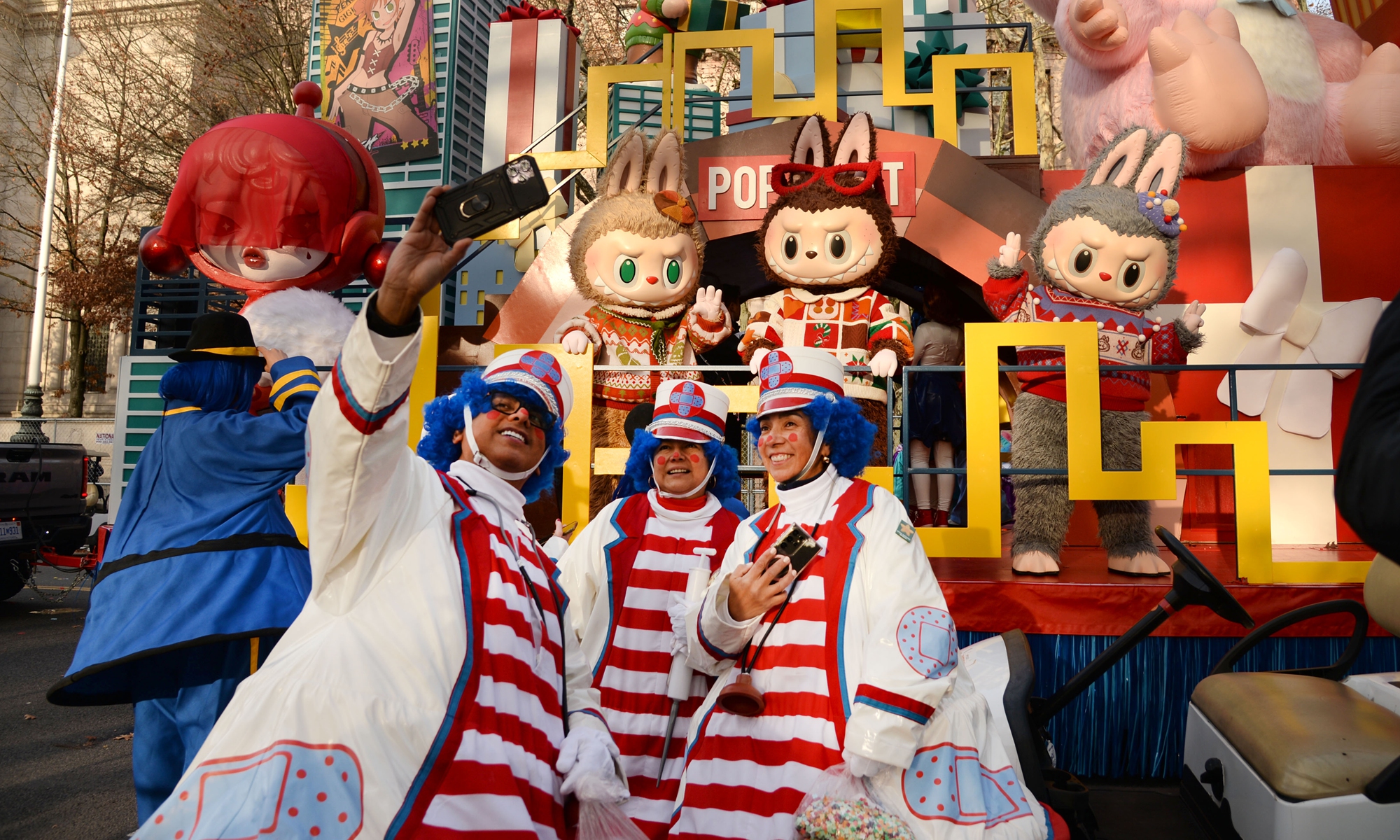
Performers pose for photos with Labubu figures during the 99th Macy's Thanksgiving Day Parade in New York, the US, on November 27, 2025. Photos on this page: VCG
"While Twinkle Twinkle is popular, everyone really knows Labubu better. Many international celebrities have boosted its visibility, and Labubu was recently featured in an exhibit at the V&A Museum. People recognize that these characters come from China, find them especially cute, and they're just incredibly popular right now," Reve, the event's co-organizer, told the Global Times.
On screens, Chinese content is also prominent. On TikTok, makeup transformation videos and short drama clips from China frequently appear in users' recommended feeds. Natalie told the Global Times that she doesn't always know where the videos originate, but she can feel that they move at a fast pace and don't require any buildup.
Games and online literature offer a longer, more immersive experience.
For example, German vlogger Maik Gramalla, inspired by Chinese games such as Moonlight Blade and Genshin Impact, traveled across China seeking real-world echoes of ancient legends brought to life through digital storytelling.
In London, Sophie Lange, a European artist working in the creative sector, is a devoted fan of Chinese romantic fiction. She showed the Global Times reporters that her phone, which contained a list of novels she had read, each carefully annotated with ratings and personal notes.
"These stories are really fun," she said, scrolling through her notes. "They're fast, dramatic, and full of surprises. I end up thinking about them all the time, even when I'm doing other things. They've become part of my daily routine, almost like a lifestyle choice rather than just entertainment."
Structural shift
If Malfoy posting the character "fu" was a lighthearted interaction at the level of symbols, what truly underpins this wave is a deeper structural transformation.
For decades, the Western world's imagination of Chinese culture largely took the form of "representation." Whether in Mulan, Kung Fu Panda, or various Orientalist visual motifs, the effort was to "translate" and "consume" distant Eastern symbols, Shi told the Global Times.
Today's bubble tea, designer toys and short dramas, however, represent a form of "embedding" - no longer spectacles to be gazed at but everyday objects that can be directly "used" and "experienced," Shi said.
Meanwhile, the center of attraction has also shifted. The structure of Chinese elements' appeal to the global Generation Z is undergoing profound change - they are no longer satisfied with romanticized imaginings of Eastern narratives but are more willing to embrace contemporary China's real-life expressions.
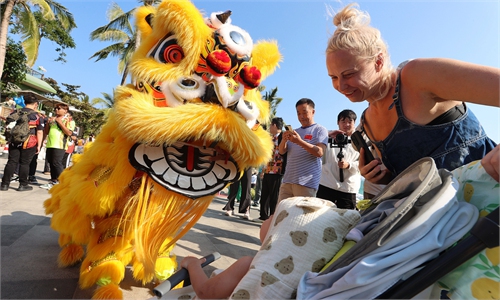
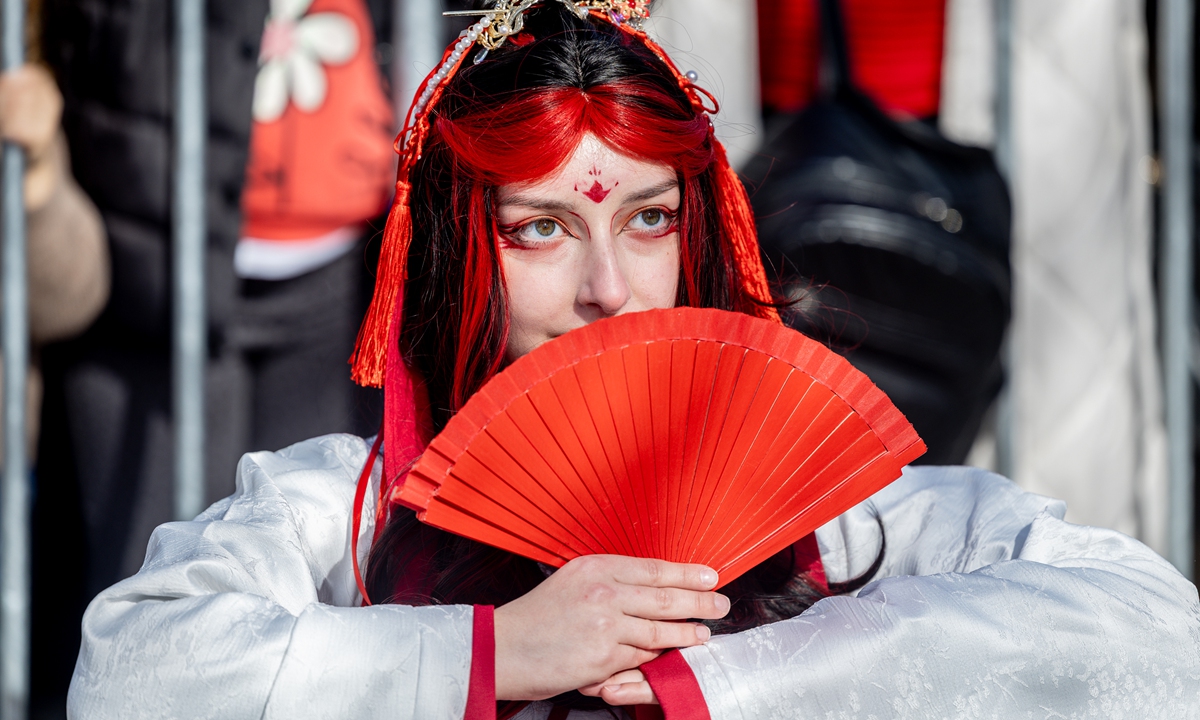
A participant dressed in clothing and accessories featuring Chinese elements joins a Spring Festival parade in Madrid, Spain, on February 22, 2026.
Shi believes this shift is no coincidence. In recent years, China's digital culture - including micro-dramas, adaptations of online literature and designer toy IPs - has developed large-scale industrial clusters and sustained output capacity. It is no longer defined by sporadic viral hits, but by a steady stream of production and dissemination.
In contrast, Western mainstream film and music industries have entered a relatively formulaic and even rigid cycle in recent years. IP recycling, risk-averse storytelling and aesthetic conservatism have made global pop culture production increasingly repetitive.
For example, The Guardian noted that Hollywood has been grappling with "big structural shifts in the technology and corporate structure of entertainment," with shooting days in Los Angeles falling more than 20 percent year-on-year and the industry no longer "the idyllic and charmed" system it once was.
Meanwhile, major international film festivals and the review platform Deadline.com have suggested that Hollywood's "symbolic value" is being lost.
Against this backdrop, internet-native, fast-moving and decentralized digital culture has offered global youth a new template for emotional expression. Micro-dramas satisfy fragmented attention spans, designer toys provide companionship, and lifestyle videos project a gentler alternative to efficiency-driven anxiety, Shi said.
"So this is not simply about 'filling a gap,' but rather resembles a structural reshaping of the logic of global pop culture production and dissemination. China's digital cultural practices have happened to land precisely on the beat of this new logic," Shi said.
Truly crossing borders
As Wang has observed, the authority to define what is "cool" and what is "modern" is loosening, and modern lifestyles are no longer synonymous with Western ones. Global pop culture is entering what can be called a "resonance era."
The term "Very Chinese Time" emerged precisely in this process of cultural resonance. Shi explained that in the past, "cool" was often tied to Western - especially American - street culture, rebellious spirit, or specific fashion trends. At the same time, Western-led notions of "modernity" were often accompanied by a linear developmental narrative and a specific aesthetic of living.
"The core of 'Very Chinese Time'," Shi said, "is that Chinese content has made the thrilling leap from being 'observed' to being actively 'used.' The depth and breadth of this embedded presence surpasses any previous wave of Chinese cultural exports."
Zhu Wei, a profess or from the China University of Political Science and Law, added that this form of Chinese pop culture does not require grand narratives of value confrontation or systemic critique; rather, it intervenes in individual lives through highly accessible, everyday, low-barrier practices.
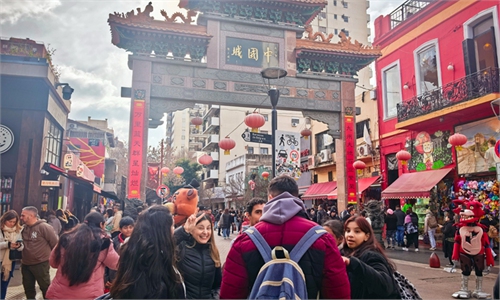
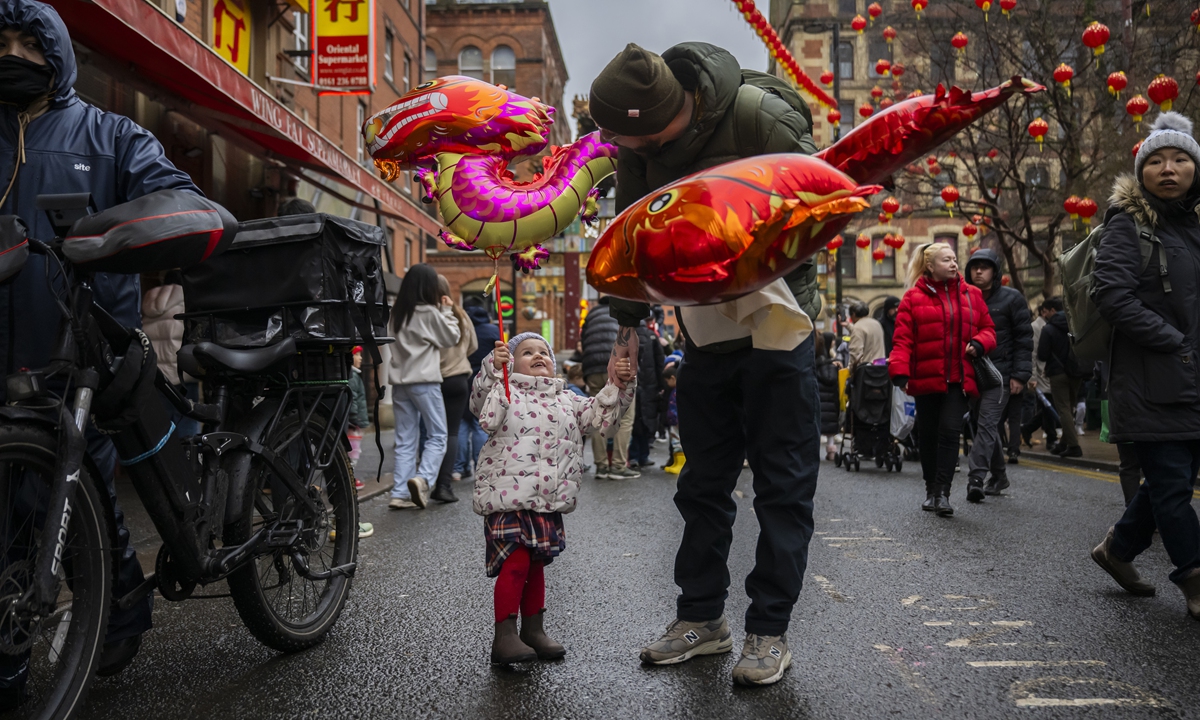
A little girl holds a balloon during the Chinese New Year celebration at Manchester Chinatown in Manchester, the UK, on February 15, 2026.
The 2025 Report on the International Communication of Chinese Culture also highlighted that a new paradigm of Chinese cultural dissemination focuses on creating global youth cultural spaces based on the logic of social currency. Taking Labubu as an example, its viral success stems from precisely embedding itself in the full social chain of celebrity posts, KOL recommendations, fan unboxing, and secondary creations. Every share, every unboxing video, transforms Labubu from a collectible toy into a "hard currency" in youth social interactions, achieving spontaneous, viral circulation through social platforms.
This makes content-centered on short videos, fan creations and community interactions - a vehicle through which Chinese culture becomes a topic young people are willing to actively share, engage with, and co-create. Its global penetration is driven by the self-reinforcing dynamics of social group propagation, said the report.
"Perhaps the change is happening in such details," Wang said. "When culture is no longer treated as something solemn to be discussed but is naturally used, that's when it truly crosses borders."
RELATED ARTICLES