Export controls on certain Japanese entities targeted, decisive, legitimate and timely, deserving close attention
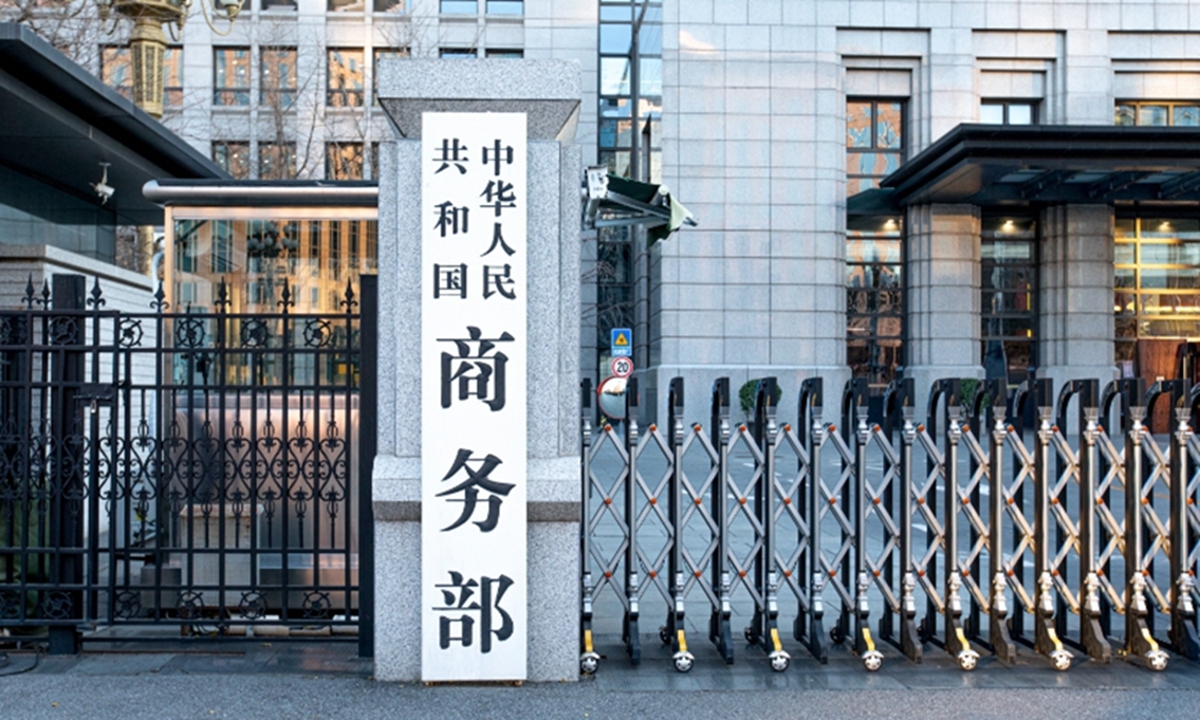
The Ministry of Commerce of China File photo: VCG
Following the implementation of export controls on dual-use items bound for Japan in January, China's Ministry of Commerce issued an announcement on Tuesday, adding another 20 entities involved in boosting Japan's military capabilities, including Mitsubishi Shipbuilding Co, to its export control list. Another 20 Japanese entities, such as SUBARU Corporation, have been placed on a watch list, as the end users and end uses of dual-use items supplied to them cannot be verified. This operation is targeted, decisive, legitimate and timely, and warrants close attention.For both China and Japan, focusing on their own development should be the primary task. This year marks the beginning of China's 15th Five-Year Plan (2026-30) period, with major and important tasks for domestic reform, development and stability. Meanwhile, Japan is currently facing numerous internal challenges, with a weak economic foundation. The ratio of Japanese government debt to GDP has reached as high as 230 percent. During the Japanese House of Representatives election, Japanese Prime Minister Sanae Takaichi pledged a policy to suspend the consumption tax on food for two years. While designed to win voter support, this move would cut the Japanese government's annual fiscal revenue by approximately 5 trillion yen. Against the backdrop of surging fiscal spending, such a policy will undoubtedly further inflate the country's national debt. Market confidence in Japanese government bonds has already declined significantly. In January, the yield on 10-year Japanese government bonds rose to a 27-year high. Higher bond yields signal a sharp increase in Japan's future debt-servicing costs. The huge hidden risks in its economy can no longer be ignored. Driven by domestic political needs, the government led by Takaichi has unwisely provoked neighboring countries, including China, on multiple occasions. If this trend continues, it will ultimately harm both Japan and others.
The development of China-Japan relations cannot be separated from mutual respect, and in particular, neither side should infringe the other's core interests. China has always attached great importance to China-Japan relations, but such importance is premised on adhering to basic principles. Regarding Sanae Takaichi and her new cabinet, China's stance has never changed: Takaichi must retract her erroneous remarks on China's Taiwan island, abide by the one-China principle and the four political documents between China and Japan, stop manipulating the Taiwan question, face history squarely, and adhere to the path of peaceful development.
Regrettably, the Japanese side has refused to accept China's reasonable demands. Particularly after Japan's ruling coalition of the Liberal Democratic Party and the Japan Innovation Party won more than a two-thirds majority in the House of Representatives election on February 8, the right-wing tendencies of the government led by Takaichi have become even more unscrupulous. On election day, Takaichi openly expressed intention to "create an environment" for visiting the notorious Yasukuni Shrine. Conservative agendas - including revising Japan's pacifist constitution and enacting an anti-espionage law - are all set to accelerate. At the same time, Japanese Defense Minister Shinjiro Koizumi has been blatantly pushing forward on multiple fronts. Even more astonishingly, after Member of the Political Bureau of the Communist Party of China Central Committee and Foreign Minister Wang Yi reiterates solemn position on China-Japan relations at the Munich Security Conference, the Japanese Ministry of Foreign Affairs inverted the facts, accusing China of "inappropriate" remarks and initiating "demarche." As a victim of World War II and firm defender of the postwar order, China's export control measures to curb Japan's dangerous tendencies are not only a protection of China's own interests, but also a fulfillment of its responsibility to safeguard international order, making them entirely justified, legitimate and lawful.
Japan's current social mindset also demands vigilance. The pacifist generation that lived through World War II has largely passed away. Today, many young Japanese voters grew up during Japan's "Three Lost Decades" and generally feel uncertain about the future. This sense of confusion, compounded by the misleading narratives of right-wing forces in Japan, has fostered serious prejudice. They attribute domestic development challenges to external factors, with hostility toward China particularly pronounced. Some Japanese have distorted the country's former industrial and technological advantages into claims of civilizational and ethnic superiority, fueling radical nationalist sentiments. Meanwhile, Japan harbors a complex and contradictory psychology toward its war of aggression against China - carrying a sense of guilt while simultaneously refusing full acknowledgment. This makes it difficult for some to accept China's rise. Japan's right wing forces have exploited these sentiments, constantly stoking nationalism and shifting blame for domestic problems onto China. Such tactics are driving Japanese society toward greater extremism, increasing the risk of a return to militarism - an outcome that would ultimately exact a painful price from the Japanese people.
For a long time, the Japanese government has clung to an unrealistic illusion: Politically provoking China while continuing to profit from the Chinese market economically. That illusion should now be shattered. In the past, China did rely to some extent on Japan for capital and technology. However, after decades of development, China's economic and technological strength has achieved a qualitative leap, significantly reducing its dependence on Japan. In contrast, the Japanese government's risky actions have artificially created obstacles for its own companies seeking to deepen their presence in the Chinese market - essentially lifting a rock only to drop it on its own foot.
China's recent export control measures are not only necessary steps to safeguard its core interests, but also constructive actions to maintain regional stability. They serve as a warning to those in Japan who seek to stray from the path of peace. If the Japanese government led by Sanae Takaichi still refuses to reflect and change course, I firmly believe that the Chinese government will take more resolute and forceful measures, showing no tolerance for any actions that harm China's national interests or seek to overturn the post-World War II international order.
The author is a professor at School of International Studies at the Renmin University of China. He holds the prestigious title of state-honored "Chang Jiang Scholar." bizopinion@globaltimes.com.cn
RELATED ARTICLES