Japan-bound flights keep declining during Spring Festival: data
Security concerns, seismic activity compound public sentiment
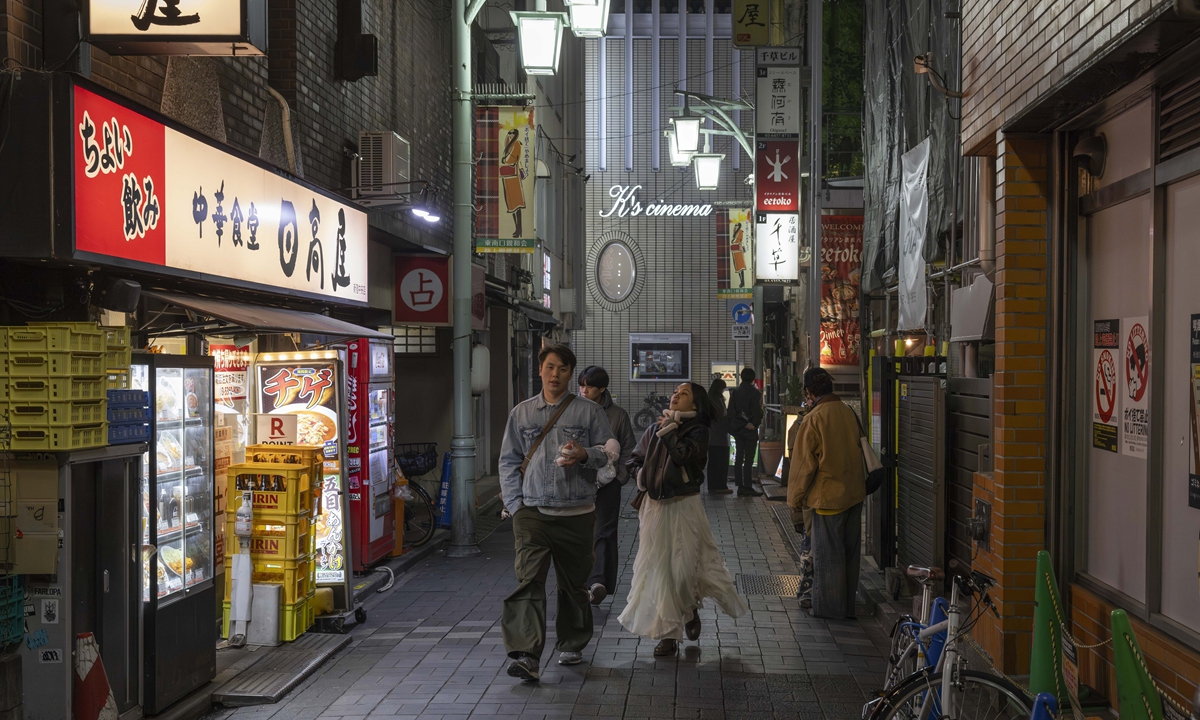
Pedestrians walk down a street in the amusement district of Shinjuku in Tokyo, on February 12, 2026. Photo: VCG
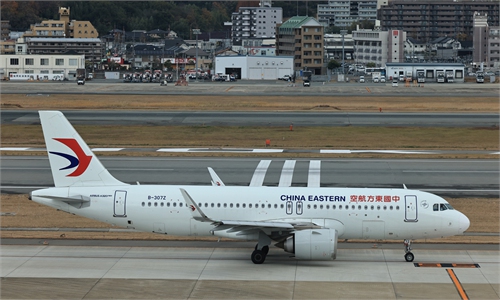
Latest data showed that air routes between China and Japan that operated during the recently concluded Spring Festival holiday continued to decline, in line with a sharp drop in Chinese travelers' willingness to visit Japan.
Industry insiders said that beyond recent fluctuations in bilateral relations that have affected public sentiment, travelers have also grown increasingly wary of Japan's public safety conditions, as well as recent seismic activity.
Some Japan-bound routes saw volatility and declines during the 2026 Spring Festival holiday, standing in sharp contrast to other short-haul destinations such as Thailand and Singapore, according to data released on Thursday by DAST, a Chinese traffic data analysis platform.
The average daily number of flights on the Shanghai Pudong-Kansai route fell by 12.9 year-on-year, the data showed, and the total number of flights during the Spring Festival holidays fell from 210 in 2025 to 120. Also, flights from Shanghai to Japan's Narita declined, dropping from 155 during the 2025 Spring Festival holiday to 121.
According to a report by Nikkei Asia, preliminary operating data released on February 25 by Kansai Airports showed that passenger numbers on China-related international routes at Kansai Airport fell 58 percent year-on-year in January, to just 270,000.
Lianhe Zaobao reported on February 21 that tax-free sales to Chinese visitors at Hankyu Hanshin Department Store fell by about 40 percent year-on-year in December 2025, and by around 60 percent in January 2026, citing data from Japanese media outlets.
The sharp declines in China-Japan flights and people-to-people exchanges have been driven by multiple factors and, judging from Japan's actions, they are unlikely to be resolved in the short term, Lü Chao, a professor at the Liaoning Academy of Social Sciences, told the Global Times on Thursday.
"Tokyo's earlier erroneous remarks on Taiwan triggered a strong public backlash in China and, against the backdrop of unresolved historical issues, further set back bilateral political and diplomatic ties, dealing a direct blow to public sentiment."
As passenger flows between China and Japan declined, airlines -- driven by cost and profitability considerations -- have been unable to sustain operations with low load factors, leading to sharp cuts in flight capacity, which is a natural market response, Lü said.
Notably, recent public security-related incidents involving Chinese nationals in Japan have occurred with increasing frequency, which Lü has also identified as one of the most critical factors behind the trend. Chinese authorities have in recent months repeatedly advised citizens to avoid travel to Japan out of concern for their safety.
The Chinese Consulate General in Osaka on Thursday again warned that public security conditions in Japan have recently been unstable, with safety-related incidents occurring frequently, and advised Chinese citizens to avoid travel to Japan. It also urged those in its consular district to closely monitor local security developments and heighten their safety awareness.
The announcement came after a Chinese national was assaulted by unidentified individuals on a street in Osaka's Sumiyoshi Ward, with a backpack containing 5 million yen ($33,000) in cash robbed.
Lü said that although China and Japan are close neighbors with deep-rooted people-to-people exchanges since the normalization of diplomatic ties, the current cooling of bilateral political relations is exerting medium- to long-term negative effects on public interactions. Stabilizing — let alone repairing -- ties, he stressed, requires that "the person who tied the bell must untie it."
He said that even if Japan enters a seasonal tourism upswing in the second quarter, such as during the cherry blossom season, the likelihood of any meaningful rebound in Chinese visitor numbers remains extremely slim. He also stressed that any easing driven by residual economic and people-to-people exchanges would likely be limited and far from a meaningful recovery, let alone a return to previous peaks.
Lü added that Chinese travelers now have a broader range of alternatives, with Southeast Asia, South Korea and other nearby or emerging destinations continuing to divert demand away from Japan. As new markets open to Chinese tourists, Japan's appeal has further weakened, while concerns over safety and the perceived lack of friendliness are likely to keep travel sentiment subdued.
RELATED ARTICLES