Third round of indirect talks between US and Iran held amid massive US military buildup in Mideast
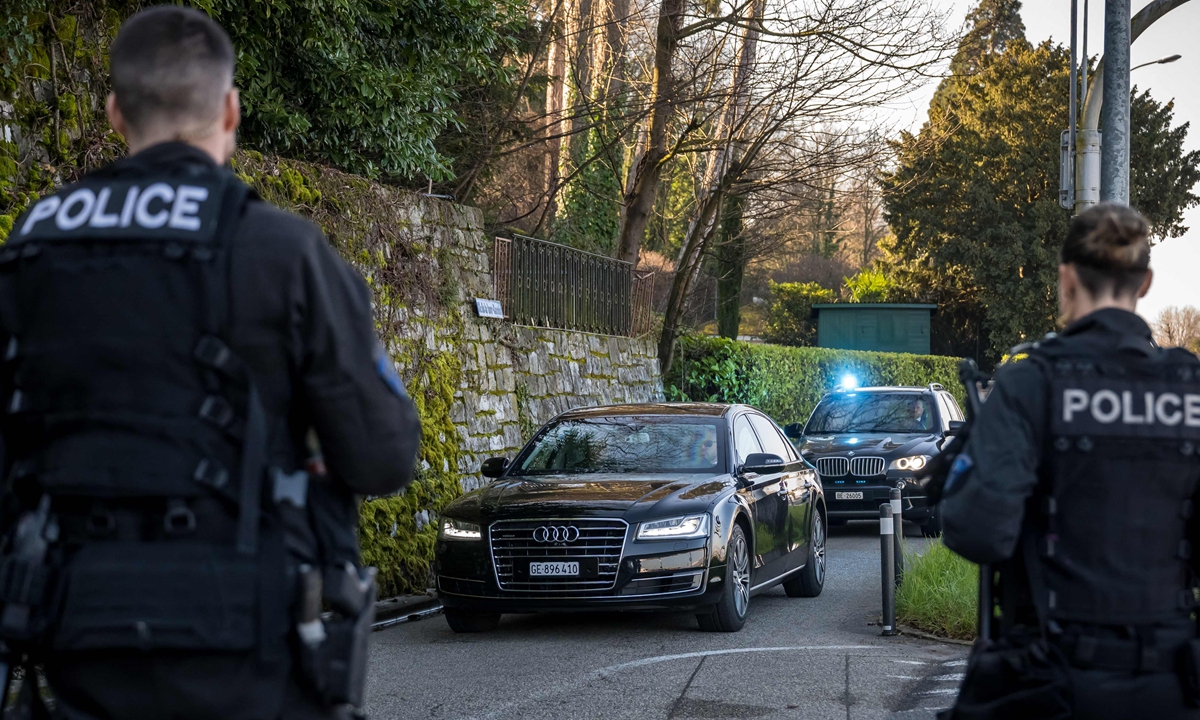
Police officers stand by as a convoy arrives at the Oman ambassador's residence for a new round of talks between the US and Iran to address Iran's nuclear program, in Geneva on February 26, 2026. Photo: VCG
Seen as a "make-or-break moment" by media amid a massive US military buildup in the Middle East, the third round of indirect nuclear talks between the US and Iran began Thursday in Geneva. When asked if China would join Russia to support Iran against any US aggression, Chinese Foreign Ministry spokesperson Mao Ning said on Thursday, "We are closely following the developments regarding Iran."China advocates resolving issues through political and diplomatic channels and opposes the use or threat of force in international relations, Mao said, adding that the people of China and Iran enjoy traditional friendship. China supports the Iranian government and people in upholding their nation's stability and legitimate rights and interests.
"We hope the various parties will cherish peace, exercise restraint, and resolve differences through dialogue. China stands ready to continue playing its role as a responsible major country to this end," the spokesperson added.
Crucial negotiations between Washington and Tehran continue in Geneva on Thursday, with US special envoy Steve Witkoff and Jared Kushner, as well as Iranian Foreign Minister Abbas Araghchi. The indirect talks aim to address Iran's nuclear program and the possibility of sanctions relief, CNN reported.
A Foreign Ministry statement from Oman, a country that has long served as a mediator between Iran and the West, said on social media platform X on Thursday that the Iranian and US delegations demonstrated "unprecedented openness to new and creative ideas and solutions" in the latest round of indirect nuclear talks.
However, amid diplomatic talks between Washington and Tehran, the US has assembled a significant array of weapons systems in the Middle East, deploying ships and aircraft to nearby waters and to US bases across the region, according to CNN.
The report added that it is the largest American military buildup in the Middle East since the Iraq war of 2003.
A report by The New York Times on Thursday noted that all eyes are on Geneva throughout the region and beyond. There is a sense here that these talks could be a make-or-break moment, the report by CNN said, as US President Donald Trump has assembled a major force in the Middle East and alluded that his finger is on the trigger. The Iranians have warned that their response would be severe.
Iranian foreign ministry spokesperson Esmaeil Baghaei told Press TV on Thursday that the negotiations would focus solely on nuclear topics and the lifting of sanctions, and said Tehran goes into them with "seriousness and flexibility," according to the report by Reuters.
Previously, Trump, speaking at his State of the Union speech on Tuesday, also stressed that he preferred a diplomatic solution, but added that he would not allow Tehran to obtain a nuclear weapon, per Reuters.
Even as the US military buildup and Iran's warnings of retaliation bring the crisis to the brink, both countries still seem to be seeking a face-saving way to avoid a war, Ding Long, a professor at the Middle East Studies Institute of Shanghai International Studies University, told the Global Times.
The expert said that both sides also intend to use military threats to gain the initiative in negotiations, increase their bargaining chips, and achieve the goal of promoting talks through pressure.
RELATED ARTICLES