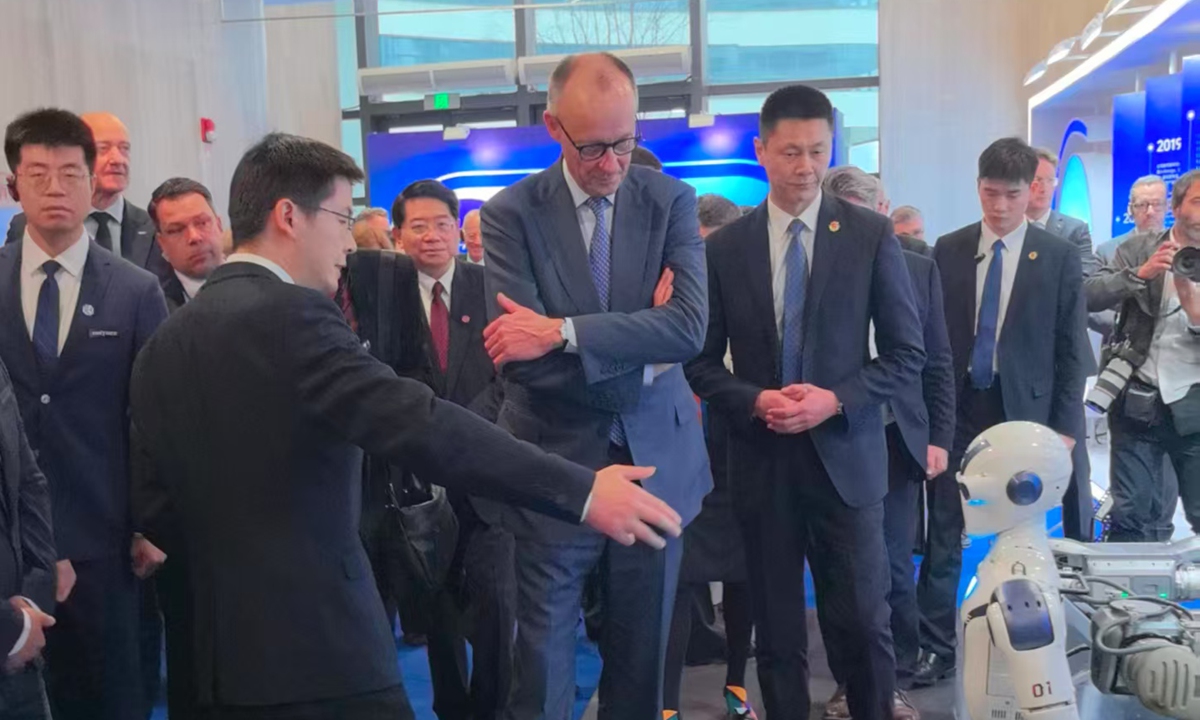
German Chancellor Friedrich Merz watches a robot, as he visited Unitree Robotics in Hangzhou, East China's Zhejiang Province, on February 26, 2026. Photo: Zhang Yiyi/GT
When German Chancellor Friedrich Merz entered the Unitree Robotics exhibition hall in Hangzhou, East China's Zhejiang Province, on Thursday afternoon, he saw a series of constantly changing scenes. In the center of the stage, a humanoid robot performed a set of Chinese kung fu "Drunken Fist"; on the boxing ring, two robots demonstrated a sparring match. Beside the assembly line, humanoid robots were completing sorting tasks.
Embodied intelligence, a technological approach that integrates artificial intelligence (AI) into physical hardware, is moving from the laboratory into industrial applications.
For the German Chancellor from a traditional industrial powerhouse, this was no ordinary visit. "It suggests that both the German government and the business sector are closely watching the cutting edge of China's digital economy, while also seeking avenues for cooperation that can deliver shared benefits," Sun Yanhong, director of the European Economic Research Office at the Institute of European Studies, Chinese Academy of Social Sciences, told China News Service.
For some German companies, this represents a shift for Germany from "being the teacher to becoming the student." Jens Dallendörfer, Regional CEO of Germany's Wilo AMEA (Asia, Middle East, Africa), told a reporter from China Daily that China has developed so quickly and so impressive, using the German proverb "Der Lehrer wird zum Schüler" or "The teacher becomes the student" to describe the changes.
Germany has long been known for its precision manufacturing. From mechanical processing to automotive engineering, from industrial software to automation control, the concept of "Industry 4.0" has been around for more than a decade, but with the deep integration of algorithms, large models, and intelligent hardware, the pace of manufacturing upgrades is also changing.
Embodied intelligence is a microcosm of this transformation.
In recent years, China has accelerated progress in robotics, intelligent manufacturing, and AI applications. From core components to system integration, and from large scale production to market deployment, the capability to complete the full industrial chain has gradually taken shape. The pressure felt by Germany's key industries, such as machinery and automotive, has increased accordingly.
The latest data from the German Federal Statistical Office confirm this trend. Although Germany's GDP ended two consecutive years of contraction last year, the added value of its manufacturing sector still fell 1.3 percent year-on-year, marking a third consecutive year of decline, with the automotive and machinery industries experiencing particularly significant drops.
Against this backdrop, China's significance to Germany becomes even more pronounced.
Bilateral trade between China and Germany reached 251.8 billion euros ($296.6 billion) in 2025, up 2.1 percent year-on-year, with China surpassing the US to once again become Germany's most important trading partner, as it did from 2016 to 2023, Germany's Federal Statistical Office said in a press release.
The breakdown is even more revealing: Germany imported 13.9 billion euros worth of machinery from China, up 11.6 percent; imports of electrical equipment rose 14.8 percent to 32.8 billion euros; and imports of data processing equipment, electronics, and optical products reached 50.9 billion euros, accounting for the largest share, China News Service reported.
The data indicate that China serves not only as a major market for Germany, but also as a crucial link in its supply networks and industrial transformation, said Sun, noting that meanwhile, in sectors such as new energy vehicles, smart manufacturing, and biomedicine, Chinese firms are moving steadily toward the higher end of the value chain, increasingly encroaching on areas long dominated by German industry.
The complex mindset of the German government and industry is also evolving, experts said.
Sun noted that China and Germany are both leading manufacturing nations, with competition between them becoming more pronounced in recent years. At the same time, there remains broad potential for win-win cooperation in areas including new energy vehicles, intelligent manufacturing, and biomedicine, the expert said, according to China News Service.
At the same time, Germany should not get overly caught up in the opposing narrative of "de-risking," experts said.
If Germany continues to overemphasize the rhetoric of so-called "security risks," it could miss opportunities to deepen collaboration with China in these critical areas and weaken its own strategic position within the global industrial chain, Zhou Mi, a senior research fellow at the Chinese Academy of International Trade and Economic Cooperation, told the Global Times on Friday.
This stop in Hangzhou was taking place against precisely this backdrop.
Merz was accompanied on this trip by executives from about 30 German companies, covering sectors such as automotive, chemicals, biopharmaceuticals, machinery manufacturing, and the circular economy. This visit was not only a reinforcement of traditional strengths but also a strategic move into future growth areas.
Intelligent manufacturing will be one of the key areas for future China-Germany cooperation. Not only are Chinese companies investing in smart factories in Germany, but European firms are also actively participating in intelligent manufacturing and industrial internet development in China, Sun said, giving example that Germany's Siemens is advancing multiple smart factory and digital production projects in China.
The changes in the new-energy vehicle sector are equally striking. In recent years, China has accelerated its electrification process, with domestic companies expanding overseas; meanwhile, German automakers have deepened R&D and localized production in China, jointly developing models with Chinese firms.
China and Germany have already built a relatively deep and closely integrated partnership in the new energy vehicle sector, and this form of industry level collaboration is likely to grow even stronger in the years ahead, Zhao Junjie, a senior research fellow at the Institute of European Studies at the Chinese Academy of Social Sciences, told the Global Times on Friday.
Similar trends are emerging in fields such as biomedicine and high-end manufacturing. Chinese innovative drug companies are accelerating international licensing and collaboration, with more frequent technology exchanges and capital interactions. Industrial engagement is no longer a one-way output but a multidimensional interweaving.
When the German Chancellor stepped into an embodied intelligence company, he saw not only the fluidity of the robots' movements but also a possible vision for future manufacturing systems. For German industry, which is under pressure to transform, the development of China's future industries is no longer just an external spectacle—it has become an important variable that need to be carefully considered, experts said.
As Roland Busch, President and CEO of Siemens AG, said, the markets of China and Germany are highly interdependent, and German companies have become an important part of China's industrial ecosystem, China News Service reported. Busch expressed hope that in the future, Chinese companies will also integrate more deeply into Germany's industrial ecosystem, the report said.
The world is changing rapidly. Therefore, we must rethink the way we cooperate, said Busch, noting that we cannot simply continue with past approaches; instead, we need to explore a new model of collaboration.
When "Industry 4.0" meets China's embodied intelligence, the focus of China-Germany economic and trade discussions is shifting from mere trade volume to a shared assessment of the logic of future manufacturing.
China News Service - Global Times
RELATED ARTICLES