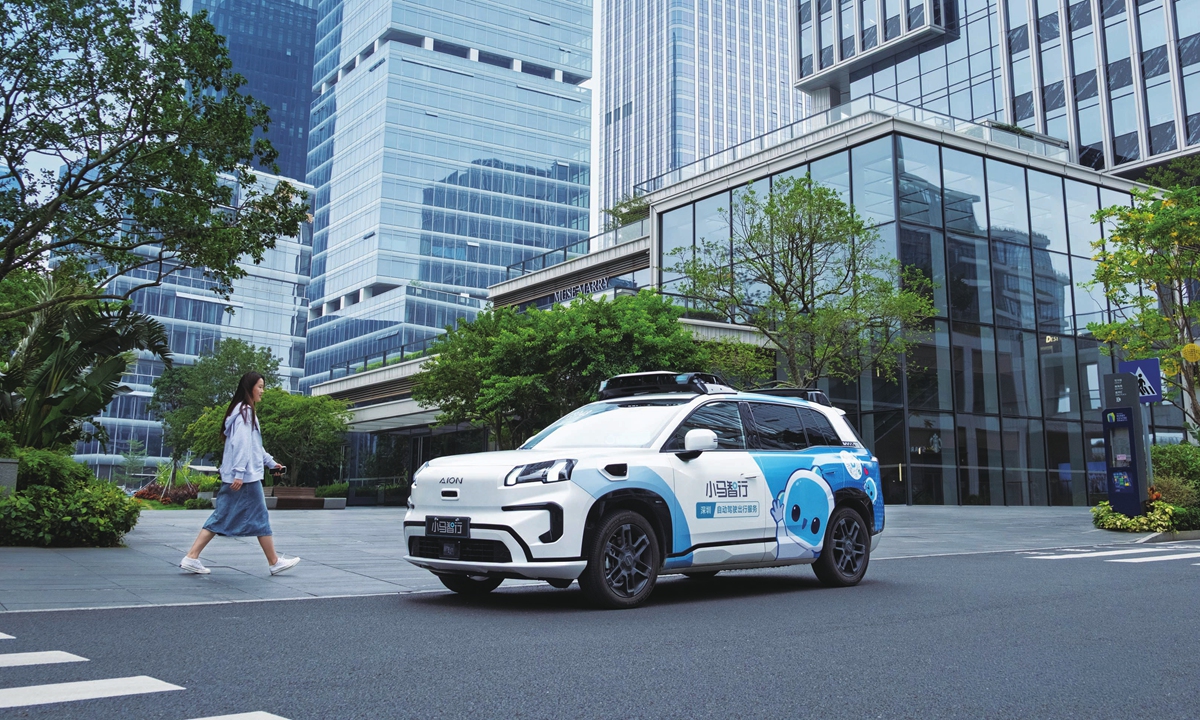
A passenger walks to a Pony.ai robotaxi in Shenzhen, South China's Guangdong Province, during the 2026 Spring Festival holiday. Photo: Courtesy of Pony.ai
When you hail a taxi during the bustling Chinese New Year holiday in Shenzhen, a tech and innovation hub in South China's Guangdong Province, you might find that your taxi is driverless. Passengers were able to travel without fare surge or service disruptions.
This isn't science fiction - it's the new reality in China, where autonomous driving company Pony.ai's fully autonomous robotaxis filled the transportation gap left by drivers heading home for the festivities. Robotaxis have emerged as one of Shenzhen's most striking tech symbols during the Chinese Year of the Horse.
During the Spring Festival holiday (February 15 to 23), orders for Pony.ai's fully autonomous robotaxis in Beijing, Shanghai, Guangzhou, and Shenzhen climbed steadily. In Shenzhen alone, paid orders on Chinese New Year's Eve (February 16) surpassed the company's total for the entire year of 2025. Daily paid orders hit new highs throughout the holiday, according to data provided by Pony.ai to the Global Times.
As orders soared and records shattered, this festive tech showcase underscores the broader acceleration of China's emerging autonomous driving sector.
Leading automakers in the country are accelerating development, reporting a series of innovational milestones. BYD has completed 150,000 kilometers of on-road validation for Level 3 (L3) autonomous driving. Baidu's Apollo Go has expanded to 22 cities globally, serving over 17 million rides, according to media reports.
In a February 24 post-holiday letter for the Year of the Horse - marking the first post-holiday workday - XPeng CEO He Xiaopeng called on employees to seize autonomous driving's "DeepSeek moment" in China. Robotaxi pilots for XPeng's ride-hailing models will begin this year, aiming to close the loop between technology, customers, and commercialization.
In terms of autonomous driving systems, service providers have emerged. For example, the assisted driving solution of Momenta (Suzhou) Technology Co delivers production-ready features across various automation levels, offering an end-to-end intelligent driving experience that covers all scenarios.
Its technology has been adopted by major Chinese passenger car manufacturers, including SAIC, BYD, GAC, Chery, Dongfeng, Changan and Geely, the company told the Global Times.
Analysts noted that the year of 2026 could be the inflection point where the autonomous driving shifts from pilot project operation to widespread adoption.
"With ongoing tech iterations, policy refinements, and industrial upgrades, China is evolving from a follower to be a leader in reshaping global intelligent mobility," Wang Peng, an associate research fellow at the Beijing Academy of Social Sciences, told the Global Times.
A December 2025 report from the China Academy of Information and Communications Technology (CAICT) highlighted that autonomous driving has entered the "fast lane," with China and the US forming a leading duo. It has become a focal point for technological competition.
Why China leads
China's leading position in the sector is underpinned by strong policy support.
In December 2025, the Ministry of Industry and Information Technology (MIIT) issued road access permits for the country's first batch of L3 conditional automated driving vehicles. Changan's Deepal SL03 and BAIC's Arcfox Alpha-S received approval, with dedicated license plates granted in the capital city of Beijing and Southwest China's Chongqing - marking the transition from testing to compliant commercialization.
China classifies driving automation into six levels (L0 to L5), as defined by the MIIT. The higher the level, the more advanced and intelligent the technology. As "conditional driving automation," L3 autonomous driving allows a vehicle to drive itself under specific conditions without human input, while still requiring the driver to be ready to take back control when necessary. Higher levels allow for progressively greater automation, with corresponding reductions in the driver's real-time responsibility.
Fu Bingfeng, executive vice president of the China Association of Automobile Manufacturers, viewed this as a pivotal step from technological validation to "conditional road access," unlocking key commercialization milestones, according to media reports.
Apart from policy support, analysts noted that technologies and innovations also matter.
"China leads globally in 5G rollout, enabling vehicle-road-cloud synergies that expand robotaxi operational scopes. China's dominance in new-energy vehicles (NEVs) and intelligent connected tech further bolsters this advantage," Zhang Xiang, secretary-general of the International Intelligent Vehicle Engineering Association, told the Global Times on Wednesday.
As China navigates these dynamics, its autonomous driving push exemplifies innovation-led growth.
Rapid industry growth has prompted financial institutions to raise their forecasts for China's robotaxi market.
For example, Goldman Sachs predicted that 500,000 robotaxis will run across more than 10 cities in China by 2030, according to a May 2025 report.
"Our forecast for China's robotaxi total addressable market (TAM) of $47 billion by 2035 compared with $54 million in 2025 is driven by decreasing costs of hardware and algorithms and lowering operating costs for fleet owners," read the report, which also projected that China's robotaxi fleet will reach 1.9 million by 2035, with a projected 25 percent penetration rate within the shared mobility market.
Ecosystem transformation
Apart from the autonomous driving sector itself, an industry insider surnamed Zeng noted that L3 road access will unleash massive economic potential, reshaping the auto ecosystem into a trillion-yuan ($146 billion) industry.
"Upstream suppliers, like LiDAR, high-precision maps, and high-computation chips, will reap mass-production benefits. Midstream automakers will shift to 'hardware + software + services' models, while downstream segments are expected to spawn new sectors such as insurance and smart traffic management," Zeng told the Global Times.
Fu also emphasized that MIIT's L3 permits activated a "symbiotic ecosystem," evolving supply chains into collaborative partnerships. "Policies mandate full-lifecycle management covering vehicles, systems, data, and operations, encouraging closer coordination between upstream and downstream companies."
Forward-thinking companies are already eyeing L4 and beyond. On February 6, Chinese artificial intelligence (AI) start-up Moore Threads and Pony.ai announced a strategic partnership for L4 tech deployment and scaling.
They aim to integrate AI algorithms with domestic AI computing power, with Pony.ai adopting China's homegrown GPUs for training and simulation - a milestone for indigenous tech in core autonomous driving domains, Moore Threads said in a statement sent to the Global Times.
RELATED ARTICLES