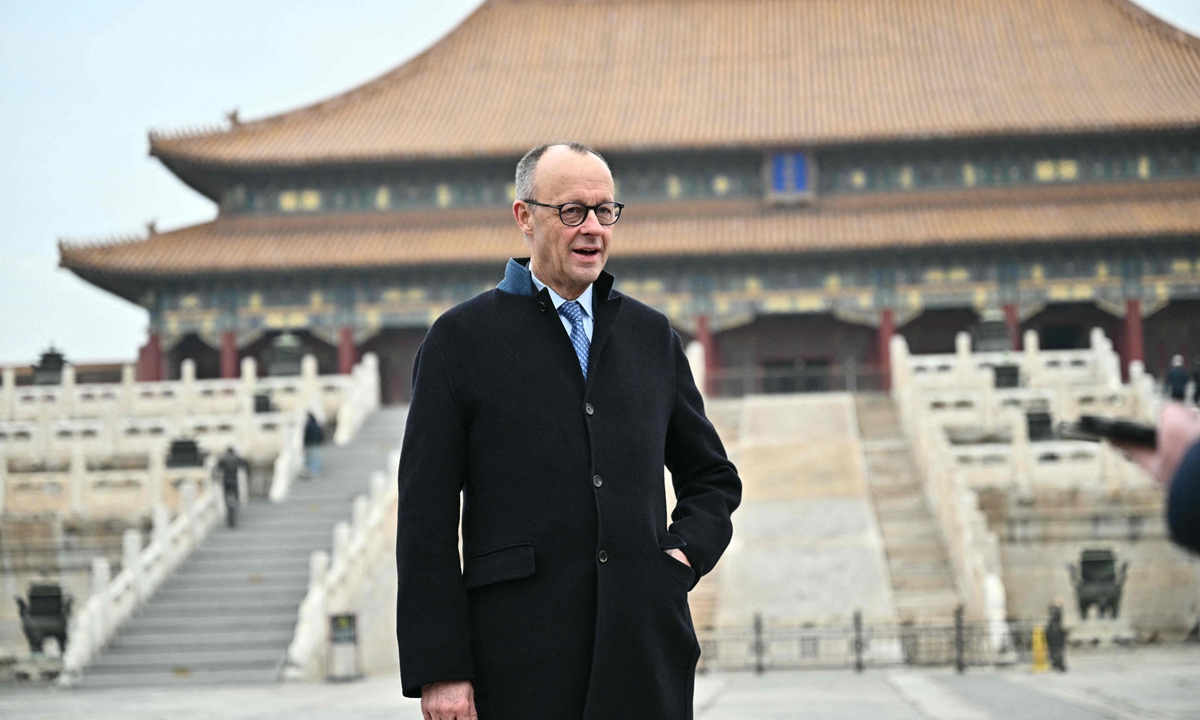
German Chancellor Friedrich Merz visits the Palace Museum in Beijing on February 26, 2026. Photo: VCG
German Chancellor Friedrich Merz wrapped up his visit to China on Thursday and shared videos of the trip on social media. It was evident that in just over two days, the chancellor enjoyed a pleasant and engaging experience in China. From visiting the Palace Museum and extending Chinese New Year greetings in Chinese for the Year of the Horse, even quoting lines from German poet Friedrich Schiller, to watching the same martial arts performance WuBot in Hangzhou that was showcased during the 2026 Spring Festival Gala, as well as robot combat shows; from test-riding the new Mercedes-Benz S-Class to visiting Siemens High Voltage Circuit Breaker Co. Ltd. to learn about the development of German-funded enterprises in China, Merz immersed himself throughout the visit. He frequently applauded, posed for photos with robots, and shared them online.
This marked Merz's first visit to China since taking office and made him the first foreign leader to visit China after the Spring Festival holiday in the Year of the Horse. President Xi Jinping met with Chancellor Merz, and Premier Li Qiang held talks with him. The two sides issued the Joint Press Statement Between the People's Republic of China and the Federal Republic of Germany. As the world's second and third largest economies and major countries with global impact, China and Germany see this visit not only as an opportunity to open a new chapter in bilateral relations, but also as a source of stability and positive energy for a world marked by turbulence and uncertainty.
One distinctive feature of the chancellor's "China Travel" was his close-range interaction with "innovative China." Merz became one of the few Western government leaders to have visited a Chinese humanoid robotics enterprise, and his trip not only opened up a new way of experiencing China but also sparked strong interest among European media in Hangzhou and the "innovation ecosystem" it represents. German media described in detail how these robots, trained with artificial intelligence, can put on boxing, acrobatics and kung fu shows, noting that they are a key focus of China's push for new quality productive forces. France's Le Monde referred to Hangzhou as "the heart city of China's digital revolution." European media outlets generally portrayed Hangzhou in positive terms, albeit with a competitive undertone, broadly acknowledging China's rapid developments and leading position in AI and robotics.
Merz's "China Travel" has given Europe a fresh perception of China to some extent, breaking through the false narrative cocoon that portrays China's high-tech development as "subsidy-driven," "low-cost replication" or even "copying." It has allowed more Europeans to see a pragmatic, enterprising, open, and inclusive China. The presence of executives from about 30 leading German companies in various industries signaled a willingness to further expand investment in China and deepen joint research and development, helping to unlock new growth drivers in areas such as AI and new-energy vehicles. The cooperation documents signed during the visit in fields including green transition, customs, sports, and media also reflected substantive and pragmatic outcomes.
Of course, whenever a Western leader visits China, some noise inevitably follows. Even before the trip, anti-China forces in Germany had prepared a set of "mandatory questions" for Merz on trade deficits and "reducing dependence," in an attempt to "set the tone" for his visit. During the trip, some Western media outlets were able to take an objective view and acknowledge China's economic and technological progress. However, some remained fixated on hyping "overcapacity" and "economic threats," even portraying the German side's positive itinerary as "deliberate packaging and propaganda" by China.
Behind these distorted mindsets lies the fact that some Western media are unable to confront the reality of China's development and progress. They likely also find it difficult to accept that, in the past three months alone, leaders including the German chancellor, the French president, the Canadian prime minister, the Finnish prime minister, and the British prime minister have all visited China and achieved notable cooperative outcomes. These mutual engagements demonstrate the absurdity of attempting to "decouple" from China and forcing today's China to accept unilateral rules set by the Western world.
For Germany, China is not only its largest trading partner but also an indispensable node in global industrial chains. China-Germany relations have long served as a "stabilizing anchor" for China-EU ties.
During the visit, Merz emphasized "valuing relations with China," "attaching high importance to the Chinese market," and "adhering to free trade and rejecting protectionism," and expressed support for enhancing dialogue and cooperation between the EU and China. It is hoped that Chancellor Merz's pragmatic approach will help foster a more balanced EU consensus on China, bring greater benefits to the peoples of China, Germany, and Europe, and contribute to global peace and prosperity.