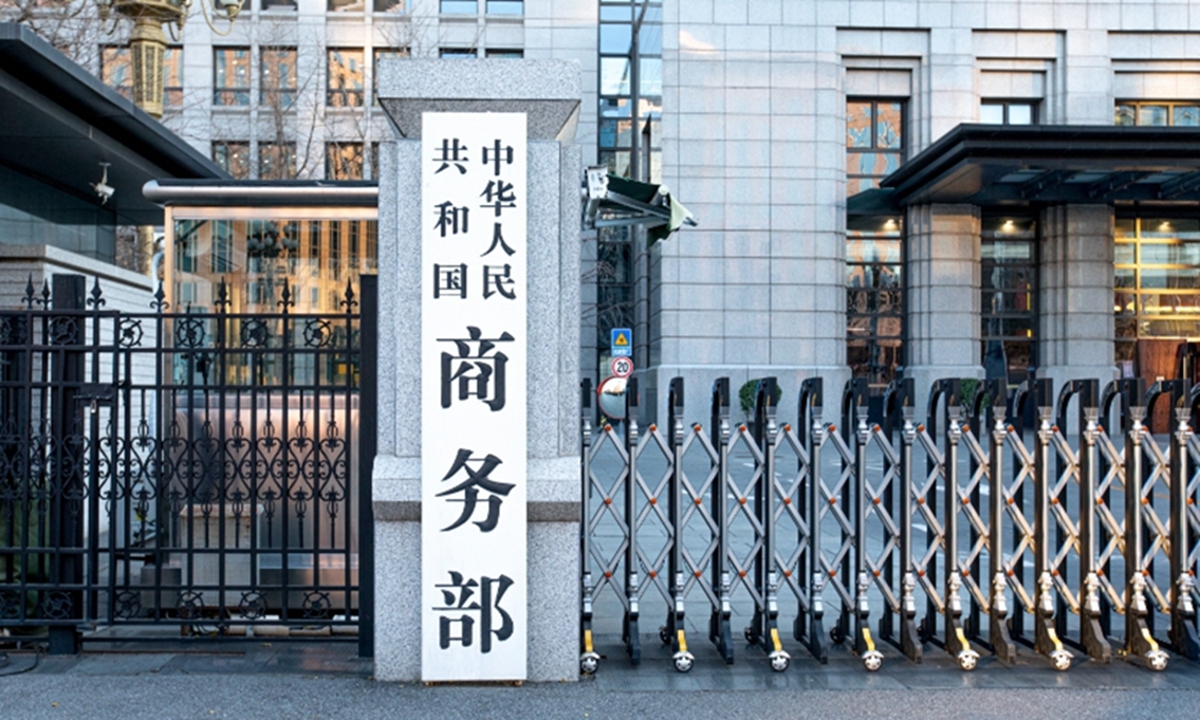
The Ministry of Commerce of China File photo: VCG
Japan's "remilitarization" and its attempts to acquire nuclear weapons pose a grave threat to regional security and stability. The key to safeguarding peace lies in taking action to curb the frenzy of Japanese right-wing forces. China's imposition of control measures in accordance with the law is a concrete action to prevent dual-use items from entering the supply chain that supports Japan's military expansion and to firmly stop any revival of militarism.
China's Ministry of Commerce recently issued a notice, deciding to add 20 Japanese entities involved in enhancing Japan's military capabilities to its export control list, while placing another 20 entities, whose end-users and end-uses of dual-use items cannot be verified, on a watch list. The move is aimed at safeguarding national security and interests, fulfilling international obligations such as non-proliferation, and curbing Japan's "remilitarization" and its attempts to acquire nuclear weapons. It is fully legitimate, reasonable, and lawful, demonstrating the spirit of the rule of law and the responsibility of a major country.
China already announced on January 6 its decision to strengthen export controls on dual-use items to Japan. The "naming" of specific enterprises this time translates the previous ban into targeted and enforceable entity controls to effectively safeguard national security and regional peace and stability. According to instruments with international legal effect, including the Cairo Declaration, the Potsdam Proclamation and the Japanese Instrument of Surrender, Japan should be "completely disarmed" and should not "maintain such industries as would enable the country to rearm for war." However, a number of Japanese enterprises, including Mitsubishi Heavy Industries, IHI Corporation, and Kawasaki Heavy Industries, have long been active in the defense industry, producing vessels, fighter jets, missiles and other equipment. For instance, several subsidiaries of Mitsubishi Heavy Industries have participated in the development of Japan's hypersonic weapon system, the Hyper-Velocity Gliding Projectile for island defense; Mitsubishi Shipbuilding Co Ltd not only builds vessels to serve Japan's maritime infringements around the Diaoyu Islands, but also supplies multi-purpose response vessels to the Philippine Coast Guard to carry out infringements in the South China Sea, threatening peace and stability in the Asia-Pacific region. China's relevant measures are a powerful reflection of precisely curbing Japan's development of offensive military capabilities and firmly upholding international law and the post-war international order.
Japan's push for "remilitarization" follows a clear roadmap and is being advanced through real actions, and a new military-industrial complex is taking shape at an accelerated pace. In recent years, Japan has accelerated the expansion of its military forces, with defense spending rising for 14 consecutive years from fiscal 2012 to fiscal 2026, and doubling within three years since 2022. "State-level manipulation" has brought substantial profits to Japanese military-industrial enterprises, even creating a "military-industrial bubble" in the capital market. Data showed that since November 2022, the share price of Mitsubishi Heavy Industries has surged by more than 650 percent, IHI Corporation by over 480 percent, and Kawasaki Heavy Industries by more than 280 percent. By contrast, the average annual growth rate of Japan's manufacturing industry during the same period was less than 1 percent.
Since Sanae Takaichi took office as prime minister, Japan's "remilitarization" process has notably accelerated, with war preparedness elevated to an absolute national priority and support for military-industrial interest groups further intensified. Reports showed that the Takaichi administration plans to fill the defense funding gap through large-scale bond issuance and the imposition of a "special defense income tax," and intends to establish a "National Intelligence Agency" this year. In her recent policy address to the House of Representatives, Takaichi claimed that "Japan must take the initiative in fundamentally strengthening its defense capabilities" and said that she would "thoroughly communicate the needs of defense procurement to the industrial sector." These actions will further bind Japan's defense spending to the interests of specific industries and conglomerates, forming a self-reinforcing, cyclically accelerating closed loop of policies and interests.
In the process of advancing "remilitarization," the nuclear ambition of Japanese right-wing forces is growing. Japanese politicians have recently engaged in repeated dangerous testing, openly clamoring for "nuclear armament" and seeking to revise the long-advocated Three Non-Nuclear Principles. As we all know, Japan is a typical "nuclear threshold state" that has long produced and stockpiled plutonium far exceeding the actual needs of civilian nuclear energy. By the end of 2024, Japan's total stockpile of separated plutonium had reached 44.4 tons. Japan has now built a complete nuclear fuel cycle system with strong nuclear industrial capabilities, which is capable of producing weapons-grade plutonium using nuclear reactors and reprocessing technologies and facilities. If the political fanaticism of the right wing were to drive Japan across the "nuclear threshold," the Pandora's box would be opened and the global nuclear non-proliferation system would suffer a severe blow. Not long ago, Singapore's Lianhe Zaobao published a commentary pointing out that nuclear non-proliferation remains the prevailing norm in international politics today, Japan's path toward nuclear armament runs counter to the interests of Southeast Asia, and reducing arms races and war risks is what regional stability requires.
Japan's "remilitarization" and its attempts to acquire nuclear weapons have posed a grave threat to regional security and stability. Lessons from history caution us that appeasing militarism amounts to betraying peace. The key to safeguarding peace lies in taking action to curb the frenzy by Japanese right-wing forces. China's imposition of control measures in accordance with the law is a concrete action to prevent dual-use items from entering the supply chain that supports Japan's military expansion and to firmly stop any revival of militarism. China will work with all peace-loving countries to defend the post-war international order and jointly safeguard regional security and stability.
Japanese right-wing forces should wake up as soon as possible: returning to the old path of militarism and aggression is a road of no return that leads to self-destruction. Any adventurous act that challenges international justice and the righteous order will surely be met with a resolute blow by forces of international justice.
This article was first published on Page 3 of the People's Daily on February 28, 2026.
RELATED ARTICLES