‘Five-minute drive away, communications temporarily cut’: Chinese students witnessing Tehran explosions tell GT
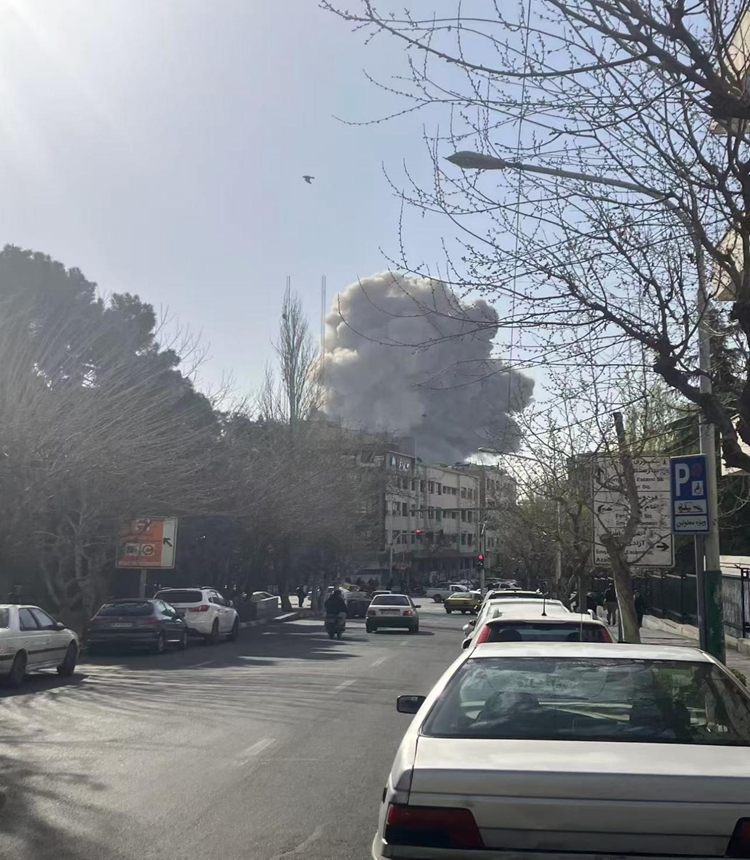
Explosions occurred in the center of Tehran, Iran on Saturday. A Chinese national surnamed Gao takes the photo of the blast.
The US and Israel launched attacks on Iran, with explosions rocking Tehran. Missiles hit University Street and the Jomhouri district, Fars News Agency reported, as smoke billowed across parts of the capital, according to Al Jazeera. Some Chinese nationals in the city told the Global Times that the blast site was just a four- to five-minute drive away from them and that communications were temporarily disrupted.
At the time of the blast, Li Zhe, a Chinese student studying Iranian studies at the University of Tehran, was planning to head to an office near a government building in central Tehran to handle paperwork. Photos he sent to the Global Times showed that the explosion site was only a four- to five-minute drive from where he was, with heavy smoke billowing into the air. Li said he could hear a distinct roaring sound of aircraft but could not determine whether it was a plane or a helicopter, along with several explosions.
Another Chinese student in Tehran, surnamed Gao, who is also studying Iranian studies, said he was on the road at the time and observed the situation near his campus. After the bomb fell, many people immediately ran out of buildings. They gathered in open areas, urgently trying to call their families but phone connections soon became unavailable, and for a period of time communication was completely disrupted.
A Chinese national surnamed Li, who resides in Tehran, told the Global Times that she witnessed the outbreak of the conflict on the spot at a square near the Azadi Tower in Tehran on the day. "A number of muffled booms suddenly rang out on the otherwise normal street, followed by plumes of smoke rising. I simply couldn't believe the war had started at that moment," she said.
She added that many Chinese nationals had been prepared for the escalation of the conflict, as the Chinese embassy had issued repeated warnings through various channels. A large number of Chinese citizens had already returned to China ahead of the Chinese Spring Festival.
Several Chinese students reached by the Global Times said that on Friday, the Chinese Embassy in Iran had issued a security alert. Two or three days earlier, Chinese community associations and chambers of commerce, in coordination with the embassy, had conducted phone outreach and preliminary registration of Chinese nationals in Iran to ensure they remained in contact with the embassy.
On Saturday, the Chinese Embassy in Iran issued a notice on its official WeChat account, urging Chinese citizens in Iran to closely monitor developments, remain calm, stay vigilant, strengthen security precautions, and immediately prepare for emergency shelter if necessary. It advised them not to travel to sensitive locations or crowded areas. In case of emergency, citizens were instructed to report to local police and contact the Chinese embassy or consulates in Iran.
Li Zhe had originally booked a flight to return to China on Saturday evening. Although there had been no official announcement of a full closure of Tehran's Imam Khomeini International Airport, his flight was unlikely to depart or arrive as scheduled.
Gao had also prepared his passport and visa and was making arrangements to return home, but the explosion has complicated his departure plans. While they had stocked up in advance on water and essential supplies. Meanwhile, some Chinese state-owned enterprises and institutions in Iran had already drawn up contingency evacuation routes and plans.
According to several Chinese students, the University of Tehran has announced the suspension of classes, and the Tehran government has asked residents to take shelter nearby. Regarding communications, Li Zhe said that at 2:40 pm on Saturday that calls and internet services using local Iranian SIM cards had been significantly disrupted, and he had to switch to roaming mode to maintain communication.
Gao also mentioned that Iran appears to have experienced an internet outage, with only the roaming function of domestic SIM cards occasionally working.
Gao told the Global Times that due to the prolonged and repeatedly failed high-pressure negotiations between the US and Iran in recent days, the public did not have high expectations for the talks and therefore did not exhibit excessive panic. There has been no noticeable rush to hoard supplies in downtown Tehran. However, the surprise attack still caught everyone off guard. With the holiday approaching, many people had planned to return to their hometowns. If the conflict continues to escalate, it is expected that more residents will choose to leave major cities like Tehran and Isfahan to take refuge in safer areas, such as their hometowns.
Gao added that traffic across Tehran has now descended into chaos, with the streets exceptionally congested. Maps show all roads as heavily jammed, making movement nearly impossible. Meanwhile, GPS positioning in Tehran has also malfunctioned, and communication apps like Snap are largely unusable. There are many people on the streets, mostly heading home or fleeing to the outskirts. Although police and Revolutionary Guard personnel are visible maintaining order on-site, the congestion and chaos show no signs of significant improvement.
RELATED ARTICLES

