US, Israel attacks on Iran show intention for regime change with negotiations likely being ‘cover’; air strikes likely to be main focus at current stage: Chinese experts
By , and Published: Feb 28, 2026 07:23 PM



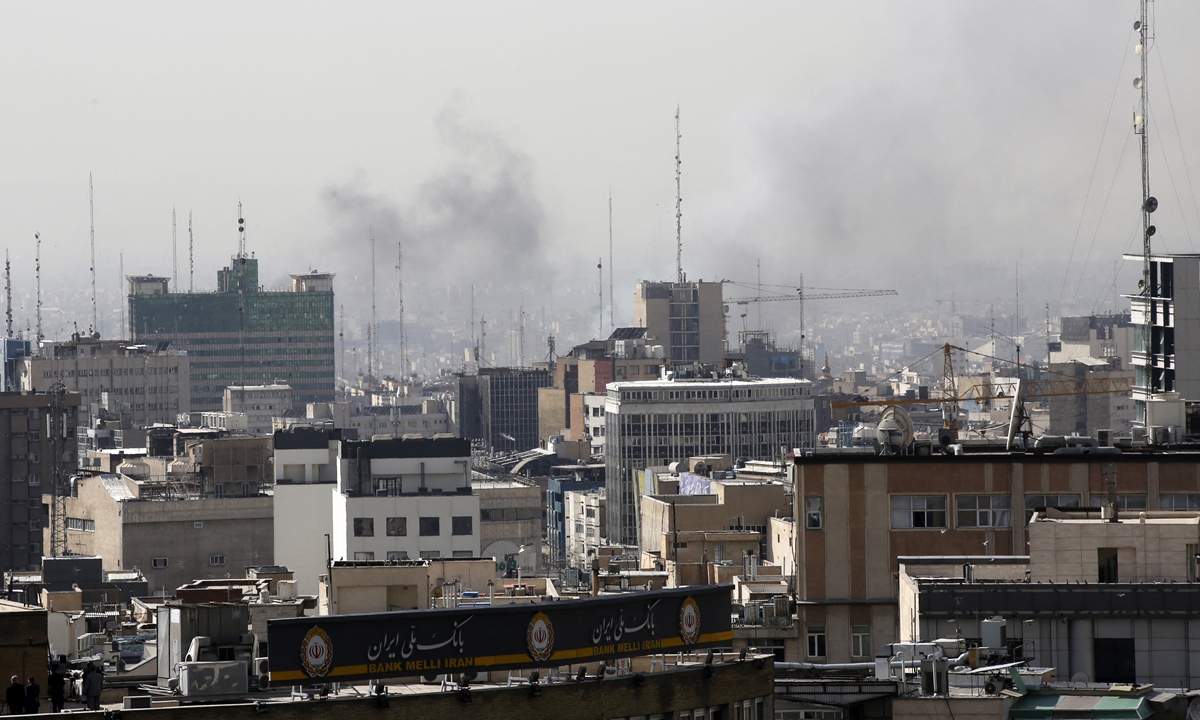
Multiple targets are attacked and an explosion occurs in Tehran, Iran on February 28, 2026. Photo: IC
The US and Israel began a wave of strikes against Iran on Saturday morning, with Iran striking back at Israel and US military bases in the Middle East, according to media reports. Notably, the strikes came amid negotiations between the US and Iran over nuclear weapons. Why the US and Israel launched the strikes amid the negotiations? Militarily, how is the conflict unfolding?
In interviews with the Global Times on Saturday, a Chinese international affairs expert said that the US and Israel's intentions have always been regime change, and the negotiations were likely just a diplomatic cover. Meanwhile, a Chinese military affairs expert said that the US is likely focusing on air strikes instead of ground attacks at the current stage, while Iran will likely focus on deploying missiles and unmanned aerial vehicles in retaliation against Israel and US bases in the region.
Intention for regime change
In a pre-recorded eight-minute video message shared on Truth Social, US President Donald Trump confirmed the strikes and threatened Iran, claiming that Iranians to "take over your government" after the attack.
Almost at the same time, Israeli Prime Minister Benjamin Netanyahu issued a video message in Hebrew after Israel and the US launched a wave of strikes against Iran, saying the operation was launched "to remove the existential threat" posed by the Islamic Republic, and "create the conditions" for Iranians to change their destiny, according to the Times of Israel.
The attacks occurred amid resumed talks between the US and Iran. Trump said on Friday that he was "not happy" about the state of negotiations with Iran over nuclear weapons, according to US media reports.
Liu Qiang, vice chairman and academic committee director of the Shanghai Center for Rimpac Strategic and International Studies and a former deputy defense attaché in Iran, said that US negotiations with Tehran may largely be symbolic, suggesting that Washington's underlying goal remains regime change - an objective he said has persisted across successive US administrations since 1979.
He told the Global Times that without addressing the Iran issue, the US cannot consolidate its influence in the Middle East. Iran's relative diplomatic isolation and internal economic pressures have created what the US administration may have believed to be a rare strategic window, potentially encouraging closer US-Israel coordination on Iran, Liu noted.
In the video, Trump also claimed that the US had "sought, repeatedly, to make a deal" to curb Iran's nuclear program, but alleged that Iran has "rejected every opportunity to renounce their nuclear ambitions."
Ding Long, a professor at the Middle East Studies Institute of Shanghai International Studies University, noted that the current developments echo last June's pattern, when the US first negotiated with Iran as a cover, and then took the opportunity to prepare for an attack on Iran with Israel.
He said the trajectory of the conflict will largely depend on the scale and speed of Iran's response, predicting significant retaliation given Tehran's preparedness. While he said the current round of fighting will surpass previous clashes in intensity, he assessed that the regime change that the US attempts to spark would remain difficult.
According to Ding, negotiations function as diplomatic cover, while military action reflects the underlying strategic intent, which he sees as aimed at regime change. In his assessment, military confrontation may be unavoidable regardless of the outcome of talks or concessions offered by Iran given the US' intentions. Under the current situation, the negotiations would be difficult to continue, Ding noted.
Military goals
The US' strikes against Iran are being carried out by air and sea, and the attacks targeted key military and political facilities in Tehran, the Iranian capital, according to media reports. Strikes have also been reported in the Iranian cities of Isfahan, Qom, Lorestan, Karaj, Kermanshah and Tabriz. The attacks on Tehran have targeted the Ministry of Intelligence, Ministry of Defense, Atomic Energy Organisation of Iran, and Parchin military complex.
Blasts were also reportedly heard near Iranian Supreme Leader Ayatollah Ali Khamenei's offices. Iran's supreme leader Ayatollah Ali Khamenei is not in Tehran, and has been transferred to a secure location, according to CCTV news on Saturday.
In his video, Trump claimed that the US will "destroy their missiles and raze their missile industry," "annihilate their Navy" and "ensure that the region's terrorist proxies can no longer destabilize the region."
Zhang Junshe, a military affairs expert, told the Global Times that by attacking the Iranian Navy, the US likely aims to completely take control of the Gulf region, as the US is well aware of Iran's strength in the Persian Gulf and the Strait of Hormuz.
Zhang said that the main forces currently being deployed involve US fighter jets in the Middle East and those from the two carrier strike groups, as well as Israeli Air Force.
The US deployed up to 12 F-22 fighter aircraft to Israel's southern Ovda airbase this week. The deployment reportedly represents the first time US F-22s have been positioned in Israel in anticipation of real-world combat operations.
Zhang noted that at present, a ground war is unlikely, and the US is unlikely to engage in ground warfare and get bogged down in wars like those in Iraq and Afghanistan. Moreover, given the fact that Iran is a highly mountainous country, airstrikes will be the main means to reduce US casualties.
Zhang said that Iran will likely deploy missiles and unmanned aerial vehicles and may mobilize Axis of Resistance countries such as Syria and forces like Houthis to counterattack Israel and US bases in the Middle East.
RELATED ARTICLES