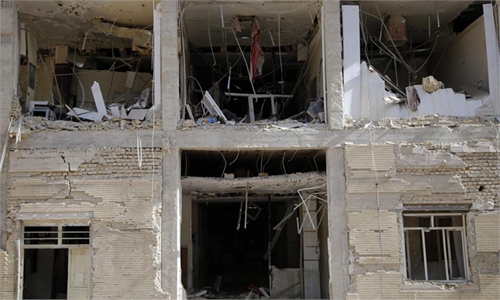
Chinese expert on US, Israeli attacks on Iran: intel plays key role; Iranian missile retaliation executed as planned
By Liang Rui and Published: Mar 01, 2026 06:10 PM

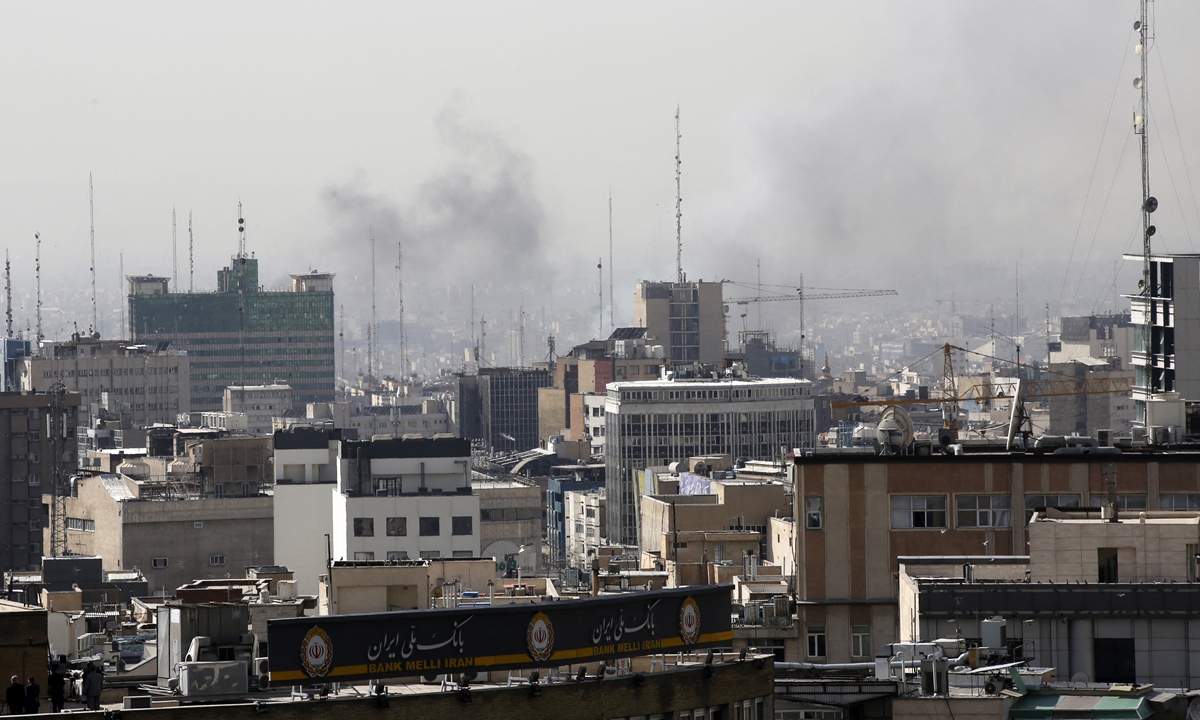
Multiple targets are attacked and an explosion occurs in Tehran, Iran on February 28, 2026. Photo: IC
After Iran's state media confirmed Sunday that Supreme Leader Ayatollah Ali Khamenei was killed in US-Israeli attacks on Saturday, a Chinese military affair expert analyzed the military tactics deployed by the US to the Global Times, noting that the US has amassed forces around Iran and gathered intelligence, before simultaneously targeting Iranian military facilities and top leadership figures in the first wave of attacks. Meanwhile, Iran likely also has pre-planned its counter-strike strategy, launching missile attacks on an unprecedented scale.
In terms of US forces gathered around Iran over the past month, US media outlet the Military Times reported on Friday, a day before the initial strikes on Saturday, that the US built up the largest force of American warships and aircraft in the Middle East in decades.
The aircraft carrier USS Abraham Lincoln and three guided-missile destroyers have been in the Arabian Sea since the end of January. Two weeks later, US administration ordered the world's largest aircraft carrier, the USS Gerald R. Ford, along with three destroyers and more than 5,000 additional service members to head there, said the report.
According to the Military Times, numerous additional US fighter jets and support aircraft also have touched down in the Middle East and bases in Europe. More than 100 fighter jets, including F-35s, F-22s, F-15s and F-16s, left bases in the US and Europe and were spotted heading toward the Middle East.
Wang Yunfei, a Chinese military affairs expert, told the Global Times on Sunday that under the twin objectives of dismantling Iran's highest power structure and its nuclear program, the US had taken the lead in amassing and deploying these forces. Meanwhile, the US and Israel exploited the timing of a meeting convened by Khamenei at his workplace to launch the strike.
"The Supreme Leader of the Islamic Revolution of Iran was martyred at his workplace in the Beit Rahbari (his compound)," Iran's state news agency IRIB's Telegram account said, reported NBC News.
An unsourced Channel 12 news report says Israel, having coordinated with the US, dropped some 30 bombs on Khamenei's compound, and that Khamenei was underground at the location, but not in one of the two deepest bunkers that only US bombs could have penetrated, said the Times of Isreal.
Wang said that Iran was said to have been heavily infiltrated, leaving little room for secrecy, especially regarding the movements and locations of senior leaders. Combined with advanced US electronic surveillance and low-orbit satellite tracking, Washington may have had highly precise intelligence on Khamenei's whereabouts.
The Jerusalem Post said on Saturday that no one knows what Israel's intelligence agency Mossad is doing at this moment, but "there is little question that its agents are, behind the scenes, at the eye of the storm."
The first wave of missile strikes directly targeted the office where he was meeting, with the timing set based on accurate knowledge of his schedule. In addition to Iranian leadership figures, military targets were hit simultaneously, Wang said.
As the US and Israel began a coordinated military offensive against Iran early Saturday, Tehran acted swiftly on its promise to hit back, targeting US interests and allies across the Middle East in a wide-ranging retaliation, according to the New York Times.
Iran's semiofficial news agency Fars reported that Iranian missile attacks had targeted US military facilities, including the Al Udeid Air Base in Qatar, Ali Al Salem Air Base in Kuwait, Al Dhafra Air Base in the United Arab Emirates and the US Fifth Fleet headquarters in Bahrain. Israel, Jordan and Saudi Arabia were also hit in the attacks on Saturday, the New York Times reported.
In addition, some civilian facilities were also hit. In the early hours of Sunday, the Dubai Media Office said four people were wounded in an "incident" at Dubai International Airport - a major transport hub, citing the BBC News.
Wang said that Iran's retaliation was likely pre-planned, as Tehran had previously vowed large-scale revenge if attacked. Since the Iranian side believes that the US and Israel had struck civilian sites including office buildings and schools, its attack on civilian facilities could be reciprocal strikes to impose pressure.
Iran has just raised the stakes by claiming to fire its new "Fattah" hypersonic missile in live combat, with state TV saying it can outrun and outmanoeuvre Western defences, reported Hindustan Times on Sunday.
Iran's strike capabilities and methods have seemingly also improved. Wang said, for example, the Fattah missile travels at extremely high speeds, beyond the interception capacity of THAAD and Patriot systems, with an interception success rate seemly below 30 percent. Most of the targets were fixed and easily located, and this round of retaliation mainly focused on such fixed sites, which cannot be moved and are easier to pinpoint. Target data may have been pre-programmed into the missiles before hostilities began.
The council of the president, the head of judiciary and a cleric member of the powerful Guardian Council will assume the leader's responsibilities in the interim following Khamenei's death, Iranian state media has reported, cited by the BBC News.
Wang said that, overall, the US and Israel forces far surpass Iran militarily and technologically, so heavy damage to Iran is unavoidable. However, Iran's retaliatory capabilities have exceeded expectations, particularly its missile penetration ability.
So far, Iran has launched a large number of missiles possibly more than Washington has anticipated. Its ability to respond rapidly - rather than delaying for days - has also inflicted tangible losses on the US and Israel, Wang added.
A Chinese Foreign Ministry spokesperson said on Saturday that China is highly concerned about the military attacks by the US and Israel on Iran. Iran's national sovereignty, security and territorial integrity should be respected. China calls for an immediate halt to military operations, to avoid further escalation of tensions, to resume dialogue and negotiation, and to maintain peace and stability in the Middle East, the spokesperson said.
RELATED ARTICLES