ARTS / CULTURE & LEISURE
Turning off lights for birds benefits urban ecology
By Published: Mar 01, 2026 07:49 PM


Illustration: Chen Xia/GT
In the age of luminous metropolises, a major park in Shenzhen, South China's Guangdong Province, decides to dim its lights at night for migratory birds. The decision has not sparked public outrage or accusations of poor management. Instead, it has earned broad praise, reflecting a frontier where urban civilization and ecological protection truly complement each other.Recently, some local residents voiced doubts about the Shenzhen Bay Park's "dim and dark" nighttime ambiance. According to the Xinhua News Agency, the official answer was direct and considerate: Dimming or turning off the lights was to protect migratory birds.
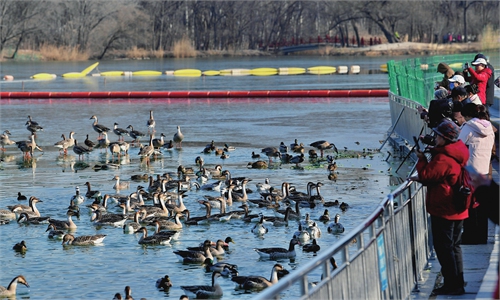
Shenzhen Bay Park lies on the East Asian-Australasian flyway, one of the world's nine vital migratory bird routes. Every winter, tens of thousands of birds stop here during their epic journeys. Too much artificial light not only disrupts the delicate ecological balance, but also interferes with the birds' resting and migration rhythms. In response, Shenzhen's park authorities began to dim lights and restrict night-time illumination.
Far from being a one-size-fits-all shutdown, Shenzhen's approach embodies nuanced, science-based management. Core entrances, transport nodes, and main walkways retain basic lighting for safety, ensuring that residents can still use the park at night while areas crucial to migratory birds are kept dark or softly illuminated. This has been guided by local regulations.
Back in 2023, Shenzhen implemented the nighttime light environment area standard, classifying the mangrove area - a wetland critical for migratory birds - as a highly restricted lighting zone. Stringent limits on light intensity, glare, and skyglow were set, and warm, low-disturbance yellow lighting replaced glaring blue-white lamps.
The Futian Mangrove Ecological Park in Shenzhen is currently home to five species listed as National Key Protected Wildlife, including the Eastern imperial eagle, the black-faced spoonbill, and the small Indian civet. Benefiting from diverse conservation methods, from 2015 to 2023, the number of insect species had risen from 109 to 1,224, while bird species had increased from 83 to 220, Chen Yudong, a staff member with the Mangrove Conservation Foundation who focuses on the protection and biodiversity of wetlands, told the Global Times.
To maintain and improve biodiversity in metropolises like Shenzhen, Chinese environmentalists are exploring the effective application of emerging technologies and analytical methods in biodiversity monitoring, such as bioacoustics, weather radar data, and lighting issues in cities, according to Insights for Cities on Biodiversity, an initiative focusing on how to sustain urban biodiversity published in Shenzhen in September 2024.
Chen said that, during the migratory season, weather radar is being used to analyze and predict the flight paths of bird flocks, informing the implementation of lighting management strategies. This technology can help reduce accidents involving birds colliding with tall buildings or windows, particularly at night.
Perhaps most telling about Shenzhen's experiment is the public response. In response to the official decision to dim the lights, residents and netizens widely express approval, with some calling the move a warm gesture: "Leaving living spaces to wildlife should be firmly supported."
The feedback is not simply about birds; it reflects the elevated ecological consciousness of the public. Increasingly, people realize that more light does not necessarily equate to a more beautiful or livable city. A truly desirable urban environment requires balance - a harmony between illumination and darkness, between activity and quiet.
Dimming lights for nature brings multifaceted rewards. Not only do wild creatures, including millions of birds, benefit from less interference in their natural cycles, but urban residents themselves rediscover the intangible pleasures of tranquility, stars, and genuine rest.
Actually, Shenzhen is not alone. In Lanshan county, Central China's Hunan Province, which also lies on the East Asian-Australasian flyway, it has become a routine to turn off the lights in public places at a fixed time in the evenings from September to November every year. Even ordinary residents dancing in the square voluntarily dim the lights to help the migratory birds find their way, according to the Guangming Daily.
Other cities like Beijing and Chengdu, Sichuan Province, have set up strict nighttime lighting controls. Shenzhen demonstrates how cities can combine unique geography and ecological demands with practicable standards, making "turning off the lights for the birds" not a touching one-off, but a replicable, scalable measure - one that could become a widespread urban consensus as cities across the nation look to curb light pollution and reinforce their green credentials.
As cities continue to expand and modernize, the experience from Shenzhen and other places in China grows more relevant. Urban progress does not have to mean vanquishing every shadow or monopolizing the night with electric glow. Instead, the ideal city will know when to step forward with brilliance and warmth - and when to step back and make space for the needs of nature.
The author is a reporter with the Global Times. life@globaltimes.com.cn
RELATED ARTICLES