IN-DEPTH / IN-DEPTH
A day with foreign legislative information collector: Listening to residents, witnessing true face of grassroots democracy in China
From observers to participants
Editor's Note:
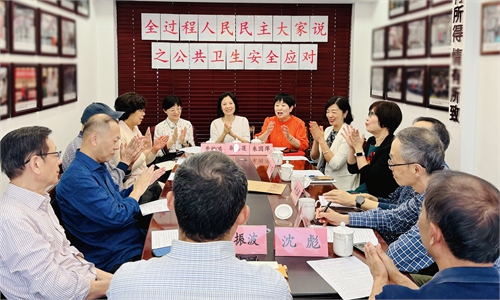
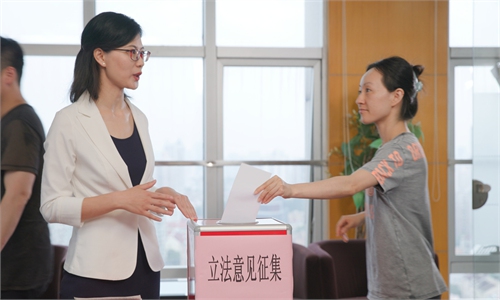
The fourth session of the 14th National People's Congress (NPC) and the fourth session of the 14th National Committee of the Chinese People's Political Consultative Conference (CPPCC) kicked off in Beijing on March 5 and March 4, respectively. As an annual major political event, the national "two sessions" serve as an important platform for national lawmakers and political advisors to build consensus and deliberate on development plans, and a key window for the world to observe whole-process people's democracy in China.
The report to the 20th National Congress of the Communist Party of China clearly states that "primary-level democracy is an important manifestation of whole-process people's democracy." Against this backdrop, the Global Times launched a special series for this year's national two sessions titled "Their Stories with Chinese Democracy," focusing on vivid practices of primary-level democracy. From foreign experts to ethnic minority grassroots officials, from urban communities to rural fields, practitioners of whole-process people's democracy at primary level listen closely to public concerns and carefully sort through and refine suggestions. They translate ordinary people's aspirations and grassroots development demands into proposals and suggestions, which are then brought to the national "two sessions." There, NPC deputies and CPPCC National Committee members conduct in-depth deliberations and promote the formulation and implementation of relevant laws, regulations and policies. This complete cycle of fulfilling duties vividly demonstrates to the world the efficient operation and strong practical capacity of China's whole-process people's democracy.
"Here in China, I can truly feel that the government is listening to the people's voices," Phommavong Pattarada, a young woman from Madagascar whose Chinese name is Liu Xiran, told the Global Times emotionally on a late February afternoon. She was holding a draft of the elderly care service regulations, which she planned to solicit opinions on from residents at the Huanongli community in Southwest China's Chongqing Municipality.
Pattarada is an international student at the Chongqing Polytechnic University of Electronic Technology (CQUET). Last July, she was hired as a foreign legislative information collector (hereinafter information collector) by the grassroots legislative contact point (hereinafter contact point) in the Zhongxinwan community, Shijingpo street of Chongqing's Shapingba district, with the responsibility of reflecting grassroots public opinion. On February 25, a Global Times reporter followed her throughout the day as she collected public opinions, and witnessed a genuine example of China's grassroots democracy.
Chongqing doesn't make foreigners 'stand outside'
In the morning, Pattarada and Yesmaganbet Doshan, another international student at the CQUET from Kazakhstan, arrived at the contact point. After exchanging pleasantries, Pattarada put on a blue uniform, getting herself ready for a community legal education session.
Doshan, whose Chinese name is Dashan, curiously flipped through the legal texts on the table, occasionally checking new words on his phone. It was his first visit to the contact point and his first close contact with China's grassroots legislative work. As a freshman, Doshan had heard from his teacher that legislative suggestions from foreign students could be directly submitted to the National People's Congress. "This surprised and warmed me," he said.
"Familiarizing oneself with Chinese laws is the foundation of the work; every legal education session builds experience," Pattarada told Doshan. She told the Global Times that "The moment I received the appointment letter last year, I felt an unprecedented sense of 'trust' and 'belonging.' Chongqing doesn't make me 'stand outside the door' just because I'm a foreigner. Instead, it told me with an open attitude: as long as you live here, you are the master of this city."
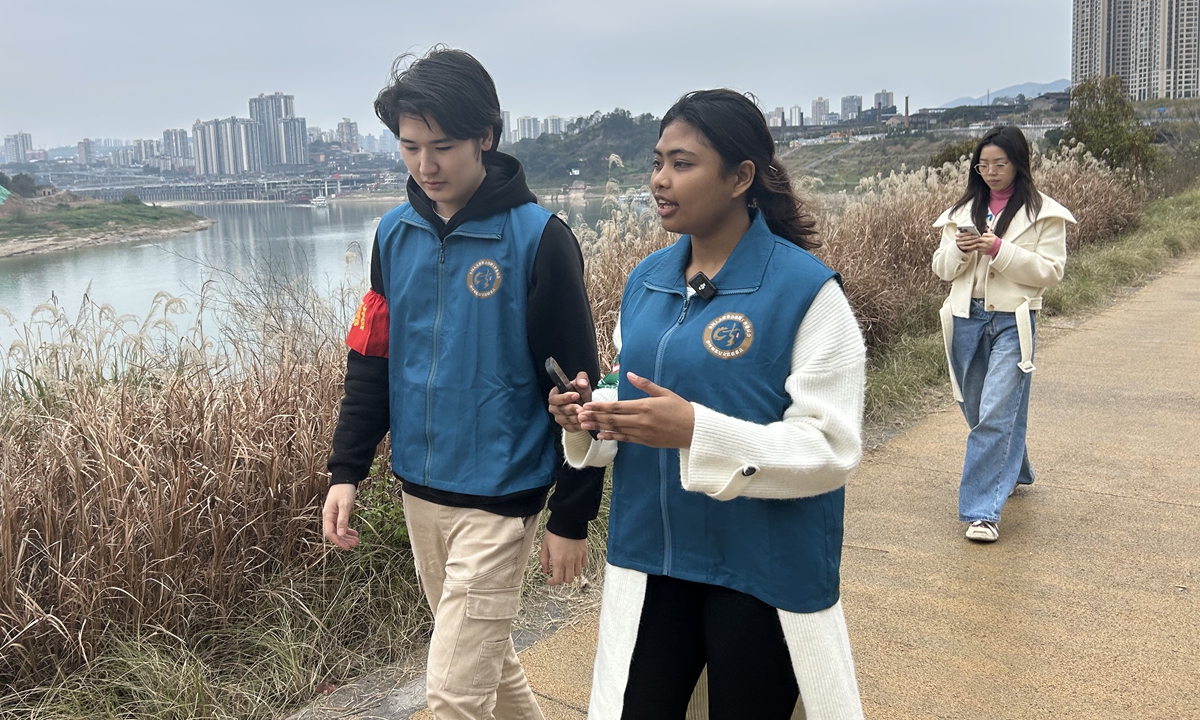
The legal education session that day focused on the Chongqing municipal parking management regulations. After the event, the two followed Feng Yifei, an urban management officer from the Tuanjieba community, to conduct an ecological survey along the Jialing River.
Pattarada noticed many boats on the river and asked Feng "Will this cause pollution?" "Don't worry, there are no sand dredgers or fishing boats on the river. This is our mother river, and we patrol regularly to protect it," Feng explained.
Foreign legislative information collectors have become important "advisors" in China's ecological legislation. Last year, when soliciting opinions on the draft of the country's first-ever environmental code, Pattarada and others paid close attention to the provisions on the River and Lake Chief System, which is a collective term for the river chief system and lake chief system. The system is an institutional innovation in China's ecological civilization construction where leading Party and government officials at all levels serve as river and lake chiefs to organize and lead the management and protection of corresponding rivers and lakes.
Pattarada and others proposed that the code should grant river and lake chiefs actual accountability and disposal powers to solve the problem of some chiefs being "in name only." This suggestion was submitted to related legislative authorities.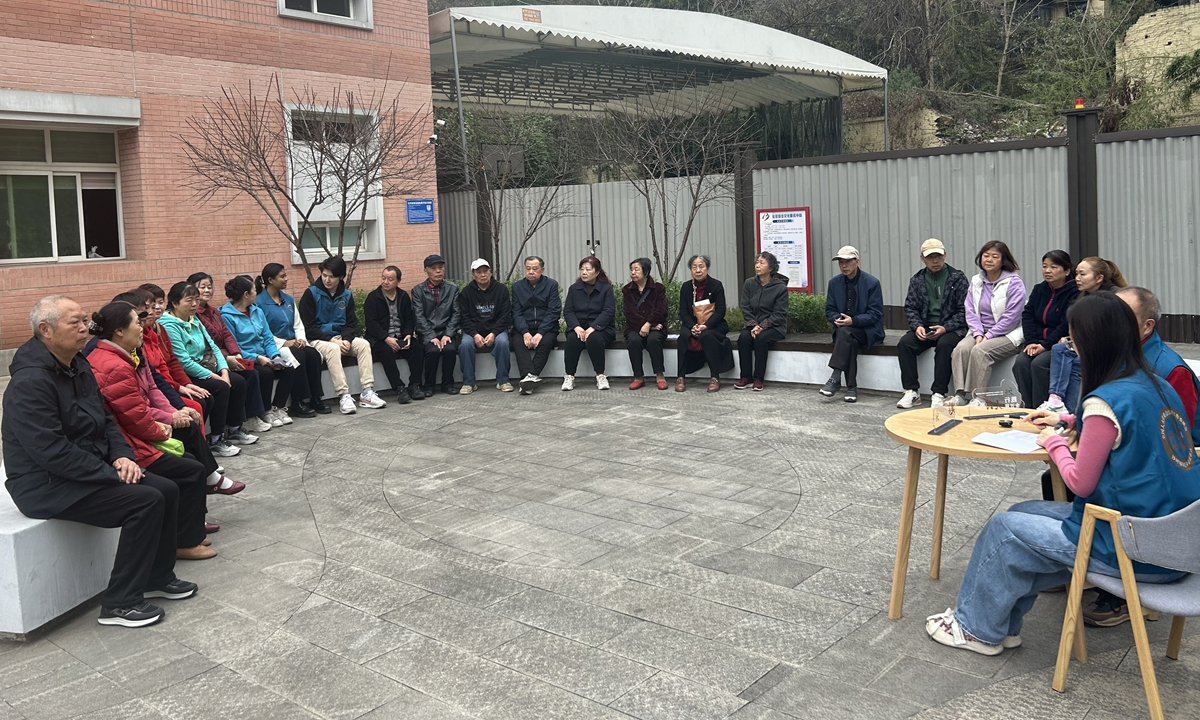
'I will record everyone's opinions'
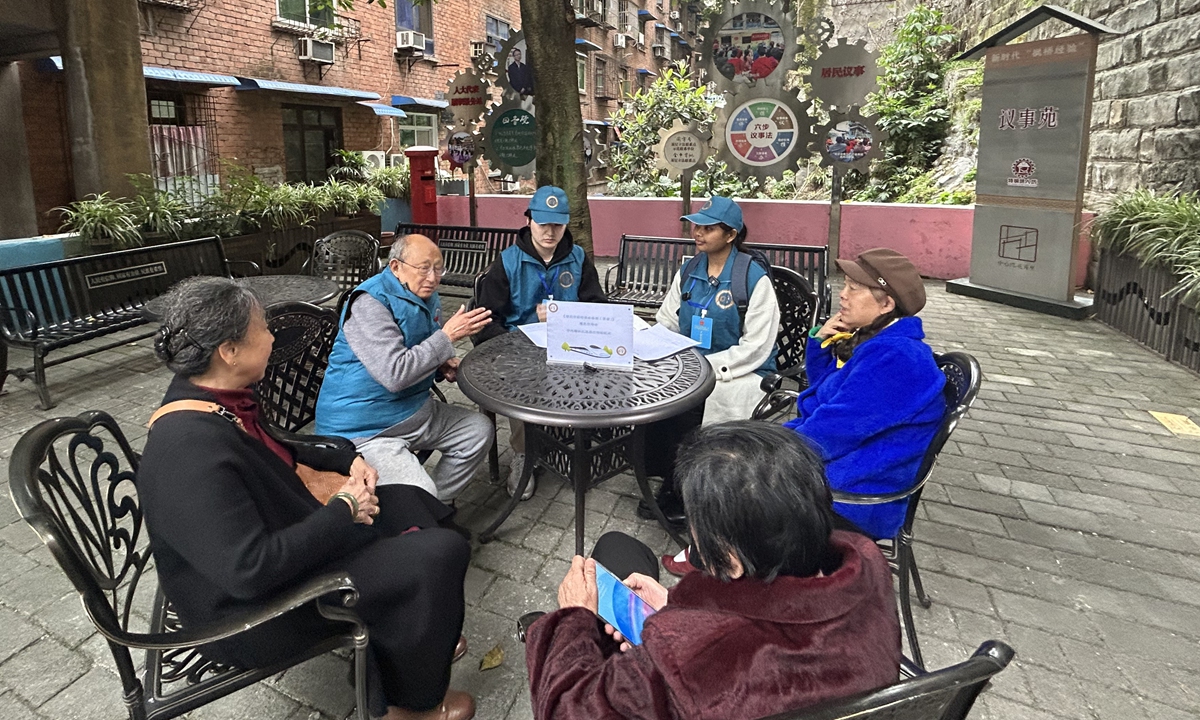
Collecting residents' views on legal drafts is the core work of information collectors. In the afternoon, Pattarada and Doshan entered the Huanongli community with the draft of Chongqing municipal elderly care service regulations. Several elderly people were sitting under a tree chatting. "Are you here to solicit opinions again?" they asked Pattarada. "Today I want to ask everyone about their thoughts on aged care. This is the draft; you can take a look," Pattarada replied.
Clearly, the elderly were very interested in this topic. Everyone walked to the community's discussion center, a place where residents gather to discuss matters. They talked freely about their aged care needs. "The elderly need emotional companionship most. There are many robots in the Spring Festival Gala. I hope the community can arrange for robots to accompany us at home or help with housework," said 73-year-old Heng. Another woman spoke in authentic Chongqing dialect, which Pattarada struggled to understand. Yao Hua, the first information collector at the contact point, noticed Pattarada's struggle immediately and started to translate the Chongqing dialect into Putonghua for her.
Sitting in the middle, Pattarada listened carefully and took notes. "Aged care is a big issue. I will record everyone's opinions. I believe China's aged care system and related laws will continue to improve," she said. Doshan listened with a translation machine and nodded in response from time to time .
In May 2020, a municipal-level grassroots legislative contact point was established at the Zhongxinwan community with a simple and direct intention to help the legislative body listen to the voices of the people. Here, people from all walks of life, including foreign residents, can sit together to discuss public affairs.
These discussions are not "going through the motions" but are aimed at solving practical problems for residents. "Even if it's just a sentence, we will carefully sort out and submit all suggestions," Luo Jie, director of the working committee of the Shijingpo District People's Congress, told the Global Times. Many old problems that have plagued residents for years, such as how to renovate old communities, install elevators, and build aged care centers, have gradually been translated into tangible improvements for residents through the solicitation and promotion of legislative opinions.
"Veterans mentoring new members" is an important model for building the information collector team. In the afternoon of February 25, Pattarada and Doshan met their mentors Huang Xueli and Zhou Geng, a couple who have worked in public opinion collection for many years. "Keep putting forward suggestions. Even if they are not adopted at first, don't lose heart; you will achieve results if you keep going," Zhou said. Huang then asked Doshan if he had the ambition to join. Doshan nodded and said he would step up his Chinese studies.
'We are not afraid of foreigners raising opinions'
Hiring foreign information collectors reflects China's openness and confidence in its legislative system. "We are not afraid of foreigners raising opinions; Instead, we welcome them to provide references for improving our laws from different cultural perspectives," Zhang Yiqing, Party secretary of the Zhongxinwan community in the Shapingba district, Chongqing, told the Global Times. "Democracy is not limited by nationality. As long as you live on this land, your suggestions have the opportunity to reach the national legislative body."
The day's experience let Doshan witness firsthand how China's grassroots democracy operates. "Every Chinese person has the opportunity to participate in formulating and improving national laws and regulations," he said.
Pattarada deeply agreed, saying that she believes China's democratic system is valuable. "At school, we often learn that democracy means the people are the masters of the country. But in some countries, only a few elites are qualified to discuss major issues like legislation. In China, information collectors go to residents to ask for their opinions. This also explains why China has achieved such great development in such a short time," she said.
Pattarada told the Global Times that she told the stories here to her friends in Madagascar. "They were greatly surprised, as this is completely different from what some Western media portray." She added that some Western figures smear China because they do not understand the real China.
Jiang Chunying, a teacher at the CQUET, often leads foreign students to observe residents' deliberation meetings. She told the Global Times that becoming a legislative information collector is a "special pass" for international students to integrate into Chinese society. "Legislative consultation is an excellent window to perceive China's democratic and legal process. They are no longer 'passers-by' in China, but 'participants' in China's democratic and legal development. This experience can help them understand what whole-process people's democracy is better than any textbook."
On February 27, Pattarada told the Global Times that three laws she had helped solicit opinions for would be reviewed at this year's national two sessons.
As night falls, Chongqing's lights shine brightly, and the Jialing River flows slowly, like grassroots voices converging into the broader current of the whole-process people's democracy. The day of Pattarada as information collector is a vivid portrayal of China's democratic and legal development. Here, every voice is heard, every appeal is valued, and everyone can be a participant, witness, and beneficiary of democracy.
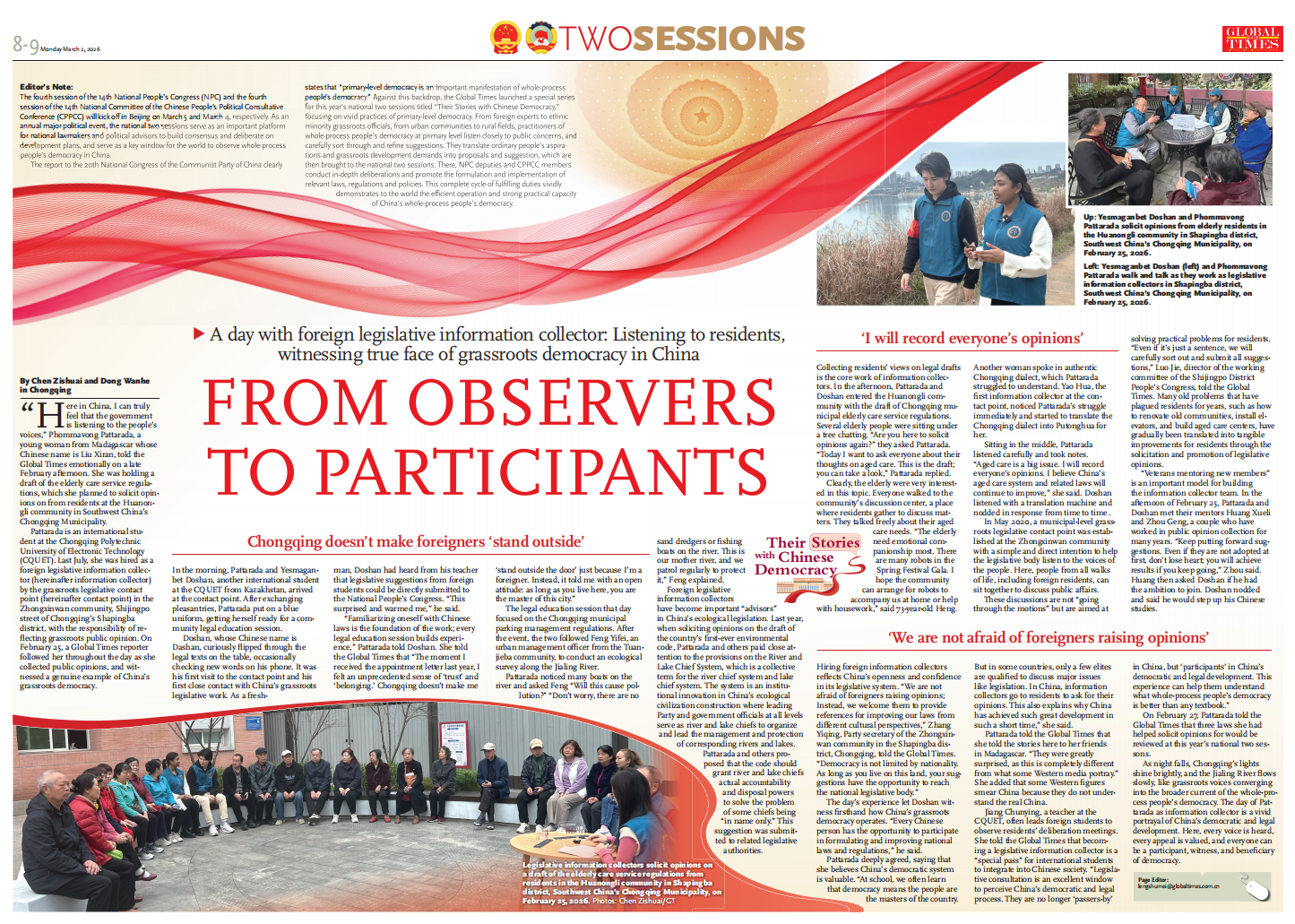
The fourth session of the 14th National People's Congress (NPC) and the fourth session of the 14th National Committee of the Chinese People's Political Consultative Conference (CPPCC) kicked off in Beijing on March 5 and March 4, respectively. As an annual major political event, the national "two sessions" serve as an important platform for national lawmakers and political advisors to build consensus and deliberate on development plans, and a key window for the world to observe whole-process people's democracy in China.
The report to the 20th National Congress of the Communist Party of China clearly states that "primary-level democracy is an important manifestation of whole-process people's democracy." Against this backdrop, the Global Times launched a special series for this year's national two sessions titled "Their Stories with Chinese Democracy," focusing on vivid practices of primary-level democracy. From foreign experts to ethnic minority grassroots officials, from urban communities to rural fields, practitioners of whole-process people's democracy at primary level listen closely to public concerns and carefully sort through and refine suggestions. They translate ordinary people's aspirations and grassroots development demands into proposals and suggestions, which are then brought to the national "two sessions." There, NPC deputies and CPPCC National Committee members conduct in-depth deliberations and promote the formulation and implementation of relevant laws, regulations and policies. This complete cycle of fulfilling duties vividly demonstrates to the world the efficient operation and strong practical capacity of China's whole-process people's democracy.
Yesmaganbet Doshan (left) and Phommavong Pattarada walk and talk as they work as legislative information collectors in Shapingba district, Southwest China's Chongqing Municipality, on February 25, 2026. Photo: Chen Zishuai/GT
"Here in China, I can truly feel that the government is listening to the people's voices," Phommavong Pattarada, a young woman from Madagascar whose Chinese name is Liu Xiran, told the Global Times emotionally on a late February afternoon. She was holding a draft of the elderly care service regulations, which she planned to solicit opinions on from residents at the Huanongli community in Southwest China's Chongqing Municipality.
Pattarada is an international student at the Chongqing Polytechnic University of Electronic Technology (CQUET). Last July, she was hired as a foreign legislative information collector (hereinafter information collector) by the grassroots legislative contact point (hereinafter contact point) in the Zhongxinwan community, Shijingpo street of Chongqing's Shapingba district, with the responsibility of reflecting grassroots public opinion. On February 25, a Global Times reporter followed her throughout the day as she collected public opinions, and witnessed a genuine example of China's grassroots democracy.
Chongqing doesn't make foreigners 'stand outside'
In the morning, Pattarada and Yesmaganbet Doshan, another international student at the CQUET from Kazakhstan, arrived at the contact point. After exchanging pleasantries, Pattarada put on a blue uniform, getting herself ready for a community legal education session.
Doshan, whose Chinese name is Dashan, curiously flipped through the legal texts on the table, occasionally checking new words on his phone. It was his first visit to the contact point and his first close contact with China's grassroots legislative work. As a freshman, Doshan had heard from his teacher that legislative suggestions from foreign students could be directly submitted to the National People's Congress. "This surprised and warmed me," he said.
"Familiarizing oneself with Chinese laws is the foundation of the work; every legal education session builds experience," Pattarada told Doshan. She told the Global Times that "The moment I received the appointment letter last year, I felt an unprecedented sense of 'trust' and 'belonging.' Chongqing doesn't make me 'stand outside the door' just because I'm a foreigner. Instead, it told me with an open attitude: as long as you live here, you are the master of this city."
The legal education session that day focused on the Chongqing municipal parking management regulations. After the event, the two followed Feng Yifei, an urban management officer from the Tuanjieba community, to conduct an ecological survey along the Jialing River.
Pattarada noticed many boats on the river and asked Feng "Will this cause pollution?" "Don't worry, there are no sand dredgers or fishing boats on the river. This is our mother river, and we patrol regularly to protect it," Feng explained.
Foreign legislative information collectors have become important "advisors" in China's ecological legislation. Last year, when soliciting opinions on the draft of the country's first-ever environmental code, Pattarada and others paid close attention to the provisions on the River and Lake Chief System, which is a collective term for the river chief system and lake chief system. The system is an institutional innovation in China's ecological civilization construction where leading Party and government officials at all levels serve as river and lake chiefs to organize and lead the management and protection of corresponding rivers and lakes.
Pattarada and others proposed that the code should grant river and lake chiefs actual accountability and disposal powers to solve the problem of some chiefs being "in name only." This suggestion was submitted to related legislative authorities.
Legislative information collectors solicit opinions on a draft of the elderly care service regulations from residents in the Huanongli community in Shapingba district, Southwest China's Chongqing Municipality, on February 25, 2026. Photo: Chen Zishuai/GT
'I will record everyone's opinions'
Collecting residents' views on legal drafts is the core work of information collectors. In the afternoon, Pattarada and Doshan entered the Huanongli community with the draft of Chongqing municipal elderly care service regulations. Several elderly people were sitting under a tree chatting. "Are you here to solicit opinions again?" they asked Pattarada. "Today I want to ask everyone about their thoughts on aged care. This is the draft; you can take a look," Pattarada replied.
Clearly, the elderly were very interested in this topic. Everyone walked to the community's discussion center, a place where residents gather to discuss matters. They talked freely about their aged care needs. "The elderly need emotional companionship most. There are many robots in the Spring Festival Gala. I hope the community can arrange for robots to accompany us at home or help with housework," said 73-year-old Heng. Another woman spoke in authentic Chongqing dialect, which Pattarada struggled to understand. Yao Hua, the first information collector at the contact point, noticed Pattarada's struggle immediately and started to translate the Chongqing dialect into Putonghua for her.
Sitting in the middle, Pattarada listened carefully and took notes. "Aged care is a big issue. I will record everyone's opinions. I believe China's aged care system and related laws will continue to improve," she said. Doshan listened with a translation machine and nodded in response from time to time .
In May 2020, a municipal-level grassroots legislative contact point was established at the Zhongxinwan community with a simple and direct intention to help the legislative body listen to the voices of the people. Here, people from all walks of life, including foreign residents, can sit together to discuss public affairs.
These discussions are not "going through the motions" but are aimed at solving practical problems for residents. "Even if it's just a sentence, we will carefully sort out and submit all suggestions," Luo Jie, director of the working committee of the Shijingpo District People's Congress, told the Global Times. Many old problems that have plagued residents for years, such as how to renovate old communities, install elevators, and build aged care centers, have gradually been translated into tangible improvements for residents through the solicitation and promotion of legislative opinions.
"Veterans mentoring new members" is an important model for building the information collector team. In the afternoon of February 25, Pattarada and Doshan met their mentors Huang Xueli and Zhou Geng, a couple who have worked in public opinion collection for many years. "Keep putting forward suggestions. Even if they are not adopted at first, don't lose heart; you will achieve results if you keep going," Zhou said. Huang then asked Doshan if he had the ambition to join. Doshan nodded and said he would step up his Chinese studies.
Yesmaganbet Doshan and Phommavong Pattarada solicit opinions from elderly residents in the Huanongli community in Shapingba district, Southwest China's Chongqing Municipality, on February 25, 2026. Photo: Chen Zishuai/GT
'We are not afraid of foreigners raising opinions'
Hiring foreign information collectors reflects China's openness and confidence in its legislative system. "We are not afraid of foreigners raising opinions; Instead, we welcome them to provide references for improving our laws from different cultural perspectives," Zhang Yiqing, Party secretary of the Zhongxinwan community in the Shapingba district, Chongqing, told the Global Times. "Democracy is not limited by nationality. As long as you live on this land, your suggestions have the opportunity to reach the national legislative body."
The day's experience let Doshan witness firsthand how China's grassroots democracy operates. "Every Chinese person has the opportunity to participate in formulating and improving national laws and regulations," he said.
Pattarada deeply agreed, saying that she believes China's democratic system is valuable. "At school, we often learn that democracy means the people are the masters of the country. But in some countries, only a few elites are qualified to discuss major issues like legislation. In China, information collectors go to residents to ask for their opinions. This also explains why China has achieved such great development in such a short time," she said.
Pattarada told the Global Times that she told the stories here to her friends in Madagascar. "They were greatly surprised, as this is completely different from what some Western media portray." She added that some Western figures smear China because they do not understand the real China.
Jiang Chunying, a teacher at the CQUET, often leads foreign students to observe residents' deliberation meetings. She told the Global Times that becoming a legislative information collector is a "special pass" for international students to integrate into Chinese society. "Legislative consultation is an excellent window to perceive China's democratic and legal process. They are no longer 'passers-by' in China, but 'participants' in China's democratic and legal development. This experience can help them understand what whole-process people's democracy is better than any textbook."
On February 27, Pattarada told the Global Times that three laws she had helped solicit opinions for would be reviewed at this year's national two sessons.
As night falls, Chongqing's lights shine brightly, and the Jialing River flows slowly, like grassroots voices converging into the broader current of the whole-process people's democracy. The day of Pattarada as information collector is a vivid portrayal of China's democratic and legal development. Here, every voice is heard, every appeal is valued, and everyone can be a participant, witness, and beneficiary of democracy.
From observers to participants
RELATED ARTICLES