ARTS / CULTURE & LEISURE
Guarding what stands: Beijing enacts new regulations to strengthen protection of Great Wall
Guarding what stands
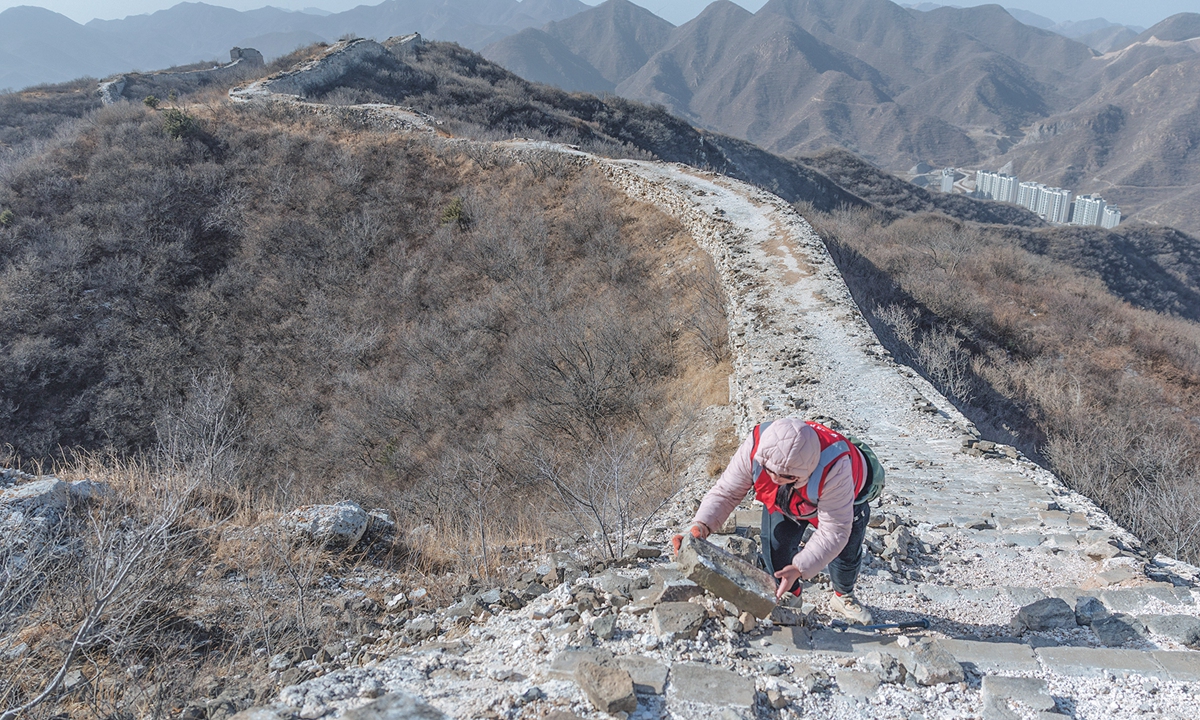
Mei Lanfen, a member of the Great Wall patrol team sorts out bricks along the Shixia section of the Great Wall on February 10, 2026. Photo: Li Hao/GT
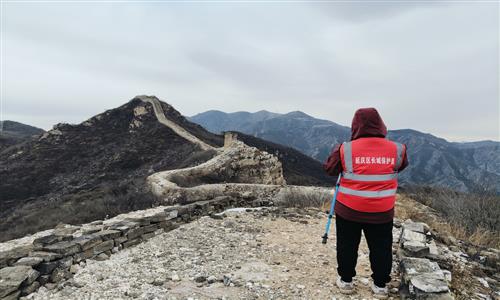
At dawn in Shixia village in Beijing's Yanqing district, Liu Hongyan begins her daily climb along a weathered stretch of the Great Wall.For more than a decade, Liu has worked as a local guardian of the ancient fortification, walking nearly 20,000 steps a day to inspect the masonry, monitor structural risks, clear weeds from stone steps, dissuade unruly visitors and pick up trash scattered along the slopes.
"Before, when we encountered problems, we could only take photos as evidence," Liu told the Global Times. "Now, with the new regulations, our work will be much easier."
Beginning March 1, that work will be backed by the newly enacted regulations on Great Wall protection, the first dedicated regulations in China focused exclusively on protecting the Great Wall.
Passed by the Standing Committee of the Beijing Municipal People's Congress, the regulations define the scope of protection to include not only the wall itself, but also related cultural heritage sites and the surrounding environment.
For Liu and other protectors, the shift marks a turning point - from relying mainly on human patrols to a system strengthened by legal authorities and technology.
Tang Yuyang, a professor at Beijing University of Civil Engineering and Architecture, told the Global Times that the regulations represent an upgrade from measures to formal legislation. "That is beneficial for protection of the Great Wall, regional development and overall planning. Now there is a clear legal basis to follow," said Tang. "It provides legislative norms for the protection, management, utilization and inheritance of the section of the Great Wall in Beijing."
Technology aids preservation
The regulations emphasize the use of technology, including modern tools, digital archives, and digital monitoring, encouraging a more scientific approach to conserving the Great Wall.
In Shixia village, nestled at the foothills of the Great Wall, where the ancient wall winds around the settlement, patrols can be grueling. Summers bring snakes and biting insects, and winters blanket the steep paths in snow and ice. "Our section of the Wall is vast and surrounds the village on three sides, which makes inspections especially difficult," Liu said.
Technology is gradually easing those burdens. The regulations allow district-level cultural heritage departments and Great Wall protection agencies to adopt electronic fencing and other technological tools to warn of climbing risks and deter unauthorized access.
Yu Haikuan, director of the Cultural Heritage Institute of the Yanqing district, told the Global Times that patrolling the Great Wall once depended entirely on human effort; now technology lends a helping hand.
For example, the electronic fence system uses technology to monitor signals from mobile phones and other devices. When someone enters a restricted area, an automated text message or other alert is sent as a warning.
According to Yu, the system not only reduces conflicts between protectors and visitors who attempt to climb unrestored sections, but also enhances the cultural and tourism environment of surrounding villages. Electronic fences can help assess the safety of relics in open areas and pave the way for controlled public access in places like Shixia village.
Beyond human patrols, Li Jing, deputy director of the Great Wall Management Bureau in the Yanqing district, told the Global Times that authorities have introduced drone patrols and satellite monitoring to detect safety risks. Key sections, including Badaling and other well-preserved areas, are now fully covered by monitoring equipment.
"Going forward, we will strengthen both human and technological defenses to implement protection work," Li said.
After decades and hundreds of restoration projects. Beijing now faces the challenge of responding to natural climate change and long-term environmental pressures, according to Tang.
"Preventive protection is even more important," Tang said. "Empowering conservation through technology can shift us from simply 'seeing' problems to truly 'managing' them, ensuring precision and sustainability."

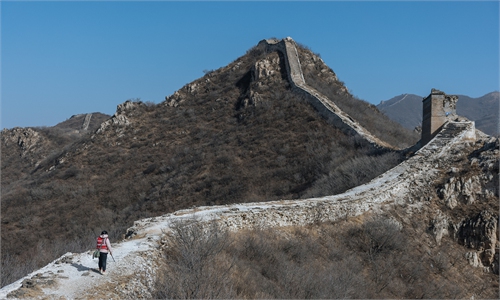
The Jiankou section of the Great Wall in Beijing Photo: VCG
Greater accessThe Great Wall in Beijing spans six districts, namely, Pinggu, Miyun, Huairou, Changping, Yanqing and Mentougou. The Great Wall in Beijing is 520.77 kilometers long and consists of 461 sections, dating from the Northern Qi Dynasty (550-557) to the Ming Dynasty (1368-1644). In 1987, the Badaling section of the Great Wall was inscribed on the UNESCO World Heritage List.
The Wall in Beijing comprises both ancient architecture and archaeological ruins, with the latter accounting for the majority. Protection extends to affiliated relics, surrounding landscapes, traditional customs and the symbiotic relationship between the wall and nearby villages.
Xu Xu, deputy head of Badaling Town in the Yanqing district, told the Global Times that local residents have long depended on the Great Wall for their livelihoods.
"For generations, this region has been organically connected to the Great Wall," Xu said. "Since the regulations were announced, villagers have been learning how to better protect and utilize it to improve their lives."
To guide the public in visiting the Great Wall while protecting cultural relics and ensuring safety, the new protection regulations introduce the concept of designated sightseeing areas. Sections of the unopened Great Wall that meet criteria could potentially be opened to visitors.
Currently, less than 5 percent of Beijing's Great Wall sections are open as scenic areas. The regulations dedicate a chapter to "inheritance and utilization," exploring how access can be expanded without sacrificing preservation, according to Tang.
In the near future, Beijing plans to review its inventory of Great Wall sites. Sections that meet certain conditions, based on preservation status, feasibility of public access, and visitor capacity, could be opened as areas for sightseeing.
RELATED ARTICLES