Intl community should take a clearer and firmer stand in opposing law of the jungle: Global Times editorial
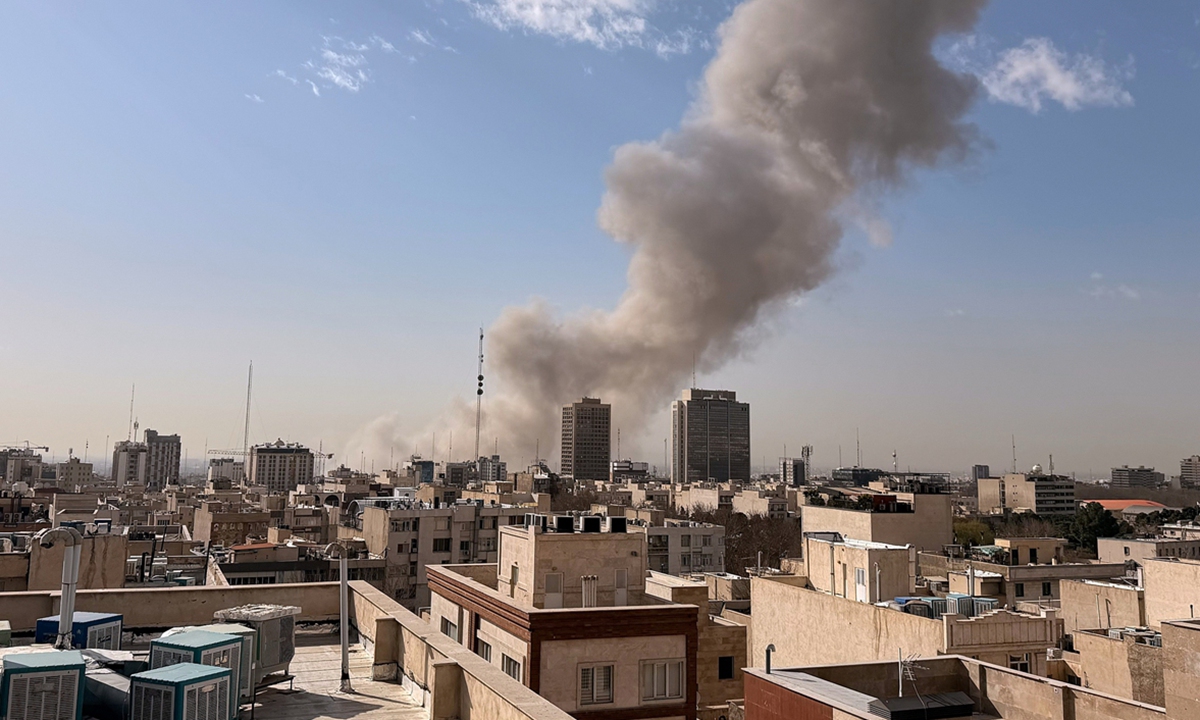
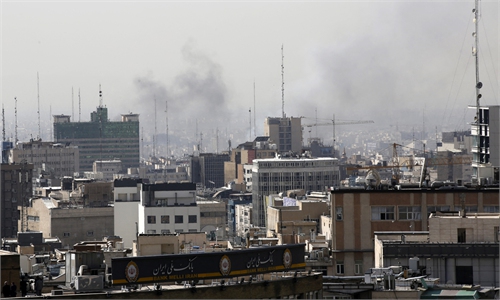
Smoke rises on the skyline after an explosion in Tehran, Iran, Saturday, Feb. 28, 2026. Photo: VCG
The just-concluded weekend saw the US and Israel launch surprise strikes on Iran, resulting in the deaths of Supreme Leader Ayatollah Ali Khamenei and several senior officials. This has plunged the Middle East into a perilous abyss. What is deeply shocking to the international community is that this attack was carried out in the midst of ongoing US-Iran negotiation processes. Many analysts believe Iran was deliberately deceived. Even more unacceptable is that the US and Israel openly killed the leader of a sovereign nation, incited regime change, and then gloated over it as some kind of "achievement." These actions represent a brazen contempt for and trampling of the fundamental norms of international relations.
No matter how meticulously the US and Israel may have planned beforehand, the trajectory of war is never something that can be neatly drawn by human hands. Conflict is like a massive vortex - once drawn in, no one can predict where it will hurl you. History in the Middle East has repeatedly proven this point. The chaos that the US and Israel have created in Iran and across the broader Middle East is very likely the prelude to an even greater tragic upheaval. A British think-tank scholar has warned that this could lead to "instability, migration, radicalism, the proliferation of armed groups, or regional spillover," potentially ushering in "another catastrophic cycle of conflict."
In fact, the reckless actions of the US and Israel have already triggered a chain reaction. The attacks have led to a number of Iranian civilians killed and wounded. The flames of war have spread from Iran and Israel to neighboring countries including Bahrain, Kuwait, the United Arab Emirates, and Qatar. Dubai International Airport has been forced to suspend operations, and thick smoke has billowed from the Burj Al Arab hotel. With the closure of the Strait of Hormuz, global energy supplies and maritime transportation chains are also plunged into uncertainty. The immediate priority - and the broad consensus of the international community - is to halt military operations without delay, prevent the further spread and spillover of the conflict, and stop the situation from spiraling completely out of control.
Most countries hope that the parties involved can quickly find pathways to de-escalation through political and diplomatic channels. They hope to see a critical turning point in the confrontation between the US, Israel on the one side, and Iran on the other - one that, while managing risks, creates conditions for the resumption of dialogue and prevents geopolitical shocks from escalating into broader international economic and security crises.
What this unilateral strike has exposed is a dangerous trend. The US and Israel's attack on Iran is not an isolated "exception"; rather, it is the outcome of a long-standing pattern in which a few countries adhere to the law of the jungle. In the past, the US bypassed the UN to launch wars in Afghanistan and Iraq, arbitrarily imposed unilateral sanctions and long-arm jurisdiction, and left behind endless conflict and suffering in those regions. More seriously, these actions have eroded the UN-centered international system and undermined the basic norms of international relations. More than 20 years have passed, and such unilateral actions have not only failed to disappear but have instead repeatedly emerged, continually leading to new humanitarian crises, which is truly heartbreaking.
Once the law of the jungle finds a breeding ground in today's world and the logic of the survival of the fittest is tacitly accepted, it will become more than just a regional disaster. If "preemptive strikes" can be used as a justification to bypass the UN, ignore diplomatic processes, and casually resort to military action against other countries, then the international system established after World War II, centered around the UN, will be rendered meaningless. Imagine a scenario where unilateral sanctions and military strikes can arbitrarily override the UN Charter, where major powers can disregard civilian lives for their own interests and recklessly ignite regional "powder kegs." The tragedies occurring in the Middle East today could just as easily be replayed in any corner of the world tomorrow, making security for all nations unattainable. The international community should issue a clearer and more definite voice against the regression to the law of the jungle. This should become the strongest consensus of the current international community.
The sudden changes in the Middle East have further highlighted the urgency and extreme importance of promoting reform in the global governance system. It once again confirms that sovereign equality is the cornerstone of global peace, while arrogance and bullying of the weak are the root causes of conflicts and turbulence. A few countries and groups, proceeding from a so-called "position of strength," have engaged in power politics and bullying practices. Such behaviors represent the biggest disruptive factor in today's international order. Why are they so unrestrained? An important reason is that the constraints of the existing international system are too weak. If the international rule of law were more robust, if countries were more proactive in practicing true multilateralism, and if hegemonic actions faced strong international pressure and incurred high political costs, the world would be closer to fairness and justice.
From the collapse of colonial systems to the end of the Cold War, and to the collective rise of countries in the Global South, the multipolarization of the world and the democratization of international relations are irreversible trends of the times. The law of the jungle has no future, and hegemonism is unpopular. The international community needs to unite more closely, uphold justice, defend the rule of law, and practice multilateralism in order to completely eliminate the soil of power politics. The Middle East, which has endured the ravages of war and the vicissitudes of life, yearns for true peace and tranquility.
RELATED ARTICLES