Deputies, members to 2026 ‘two sessions’ depart for Beijing
By Published: Mar 02, 2026 11:38 PM

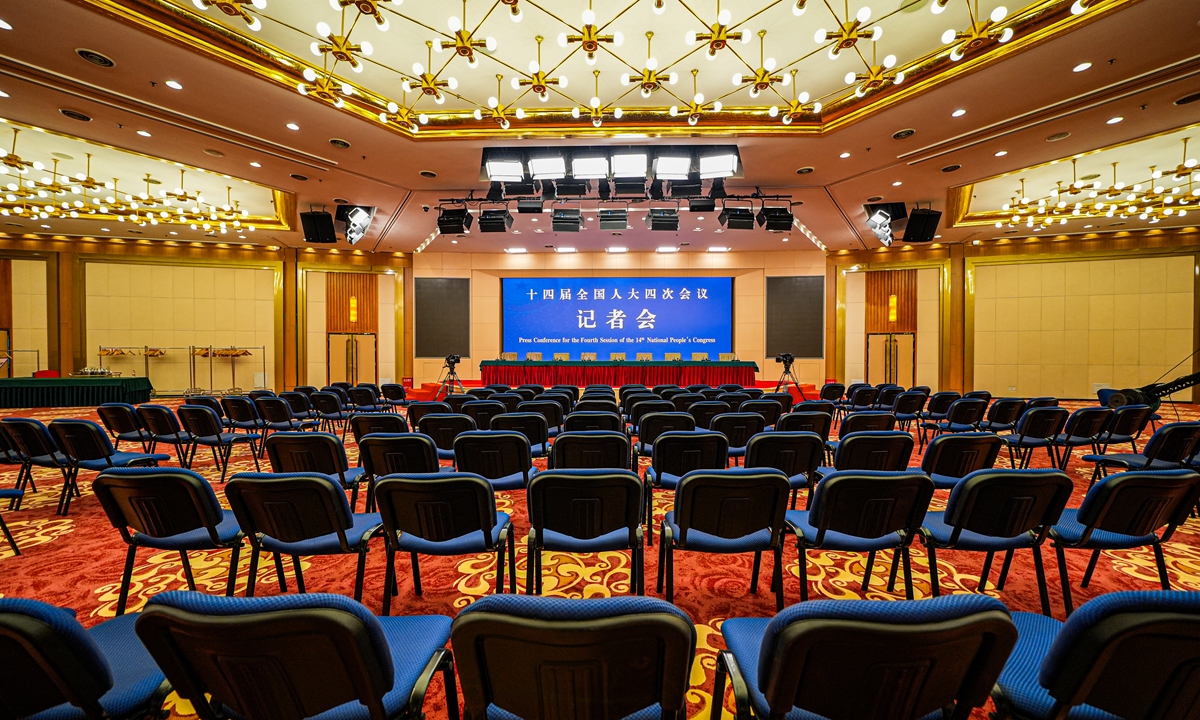
A press center for China's annual sessions of its top legislature and political advisory body, known as the "two sessions," opens on February 27, 2026 at the Media Center Hotel in Beijing, capital of China.
China's annual "two sessions" of its top legislature and political advisory body are gearing up to convene this week. Some provincial deputies to the 14th National People's Congress (NPC) and members of the 14th National Committee of the Chinese People's Political Consultative Conference (CPPCC) gathered in their provincial capitals on Monday to prepare for departure to Beijing.
Before departing for Beijing, deputies and members to this year's "two sessions" - described by some foreign media as one of the year's biggest policy events for China watchers - have reportedly conducted a series of inspections and field visits, gaining a deeper understanding of major projects and key industries driving high-quality economic development in relevant provinces and cities.
These efforts are aimed at better preparing them to offer informed proposals and suggestions at the upcoming sessions, according to media reports.
The fourth session of the 14th NPC and the fourth session of the 14th National Committee of the CPPCC will kick off on March 5 and March 4, respectively, according to the Xinhua News Agency.
The NPC, China's national legislature, will hold a press conference on Wednesday, one day ahead of the opening of its annual session, according to an official statement on Monday.
Ahead of the annual session, NPC deputies based in Xuzhou, East China's Jiangsu Province have carried out in-depth research and widely solicited public opinions focusing on areas such as industrial development, rural revitalization, social welfare, ecological and environmental protection, and coordinated regional development, according to an official statement from the local government. They have drafted a number of targeted and practical proposals and suggestions.
In Southwest China's Chongqing Municipality, NPC deputies visited a local logistics center, industrial park, Changan automobile intelligent experimental center on February 10, and studied and discussed the proposals they plan to submit, according to a local official announcement.
Hong Kong Special Administrative Region (HKSAR) NPC deputy Kenneth Fok, along with other four deputies, plan to submit more than 30 proposals, with over half related to the HKSAR or the Guangdong-Hong Kong-Macao Greater Bay Area, the Global Times learned on Monday.
The proposals cover a wide range of topics, including enhancing Hong Kong's development as an international financial center, innovation and technology hub, shipping center, aviation hub and legal hub; assisting mainland enterprises in using Hong Kong as a gateway to overseas markets; promoting Greater Bay Area integration and deepening Shenzhen-Hong Kong cooperation; improving cross-border transportation; as well as advancing sports development, ensuring food security, and improving the lives of grassroots and vulnerable communities.
These initiatives closely align with the 15th Five-Year Plan (2026-30) to leverage Hong Kong's strengths and contribute to national development.
Foreign media and some overseas think tanks are also closely watching the upcoming "two sessions."
The Wall Street Journal said in an article on Monday that "China's 'two sessions' to shed light on what lies ahead for economy."
"This year's gathering of the NPC and the top political advisory body marks a watershed moment," the Eurasia Review said in an article on Saturday.
It is the official launch of the 15th Five-Year Plan - a blueprint that will carry the world's second-largest economy through 2030, the article noted.
While many observers remain fixated on the headline growth numbers, the real story lies in a fundamental shift of the Chinese economic model: A move away from the era of growth at any cost toward a sophisticated, technology-driven and consumption-led future, it added.
Some of key areas traders and analysts are watching ahead of this year's "two sessions" include technology, as from DeepSeek in early 2025 to a surge in robotic shares, tech stocks have powered China's market rebound, Bloomberg said.
Speaking of the 15th Five-Year Plan, analysts expect the emphasis to remain firmly on industrial upgrading, technological self-reliance, and building what officials call a "strong domestic market," the Straits Times said on Monday.
More than 3,000 journalists, including over 1,000 from China's Hong Kong, Macao, Taiwan and abroad, have registered to cover this year's "two sessions," according to the press center, per Xinhua.
Muhammad Asghar from Associated Press of Pakistan, who is covering this year's "two sessions," told the Global Times on Monday that he will be focusing on China's foreign relations and its role in maintaining peace and stability in the region and world.
"I will be covering the 'two sessions' to show how China strengthens its socialist model with Chinese characteristics, implementing policies that drive the country's economic and social development," Bruno Falci, a correspondent for Latin American media teleSUR, told the Global Times on Monday.
"I will highlight the priorities of the new Five-Year Plan, which has set ambitious goals for innovation, sustainable growth and the well-being of the population. Additionally, I plan to show how these decisions reflect China's strategic commitment to international cooperation, especially with Latin America, expanding trade, investment, and partnerships that bring mutual benefits," he said.
RELATED ARTICLES