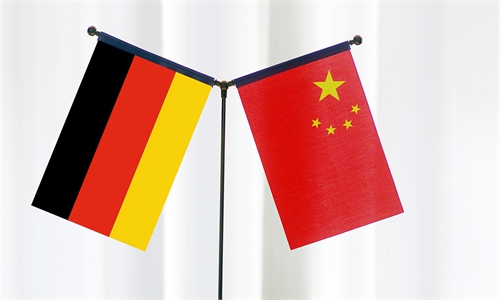
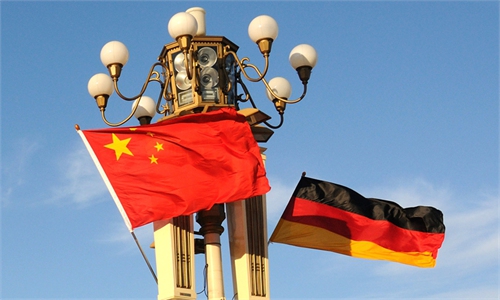
Chinese, German officials exchange views on deepening financial cooperation in video call
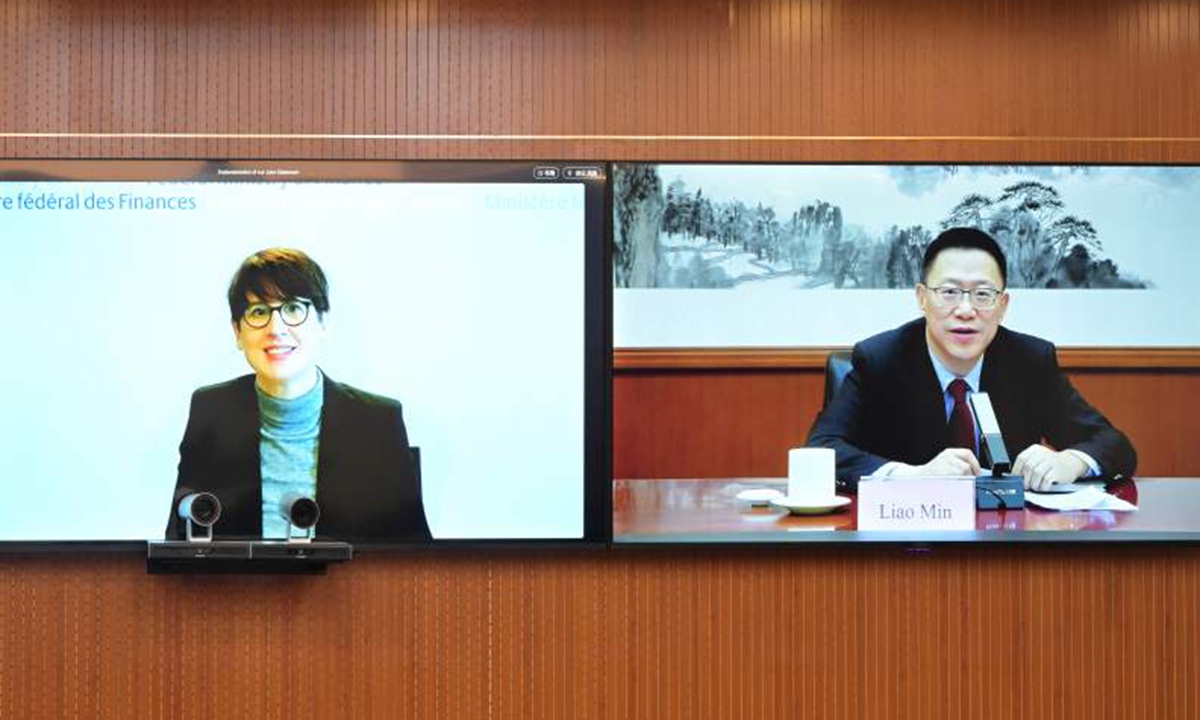
China's Vice Minister of Finance Liao Min holds a video call in Beijing with Jeanette Schwamberger, state secretary of the German Federal Ministry of Finance, at the latter's request, on March 2, 2026. Photo: China's Ministry of Finance
China's Vice Minister of Finance Liao Min on Monday held a video call with Jeanette Schwamberger, state secretary of the German Federal Ministry of Finance, at the latter's request, with the two sides having an in-depth exchange of views on the China-Germany High-level Financial Dialogue and cooperation between China and Germany in the G20 finance channel, China's Ministry of Finance said on Tuesday.This video call served as a continuation of the important outcomes from German Chancellor Friedrich Merz's recent visit to China, reflecting the pragmatic and cooperative relationship between the two countries, a Chinese expert said.
The expert noted that recent positive interactions between China and Germany highlight the importance of consultations on an equal footing in promoting mutual understanding and resolving differences, which will further deepen bilateral economic and trade cooperation and enable the two sides to jointly address global challenges.
According to the Ministry of Finance, Liao said during the video call that German Chancellor Friedrich Merz had successfully concluded his visit to China. China stands ready to work together with Germany to implement the important consensus reached by the leaders of the two countries, enhance communication and cooperation within the framework of the China-Germany High-level Financial Dialogue, and promote sound and steady development of bilateral economic ties, Liao said.
As major global players, China and Germany should strengthen coordination on multilateral platforms including the G20 to jointly tackle global challenges, steadfastly uphold multilateralism and free trade, oppose protectionism, and contribute more to world peace and development, Liao noted.
Schwamberger said that Germany places high importance on its relationship with China, positively evaluates the fruitful results of Chancellor Merz's recent visit to China, and stands ready to further deepen bilateral cooperation in finance and other fields for mutual benefit and win-win outcomes.
As major countries bearing shared responsibility for addressing global challenges, Germany and China have enjoyed sound communication and coordination under the G20 framework. Both sides should continue to advance the G20's greater role in responding to global issues, Schwamberger noted.
The two sides also exchanged views on other issues of respective concern, said the ministry.
"This video call represents a continuation of the important outcomes from Merz's China trip. In just one week, the two sides have transitioned to concrete engagement in the financial and economic domains, vividly demonstrating the pragmatic economic ties between China and Germany," Jian Junbo, director of the Center for China-Europe Relations at Fudan University's Institute of International Studies, told the Global Times on Tuesday.
Jian noted that strengthening bilateral financial and economic cooperation meets the internal demands of both countries' development and serves as a necessary response to the growing unilateralism on the global stage.
"Both sides can enhance collaboration in financial technology, digital finance, and cross-border investment on one front, while jointly advancing 'China-Germany solutions' via multilateral platforms on the other, to foster a more open and free global economic order," Jian said.
After wrapping up his visit to China, Merz delivered a speech saying that Germany "is no longer productive enough" while mentioning China's development model. The video of his remarks in the speech went viral and sparked discussion.
Jian said that Merz's visit gave him a more objective and accurate understanding of China's actual situation and development status. "This fully demonstrates the great importance of mutual visits between the two countries, which are a key pathway to enhancing mutual understanding and reducing misjudgments," the expert noted.
Referring to the prospects of the China-Germany economic relationship, Jian said that as German industry is under pressure to transform, bilateral economic ties will feature a combination of deep cooperation and fierce competition, from traditional areas including auto manufacturing to emerging industries such as artificial intelligence and humanoid robots.
"Cooperation is driven by economic complementarity and mutual interests, while competition results from structural shifts and geopolitical-economic pressures," Jian said, noting that through frank dialogues and exchanges, both sides can achieve "competitive coexistence" — deepening practical cooperation while managing differences to achieve mutual benefit and win-win results.
RELATED ARTICLES