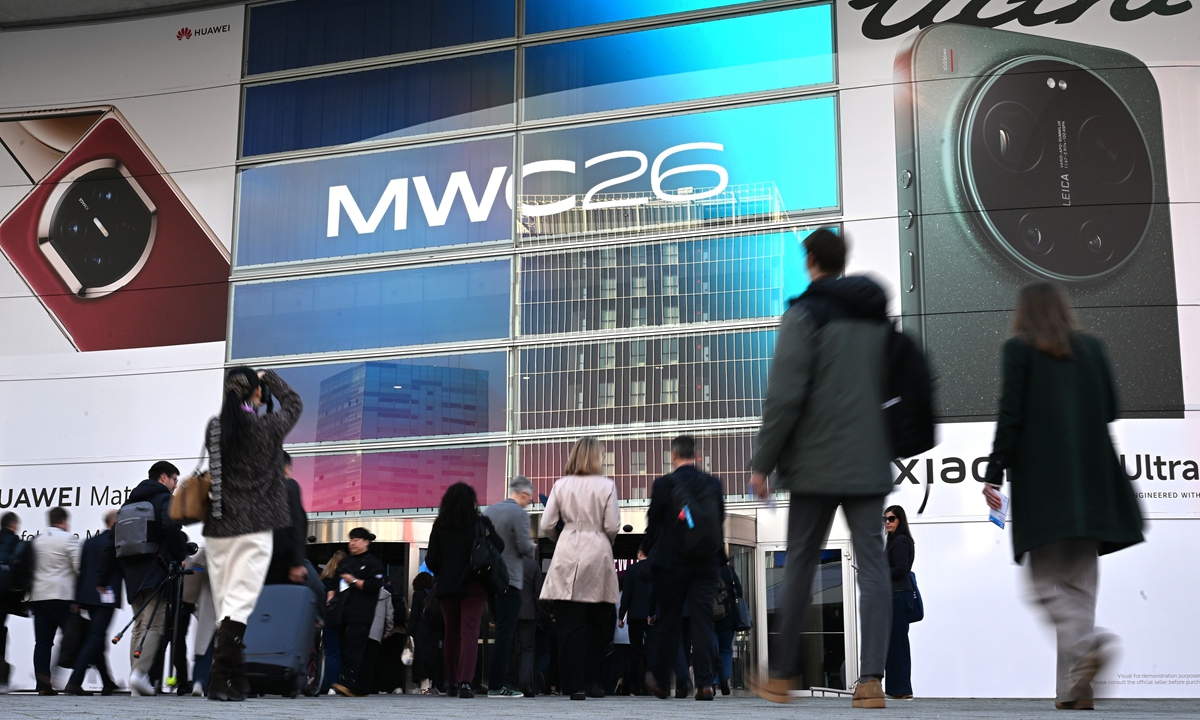
Visitors to the Mobile World Congress (MWC) go to the entrance on March 2, 2026. The global mobile communications industry showcases its latest products and services at the MWC in Barcelona, Spain. Photo: VCG
As the global tech community turned its attention to the Mobile World Congress (MWC) in Barcelona from Monday to Thursday, artificial intelligence (AI) once again took center stage, with Chinese exhibitors delivering a particularly remarkable show.Data from MWC 2026 shows that the number of Chinese exhibitors at this year's event surged from 288 last year to more than 350, covering the entire industrial chain including communication operations, equipment supply, terminal manufacturing, and core components, Science and Technology Daily reported.
The three major Chinese operators - China Mobile, China Telecom, and China Unicom - all made appearances. Infrastructure manufacturers such as Huawei and ZTE focused on intelligent solutions, while terminal manufacturers such as HONOR and Xiaomi brought the latest explorations in AI hardware, the China Securities Journal reported on Wednesday.
Collectively, these innovations centered on industrial application reveal that the real key to unlocking the dividends of the AI era lies not in how dazzling the technology is, but in the extent to which it can be translated into tangible productivity.
A profound shift is underway in the global focus on AI. There was a time when the pursuit of technological sophistication became an obsession, with the scale of computing power and algorithmic complexity touted as the only metrics for AI progress. However, the dividends of the AI era have never been technological achievements confined to laboratories; they emerge from deep integration with the real economy and widespread industrial application. The true key to unlocking AI's potential lies in translating advanced algorithms into productive efficiency, channeling intelligent capabilities into development momentum, and - most critically - equipping developing nations with the means to accelerate industrialization and pursue leapfrog growth.
In this direction, Chinese tech companies have consistently adhered to an application-oriented approach, forging a pragmatic and innovative path. MWC 2026 served as a vivid showcase.
For instance, building on its long-term commitment to human-centric AI, HONOR launched Robot Phone at the MWC 2026, a bold exploration of embodied intelligence and a new species of smartphone that reimagines how future AI devices could integrate motion and spatial awareness.
Beyond HONOR, domestic brands such as AgiBot and Alibaba's Qwen also showcased the diverse applications of AI in terminal devices. Meanwhile, companies such as Huawei and ZTE continued to advance infrastructure and intelligent solutions, while operators such as China Mobile steadily strengthened the computing power base. Through these concrete efforts, Chinese enterprises are demonstrating a viable path for AI to empower industries and enhance people's livelihoods, contributing Chinese wisdom and strength to the global effort of sharing opportunities in the AI era.
The application-oriented path taken by Chinese companies holds significance for many developing nations that extends far beyond technology. Historically, technological revolutions led by developed countries have often solidified their first-mover advantages, leaving latecomers behind due to weak infrastructure and insufficient technological accumulation. This is the deeper context behind the challenge of the digital divide in the AI era.
For latecomer nations seeking to catch up in this transformative era, a feasible path is gradually coming into focus: rather than repeating the long, arduous climb of traditional industrialization, they can strive for developmental "leapfrogging" by directly embracing intelligent applications. This is precisely the possibility revealed by the practices of Chinese companies.
That promise, however, rests on a broader foundation. Emphasizing an application-oriented approach does not mean denying the value of basic research. A healthy AI innovation ecosystem ultimately needs to strike a balance between basic research and application implementation. The products showcased by Chinese enterprises at this year's MWC demonstrate a pragmatic attitude: they neither blindly pursue the myth of computing power, nor ignore the importance of underlying technological innovation.
Instead, they take solving practical problems as the criterion, flexibly integrate various technological resources, and make technology serve industrial needs. This balance reminds us that the key to unlocking the dividends of the AI era lies not in taking sides in an either-or manner, but in aligning technological evolution with industrial needs, making intelligent algorithms a real productive force for improving the general well-being of humanity, and ensuring that AI dividends benefit everyone.
RELATED ARTICLES