‘Two sessions’ serve as important window for understanding China’s governance: Global Times editorial
Listen
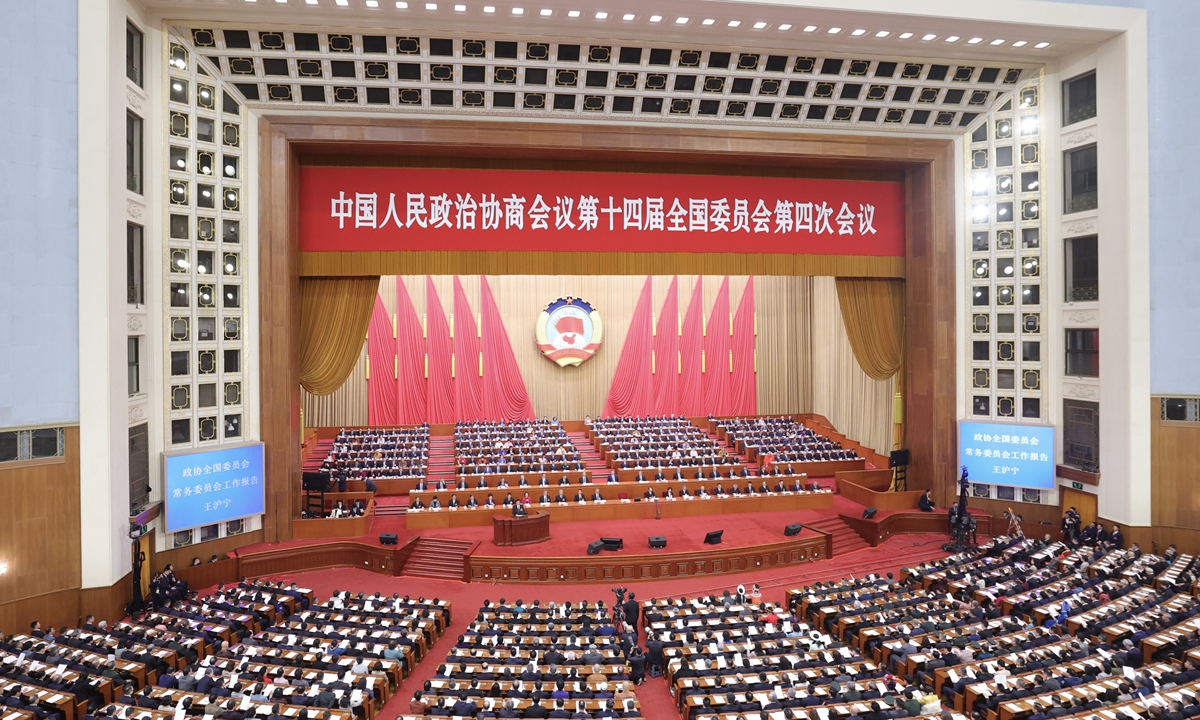
The opening meeting of the fourth session of the 14th Chinese People's Political Consultative Conference (CPPCC) National Committee is held at the Great Hall of the People in Beijing, March 4, 2026. Photo: cnsphoto
The fourth session of the 14th National People's Congress (NPC) will open in Beijing on Thursday. BBC reported that the "two sessions" - China's annual sessions of the NPC and the National Committee of the Chinese People's Political Consultative Conference (CPPCC) - are an important window for observing the trends in China's politics and economy. The "two sessions" also provide an important window into how China's system operates. Through them, the world can see how a major country with over 1.4 billion people aggregates diverse social demands into national policies and transforms broad public opinions into political consensus and effective governance actions.
In today's world, grasping the true meaning of democracy is no easy task. "Democracy is not an ornament to be used for decoration; it is to be used to solve the problems that the people want to solve." To judge whether a country is democratic, one should assess whether the people have broad and sustained channels for participation, and whether effective governance is achieved behind the procedures. Jean Pegouret, president and founder of the Saphir Eurasia Promotion agency, said that the "two sessions" represent an example of democratic governance for the rest of the world.
A distinctive feature of China's whole-process people's democracy is that it consistently sets solving practical problems as the goal of institutional operations, ensuring decision-makers always hear the people's voices, fully incorporate them into concrete policies, and continuously generate feedback and improvements within the institutional framework. In this sense, the reason why China's whole-process people's democracy is characterized as "the most extensive, most genuine, and most effective" is precisely because it unifies process-oriented and results-oriented democracy, procedural and substantive democracy, direct and indirect democracy, as well as people's democracy and the state's will - forming a comprehensive, all-encompassing, and fully covered institutional system that opens up new horizons for the development of human political civilization.
From a global perspective, China's "two sessions mechanism" represents a unique political institutional arrangement. The system of the NPC is a great institutional creation of the Communist Party of China, emerging organically from China's historical traditions, social structure, and development needs. It is China's fundamental political system.
The system of the CPPCC serves as a key institutional form of socialist consultative democracy with Chinese characteristics.
This mechanism embodies both electoral democracy and consultative democracy. It reflects both democratic centralism and broad social participation. Through legally prescribed procedures, the system of people's congresses makes decisions on major national affairs. Deputies to people's congresses at all levels come from different ethnic groups, sectors, social strata, and political parties, giving the system broad representativeness and making it an important channel for expressing the overall interests and social demands of the people. The CPPCC, through sector-based consultations, maintains extensive connections with people from all walks of life, enabling views from different groups and fields to be fully expressed.
China is a vast country with complex conditions. Finding the "greatest common ground" in the interests and needs of the broadest masses is by no means an easy task. In China's political system, the leadership of the CPC, the people's status as masters of the country, and ruling the country by law on all fronts are organically unified, and the "two sessions" serve as a concrete embodiment of this unity. On the one hand, the "two sessions" provide an important channel for the people to express their views and participate in national governance. On the other hand, they integrate the Party's leadership with people's democracy, enabling the Party's proposals to be transformed into national laws and public policies through legal procedures. In this process, the national "two sessions" are able to properly consolidate opinions from all sides, pool social wisdom, and form a shared will to advance national development.
In today's turbulent and changing world, the practice of China's whole-process people's democracy carries important civilizational significance. It demonstrates that democracy does not have a single model; different countries can explore political systems suited to their own history, culture, and stage of development. The development of socialist democracy with Chinese characteristics has not only advanced the modernization of China's national governance system but also provided new experiences for enriching and developing human political civilization, making important contributions.
China's "two sessions" are also showing to the world: they show how people participate in the entire process of national governance through institutionalized channels. Today, "China's governance" is universally recognized worldwide, carrying far more weight than any amount of preaching.
Irfan Ashraf, a journalist with Pakistan's SAMAA TV, currently covering the "two sessions" on site, expressed particular interest in China's people-centered development concept and the ways in which other countries can adapt these experiences for the well-being of their own populations.
This year marks the inaugural year of its 15th Five-Year Plan (2026-30) period. Successfully convening the national "two sessions" holds important and far-reaching significance for effectively carrying out the work this year and even over the next five years, for planning and fulfilling the main phased goals and tasks of socio-economic development, and for laying a solid foundation and accumulating strength to basically achieve socialist modernization. By understanding the "two sessions," countries around the world will gain a deeper understanding of the essence of China's governance.
RELATED ARTICLES