China sets 4.5–5% GDP growth target for 2026; range 'allows policy flexibility,' signals commitment to stable growth despite global headwinds: experts
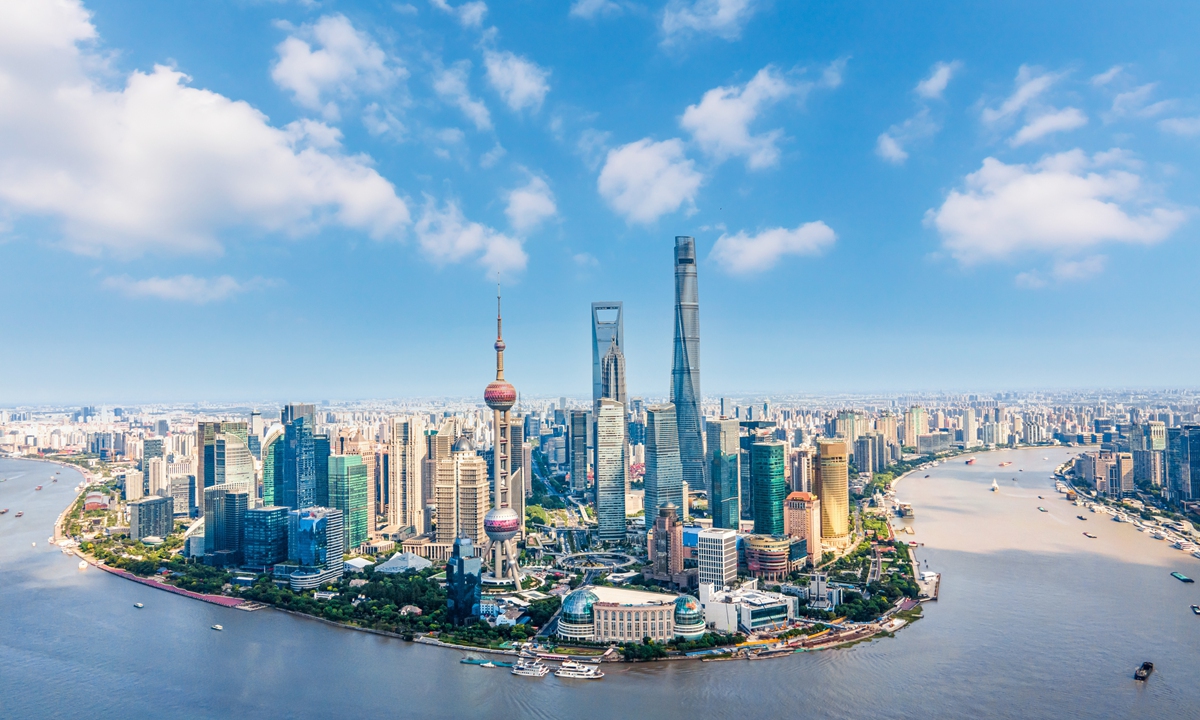
A view of the Lujiazui area in Shanghai Photo: VCG
China targets an economic growth of 4.5 percent to 5 percent this year and will strive for better in practice, according to a Government Work Report submitted Thursday to the country's top legislature for deliberation.
Analysts said that the target range reflects a more prudent assessment of global uncertainties, and allows greater policy flexibility to focus on the high quality development while still signaling policymakers’ commitment to maintaining stable growth in the world's second-largest economy amid rising global risks and turmoil.
The annual growth target was unveiled in the Government Work Report delivered by Premier Li Qiang to the National People's Congress (NPC) for deliberation, as the national legislature opened its annual session on Thursday morning.
This will lay a solid foundation for achieving the goal of doubling China's 2020 per capita GDP by 2035 to reach the level of a moderately developed country, the report said.
In addition to the GDP growth target, the Government Work Report also revealed a slew of other development targets, which include a surveyed urban unemployment rate of around 5.5 percent; over 12 million new urban jobs; an increase in consumer price index of around 2 percent; growth in personal income in step with economic growth; a basic equilibrium in the balance of payments; grain output of around 700 million tonnes; and a drop of around 3.8 percent in carbon dioxide emissions per unit of gross domestic product.
The deficit-to-GDP ratio, another closely watched figure, is set at around 4 percent for 2026, with the total government deficit at 5.89 trillion yuan, 230 billion yuan more than last year.
As 2026 marks the inaugural year of China's 15th Five-Year Plan period (2026-30), this year's "two sessions" served not only as an important window into China's macroeconomic policies, but also as a foundation for the country's development blueprint for the next five years, analysts said.
NPC deputy Yu Miaojie, president of Liaoning University, told the Global Times on Thursday that to ensure the Chinese economy gets off to a good start in the inaugural year of the 15th Five-Year Plan period, it is of paramount importance to pinpoint new growth engines and maintain stable and sustained economic growth.
A growth target of 4.5 percent to 5 percent allows greater policy flexibility, enabling localities to focus on high-quality economic growth as their primary goal and, more importantly, place greater focus on people's livelihoods, Yu said. “Maintaining an annual economic growth rate within this range reflects the ‘stability’ of China's economy.”
Amid escalating geopolitical conflicts and growing global turmoil, China's economy has maintained stable and sustained growth, driven by the country's economic resilience and social stability, Yu said, noting the steady track record of economic growth in the past several years.
Denis Depoux, global managing director of strategy consulting firm Roland Berger, told the Global Times on Thursday that it is crucial to understand that this “growth consensus” is not a sign of weakness.
“In the context of rising global uncertainty, the growth target creates fiscal and political buffers for China to drive the reform and address the real problems without the pressure of chasing high growth at all costs. It allows for a significant reallocation of capital away from inefficient investments and toward the real needs of the economy, namely technology and people,” Depoux said, adding that engaging with the “China Speed” and its dynamic ecosystem is an opportunity for multinationals to capitalize on a strategic advantage.
RELATED ARTICLES