Foreign netizens marvel at China's superior map apps, citing advanced functions, user experiences and ecosystem
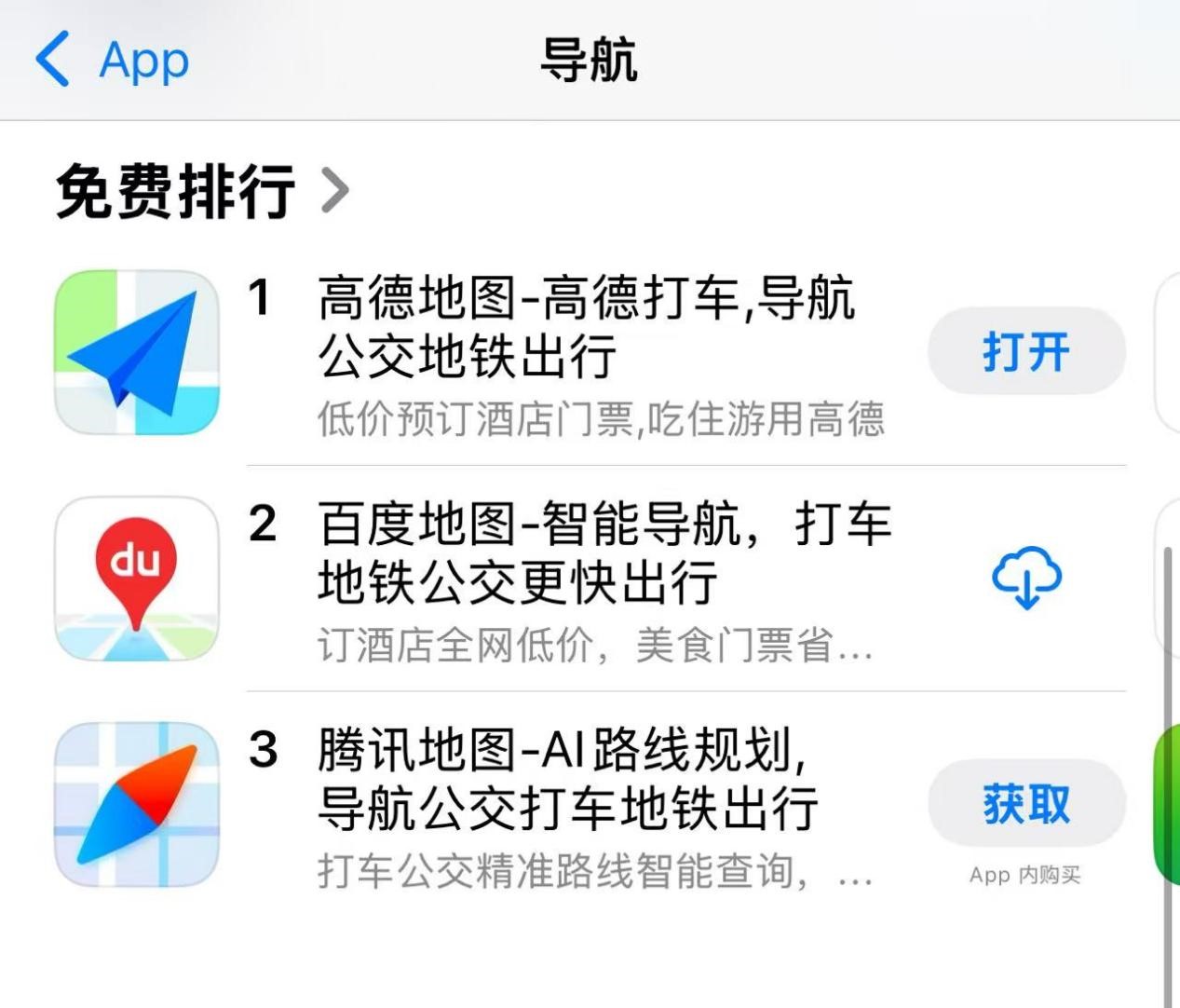
Screenshot of the apps of Amap, Baidu Maps and Tencent Maps
A growing number of foreign netizens are praising Chinese navigation and positioning apps such as Amap, Baidu Maps and Tencent Maps for a set of features and integrations, noting that China's digital infrastructure has created consumer technology experiences that increasingly diverge from — and in some respects surpass — those available in Western markets.
Indian tech blogger Noah Cat, who has about 20,000 followers on X, sparked widespread discussion with a post that has garnered over 1.5 million views as of press time on Thursday. "Forget Apple Maps and Google Maps, these Chinese maps literally show how much of your route is covered by shade — not just shade either, it tells you whether it's from buildings or trees this is such a clever feature and a lifesaver for pedestrians and cyclists," he wrote in the post.
The shade-routing function is only one of several capabilities that foreign users describe as borderline "clever." Other widely praised functions include lane-change notifications on highways, live countdown timers for traffic lights, and real-time bus tracking that shows a vehicle's exact location and an accurate estimated time of arrival.
X user Vin Asia demonstrated a "green wave" function developed by a Chinese map app that calculates the optimal average speed to maintain so a driver can pass consecutive green lights. "On streets with a lot of traffic lights, they even tell you the average speed to maintain to catch all green lights, you can see here I have already passed 4 in a row, it's like a game," read the post.
Behind these innovations lies a formidable technical infrastructure. Some online observers said the visible superiority of Chinese map apps is less about a single clever feature and more about an ecosystem advantage.
"It is fascinating — and it shows how much mapping is really an ecosystem game, not just an app," an X user named TULGAR CAPITAL wrote in a lengthy post.
In China, Amap and Baidu Maps sit on top of dense urban data, massive real-time user volume, tight public transit integrations, and BeiDou Navigation Satellite System precision. That combination enables lane-level guidance, traffic-light countdowns, bus tracking, and hyper-granular routing, according to the X user.
"The broader takeaway isn't just that Chinese maps are good. It's that infrastructure + scale + vertical integration create step-function differences in user experience. And those advantages are extremely hard to replicate outside their native environment," he said.
Another X user, Arnaud Bertrand, pointed out that three elements explain the edge: a hyper-competitive ecosystem of data-surveying firms, the massive user base that fuels superior real-time data, and BeiDou positioning, which he said outperforms Western GPS in precision.
"All these advantages give China an immense advantage in enabling autonomous driving domestically," the user wrote in a post.
The "user-centric" concept of Chinese digital software is what appears to draw many foreign netizens to praise Chinese mapping apps, Wang Peng, an associate research fellow at the Beijing Academy of Social Sciences, told the Global Times on Thursday, noting that the features of Chinese mapping applications have evolved from simple "route guidance" to "real-world simulation," tackling real-world complex problems.
Features such as shade recognition and sudden braking alerts in Chinese mapping apps represent not isolated technological breakthroughs, but rather a concentrated display of systems engineering capabilities, said Wang, adding that this reflects how Chinese enterprises focus their R&D efforts on diving deep into specific usage scenarios, aiming to meet customers' needs and addressing pain points in people's daily commutes.
Beyond technology, the reason behind the growing popularity of Chinese mapping apps is also likely related to the growing number of foreign visitors in China under the visa-free policy: as inbound travel has been made more convenient, many foreign visitors have firsthand experienced mapping app features supported by the BeiDou Navigation Satellite System and other Chinese technologies, and this "better‑than‑expected" convenience has spread spontaneously on overseas social media, according to Wang.
RELATED ARTICLES