Draft environmental code, two other draft laws tabled for deliberation at NPC annual session
Code highlights low-carbon development, sets example for global environmental governance: experts
By Published: Mar 05, 2026 09:02 PM

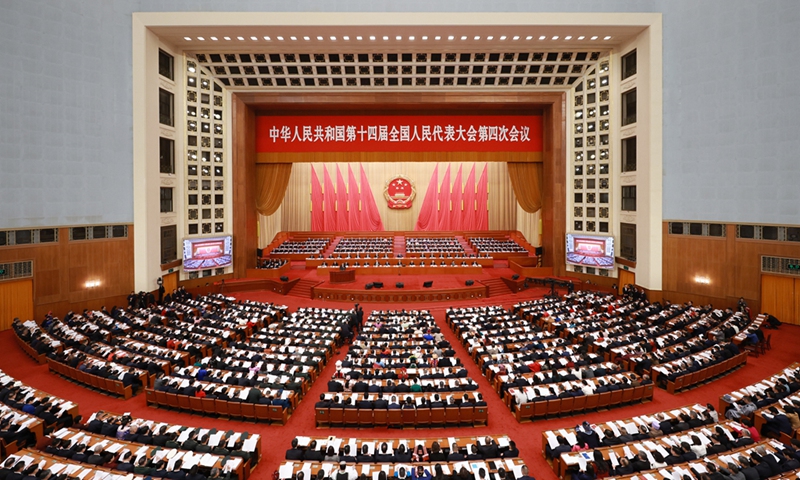
The opening meeting of the fourth session of the 14th National People's Congress (NPC) is held at the Great Hall of the People in Beijing, capital of China, March 5, 2026. (Xinhua/Wang Ye)
Li Hongzhong, a vice chairman of the National People's Congress (NPC) Standing Committee, addressed the fourth session of the fourth NPC on Thursday, delivering explanatory remarks on three draft laws submitted for deliberation: an environmental code, a national development planning law and a law on promoting ethnic unity and progress, the Xinhua News Agency reported.
The proposed environmental code seeks to embed the principle of green development more firmly within the rule-of-law framework by systematically integrating and revising existing environmental legislation. It comes at a crucial time, since China has pledged to peak its carbon emissions by 2030, according to Xinhua.
The law on promoting ethnic unity and progress is designed to strengthen social cohesion and forge a strong sense of community for the Chinese nation, while the law on national development planning will serve as a basic law to regulate the formulation of national development plans and ensure the implementation, Xinhua reported.
The draft environmental code consists of 1,242 articles in five sections - general provision, regulations on pollution prevention and control, ecological conservation, green and low-carbon development and legal liability and supplementary provisions.
The draft environmental code aims to address the fragmentation and overlap in China's existing ecological and environmental laws. By integrating the regulations governing water, air, noise, solid waste and ecological protection, the code will enhance the coherence, integrity and coordination of environmental legislation. This shift moves the focus from protecting individual elements to safeguarding the entire ecosystem, Qin Tianbao, a law professor at Wuhan University, who participated in the drafting of the legislation, told the Global Times.
Speaking at a press conference on Wednesday, Lou Qinjian, the spokesperson for the fourth session of the 14th NPC, said that with China entering a stage of high-quality economic and social development featuring green and low-carbon transitions, there is a vital need for the strictest institutions and the most rigorous rule of law to protect the environment and drive green development.
The environmental code is expected to make legislation in this field more systematic, integrated, coordinated and timely, he noted.
A dedicated section on low-carbon development stands out as one of the draft code's most notable features — a landmark institutional innovation that has drawn significant international attention, said Qin, noting that it establishes a top-level framework and provides principled guidance for China's carbon emissions reduction. In the absence of a stand-alone climate change law, the code elevates green and low-carbon development to a formal legal status and sets out its fundamental principles.
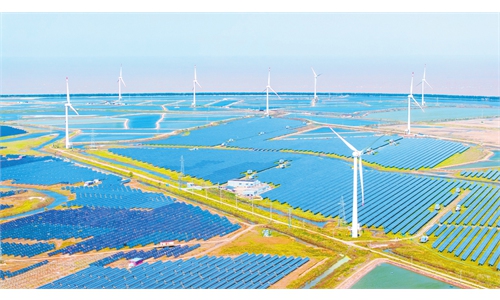
Also on Thursday, a government work report submitted to NPC legislature for deliberation has vowed to accelerate the country's green transition across the board, with the target of cutting carbon dioxide emissions per unit of GDP by 17 percent during the 2026-30 period.
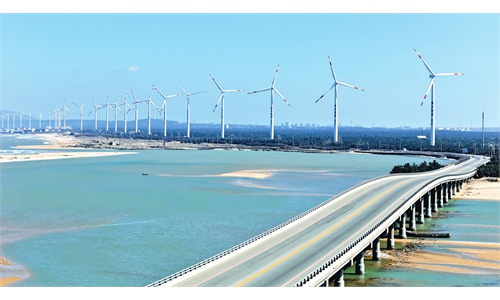
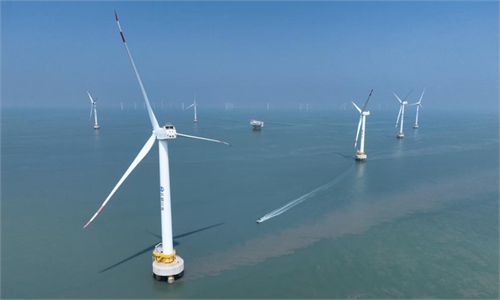
In recent years, China has intensified efforts to achieve its dual goals of peaking carbon dioxide emissions before 2030 and attaining carbon neutrality before 2060, drawing growing global attention.
The Bloomberg reported on Wednesday highlighted that the nation is quietly dominating yet another area of the global energy transition: long-duration energy storage. Long-duration energy storage can hold and release electricity for many more hours or even days, the report explained.
"For the first time, China's carbon emissions fell even as electricity demand continued to rise, a development that, if sustained, would challenge one of the most persistent assumptions in climate economics: that growth inevitably brings higher emissions," Forbes reported in an article published in January.
The BBC reported last month said that China "is becoming a green superpower." China "has been building an unrivaled green energy grid," said the report, and China's dual carbon goal "now appears to be within reach with analysts from Carbon Brief saying its carbon dioxide emissions have been flat or falling for 21 months."
For a long time, environmental protection and economic growth have often been pitted each other, Wei Yuansong, director of the laboratory of water pollution control technology, research center for eco-environmental sciences of the Chinese Academy of Sciences, told the Global Times. However, China's approach to ecological protection enables a new development paradigm, showcasing how conservation itself can generate value and enable economic growth and environmental protection to advance in harmony, Wei added.
Wei is also a member of the 14th National Committee of the Chinese People's Political Consultative Conference (CPPCC).
The draft code was developed with an eye toward extraterritorial application and alignment with international rules. By including principled provisions on carbon footprints and green supply chains, it lays a domestic legal foundation for the future mutual recognition of Chinese and international standards, thereby enabling to participate more deeply in the shaping global environmental rules, said Qin.
This approach — balancing domestic governance with international engagement — offers a compelling institutional mode for advancing a fairer and more equitable global environmental governance system, Qin noted.
RELATED ARTICLES