15th Five-Year Plan to provide significant opportunity for cross-Straits exchanges: CPPCC member
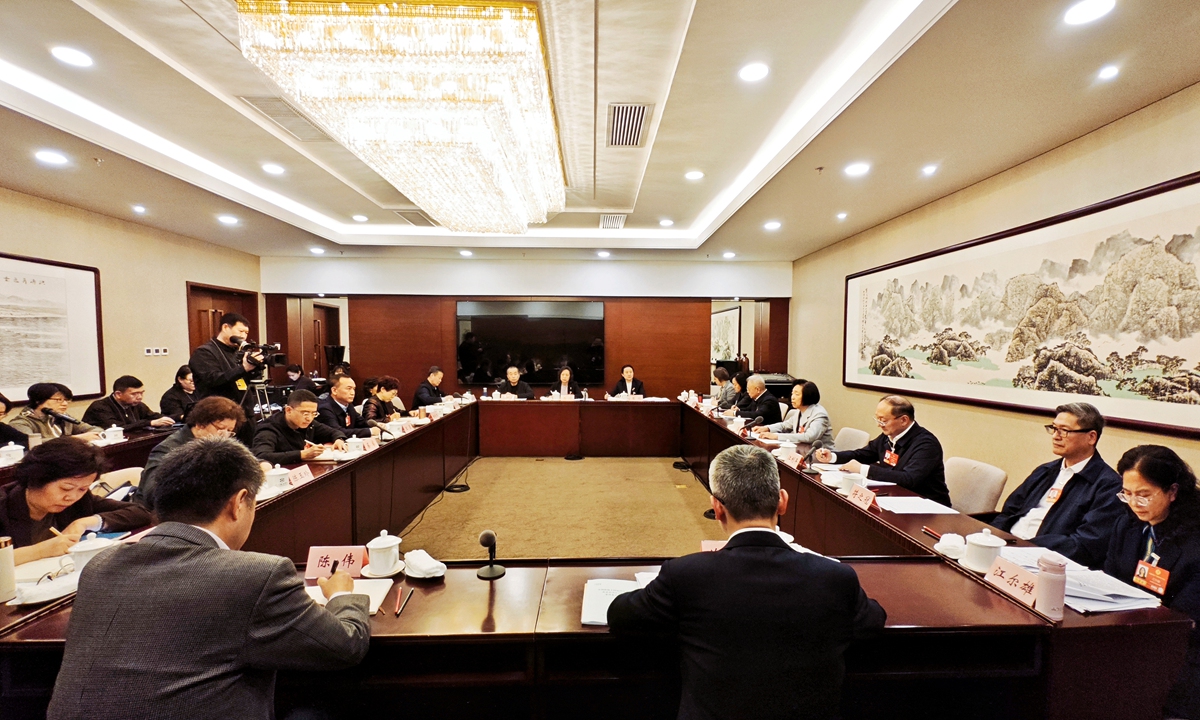
Members of the 14th National Committee of the Chinese People's Political Consultative Conference (CPPCC) from the Taiwan Democratic Self-Government League convened a group meeting during the "two sessions" in Beijing on March 5, 2026. Photo: Courtesy of the Central Committee of the Taiwan Democratic Self-Government League
"The 15th Five-Year Plan period (2026-30) will be a critical period for advancing Chinese modernization. It will also provide a significant opportunity for the development of economic and cultural exchanges across the Straits," Xu Kewei, a member of the 14th National Committee of the Chinese People's Political Consultative Conference (CPPCC), also a member of the standing committee of the Central Committee of the Taiwan Democratic Self-Government League, told the Global Times on Thursday.
In the past, such exchanges have, to some extent, been hindered by various obstacles imposed by Taiwan regional authorities, which have negatively affected their development. However, I think people-to-people exchanges cannot be stopped. People's aspiration for development and peace remains the mainstream theme, Xu said.
Employment and entrepreneurship opportunities have become a magnet for the Chinese mainland's attraction for young people from the island of Taiwan. Chen Yuling, a member of the 14th CPPCC National Committee and a member of the standing committee of the Central Committee of the Taiwan Democratic Self-Government League, told the Global Times on Thursday that the mainland has achieved remarkable accomplishments in scientific and technological innovation field such as artificial intelligence, which will provide more opportunities for employment and entrepreneurship for young people from the island of Taiwan during the 15th Five-Year Plan period (2026-30).
During her on-site research, Chen found that many Taiwan youth in the mainland have personally experienced the job opportunities and better sources for their entrepreneurship. "In the future, the mainland will have greater appeal and better prospects for employment and entrepreneurship among young people from the island," she said.
Cultural bonds, meanwhile, demonstrate unique strength in consolidating exchanges and communications across the Straits. Liu Yan, a member of the 14th CPPCC National Committee, told the Global Times on Thursday that Zhejiang Xiaobaihua Yue Opera Troupe's performances on the island of Taiwan have received a warm welcome among Taiwan audience, which reflects Taiwan compatriots' admiration for traditional Chinese culture.
"Compatriots on both sides of the Straits share the same roots, origin, language, and culture, and that during the 15th Five-Year Plan period, we can narrow the distance between us through cultural connections," Liu said.
The government work report submitted Thursday to the country's top legislature for deliberation stressed the need to fully implement the Communist Party of China's overall policy for the new era on resolving the Taiwan question, reaffirming commitment to the one-China principle and the 1992 Consensus.
This year, there are some new phrases including "people on both sides of the Straits should work together to pass on and carry forward Chinese culture" and "We will implement policies designed to ensure equal treatment for our Taiwan compatriots," according to the report.
"Taiwan compatriots and enterprises have great development room in the mainland," Wang Yu, a member of the 14th CPPCC National Committee, told the Global Times on Thursday.
Wang said that he made a proposal during this year's "two sessions" on deepening the integrated development of cross-Straits industrial and supply chains. "In the starting year of the mainland's the 15th Five-Year Plan period, I sincerely welcome Taiwan compatriots and enterprises to visit the mainland more often, explore its opportunities, engage in in-depth exchanges, identify complementary advantages and cooperation areas, and deepen integrated development," he said.
RELATED ARTICLES