ARTS / CULTURE & LEISURE
New findings shed light on evolution from fish to humans

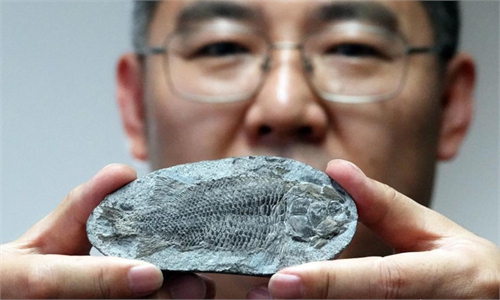
A bony fish illustration Photo: Courtesy of Zhu Youan
Chinese scientists have discovered fossils of bony fish dating back about 436 million years, providing key evidence that helps fill major gaps in the evolutionary chain linking ancient fish to humans.The research was conducted by a team from the Institute of Vertebrate Paleontology and Paleoanthropology (IVPP) at the Chinese Academy of Sciences (CAS). Their findings were published in two papers in the journal Nature on Thursday.
Bony fish account for some 98 percent of all vertebrate species. From jawed vertebrates to bony fish, then to lobe-finned fish, and eventually to a branch of lobe-finned fish that moved onto land and became the ancestor of all four-limbed animals, including humans. This sequence forms the central evolutionary pathway from fish to humans.
However, the early stages of their evolution are not well understood. The core issue is the fragmented nature of the fossil record for specimens that date back earlier than the beginning of the Devonian Period, some 419 million years ago.
Across two papers, IVPP researchers help to plug that gap. In the first paper, the researchers reveal the near-complete skeleton of a small bony fish dating to the early Silurian (around 436 million years ago), making it the oldest known bony fish. Named Eosteus chongqingensis, this 3-centimeter fish displays features that place it close to the earliest stages of bony fish evolution.
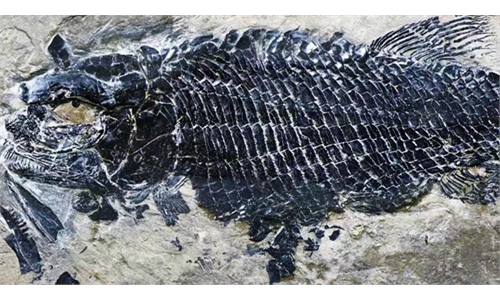
In the second paper, the researchers reveal fossil material from the fish Megamastax amblyodus, the largest pre-Devonian vertebrate currently known. Dated to around 423 million years ago, these latest remains add an entire skull with teeth and jaws to the picture, offering fresh insight into the origin of bony fish characteristics.
According to Zhu Youan, a member of the research team from IVPP, the discovery fills a key gap in the evolutionary story from fish to humans in two ways.
The newly discovered fossil of Eosteus chongqingensis dates to about 436 million years ago in the early Silurian, making it the oldest known record of a bony fish. It is about 10 million years older than any previously known fossil evidence of the group.
In addition, the discovery helps fill a gap in the evolutionary tree. Both species belong to a little-known "stem group" of bony fish, early forms that lived before the evolutionary split between lobe-finned and ray-finned fish, the two major branches of the group.
"The findings help fill a key gap in the evolutionary journey from fish to humans and provide further evidence that China was an important 'cradle' for the early evolution of vertebrates," Zhu told the Global Timers on Thursday.
These primitive fossils of bony fish were found in South China. In addition, the earliest fossil evidence for nearly every major group of jawed vertebrates has also been discovered in the region, often appearing 10 million to 20 million years earlier than similar fossils found elsewhere in the world, Zhu told the Global Times.
According to Zhu, during the Silurian and Devonian periods, the South China Block was an isolated landmass located near the equator. It had long coastlines, and strong weathering on land washed large amounts of inorganic nutrients into nearby seas. Warm and cold ocean currents also converged in the region.
Those conditions resembled modern productive fishing grounds and created an environment well suited for fish to thrive and diversify, making South China an important center for early vertebrate evolution, noted Zhu.
Future research on China's unique Silurian jawed vertebrate fossils could help scientists better understand a series of key evolutionary leaps in the early transition from fish to humans, Zhu told the Global Times.
RELATED ARTICLES