China’s GDP growth target shows flexibility; economy has foundation for stable expansion in 2026
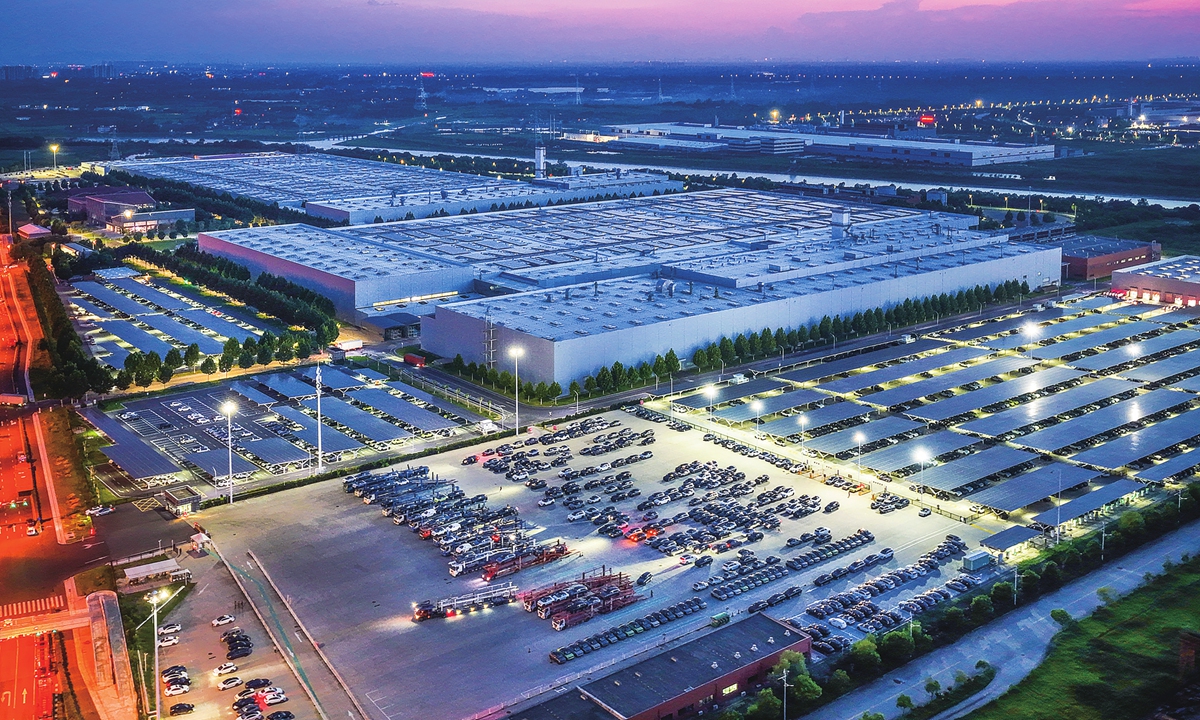
A view of the electric vehicle storage yard at a NIO factory in Hefei, East China's Anhui Province, on August 21, 2025. Photo: VCG
China targets economic growth of 4.5 to 5 percent in 2026 and will strive for better in practice, according to a government work report submitted Thursday to the country's top legislature for deliberation. The target reflects flexibility, enabling local regions to prioritize high-quality economic growth and, more importantly, to contribute to Chinese modernization.
The adjustment of the economic growth target aligns with the guiding principles of the 2025 Central Economic Work Conference, creating sufficient room for the transformation and upgrading of China's growth model, propelled by the development of new quality productive forces. The flexible range-based target will help alleviate the situation of strong supply but weak demand, thereby addressing the issue of persistently low prices.
Compared with the GDP growth target, more attention should be paid to China's resilient growth momentum. The government work report has outlined solid steps to be taken to achieve the goal, including building a robust domestic market, fostering new growth drivers at a faster pace, and accelerating self-reliance and strength in science and technology.
A series of favorable factors will ensure China's overall upward growth in the medium to long-term. China's economic growth can be characterized by several keywords, namely "stable", "diverse", "strong", and "large". Currently, the world is facing unprecedented changes unseen in a century - geopolitical conflicts are intensifying, and the international situation is becoming more turbulent. Against this backdrop, China's economy remains stable and sustainable.

Yu Miaojie Photo: Courtesy of Yu Miaojie
The driving force behind China's economic growth is the country's economic security and social stability. The economy in the 14th Five-Year Plan period (2021-25) was marked by four consecutive leaps - surpassing 110, 120, 130, and 140 trillion yuan, which underscores a more solid economic foundation and stronger resilience.As for "diverse," China has many advantages in its economy, such as its strong manufacturing value-added sector, the real economy, and the cultivation of new quality productive forces. In particular, the Communist Party of China (CPC) and the central government adhere to the combination of an effective market and a proactive government, which constitutes an institutional and governance advantage in promoting high-quality development.
In terms of "strength", this is reflected in China's rapid development of technological innovation capability, with some sectors not only reaching the forefront globally, but even ranking first in the world. In terms of total economic output, China still ranks second. However, judging from indicators such as foreign exchange reserves and total trade volume, China clearly holds a leading position in the world.
China has built a comprehensive industrial system encompassing 41 major categories, making it the world's only country with a complete set of industrial classifications recognized by the United Nations. Notably, emerging industries such as artificial intelligence, new and clean energy, high-end equipment, biomedicine, and quantum computing are thriving.
More importantly, with a population of over 1.4 billion, China's super-large market and ever-growing consumption strength will continue to unleash enormous import demand and growth potential.
According to this year's government work report, a total of 1.3 trillion yuan ($188.85 billion) of ultra-long special treasury bonds will be issued to provide continued support for endeavors such as implementing major national strategies, enhancing security capacity in key areas, and carrying out large-scale equipment upgrades and consumer goods trade-in programs. Experience in the past several years has shown that this policy is effective for driving growth.
Thus, I believe that China's economy will maintain a contribution rate of 30 percent to global economic growth during the 15th Five-Year Plan period (2026-30), continuing to be a driving engine of the global economy.
Currently, external risks and challenges are intensifying, especially the unilateralism and narrow isolationism pursued by some countries, which pose significant challenges to economic globalization. However, the more turbulent the external environment and the more uncertain the global economy, the more we need to manage our own affairs well.
The guiding principles for China's economic and social development during the 15th Five-Year Plan period are very clear. "We will continue to pursue economic development as our central task, with high-quality development as our main focus, reform and innovation as the fundamental driving force, meeting the people's ever-growing needs for a better life as our fundamental goal, and full and rigorous Party self-governance as the fundamental underpinning for all our efforts," as stated in the Recommendations of the Central Committee of the Communist Party of China (CPC) for Formulating the 15th Five-Year Plan for National Economic and Social Development, which were made public in October.
China is expected to advance reforms in areas such as the building of a unified national market, with key tasks including unifying the underlying institutions and rules of the market, improving the high-standard market infrastructure connectivity, and building a unified market for factors and resources so as to contribute to the construction of a new development pattern and promote the country's high-quality development.
The article is based on an interview with Yu Miaojie, a member of the 14th CPPCC National Committee and president of Liaoning University. bizopinion@globaltimes.com.cn
RELATED ARTICLES