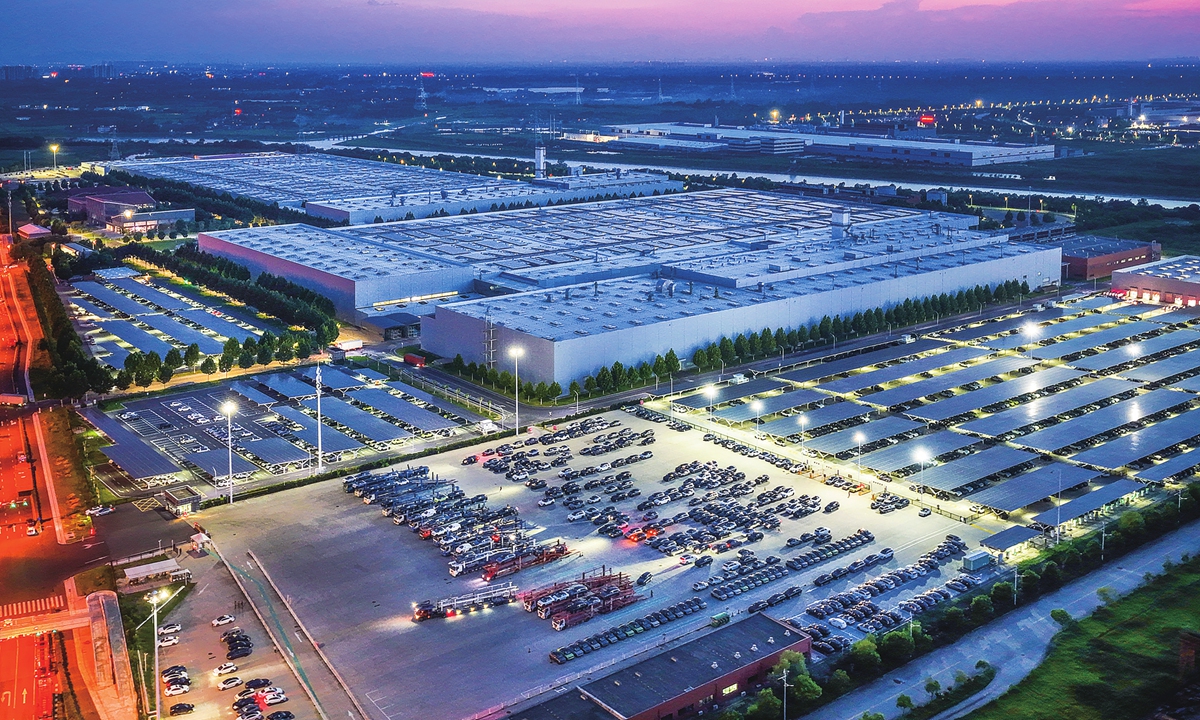
A view of the electric vehicle storage yard at a NIO factory in Hefei, East China's Anhui Province, on August 21, 2025. Photo: VCG
China's two sessions always send clear signals about development priorities, and this year, those signals are even more important as China enters a new five-year plan period. The message to the world will be continuity and confidence.
The 2026 two sessions in China are highly practical and forward-looking, focused on translating the 15th Five-Year Plan into concrete policies. From the government work report submitted Thursday to the country's top legislature for deliberation, we see strong emphasis on high-quality development, scientific and technological self-reliance, expanding domestic demand, and high-standard opening-up.
The country's economic growth target of between 4.5 to 5 percent in 2026 is sensible and achievable, with the central government's measures to stabilize foreign investment and trade, new steps in green technology and green renewable energy, and further support for private enterprises and innovation which are expected to inject new momentum into the economy.
The external environment faced by China this year will remain complex and at times challenging, as continued protectionism, unilateral measures, and geopolitical frictions weigh on the global economy.
However, China has already demonstrated it can navigate this landscape effectively by reducing excessive dependence on any single market and focusing on domestic economic growth. China's home-driven growth model makes its economic forecast one of the most reliable and stable components of global projections - quite unlike the greater volatility we see in Europe or elsewhere.

Michele Geraci Photo: Courtesy of Michele Geraci
Thus, I have full confidence in China's economic outlook for 2026, which stems from several enduring fundamentals of the country. China boasts a complete and resilient industrial supply chain that few countries can match, as well as the world's largest and still-growing domestic market. With consistent macroeconomic governance and policy continuity, China has been making rapid progress in tech innovation, represented by DeepSeek, Huawei, BYD and the "Six Little Dragons" in Hangzhou, East China's Zhejiang Province.
In addition, China can continue to tap development opportunities through deeper cooperation with the Global South countries, high-quality development of the Belt and Road Initiative (BRI), solid implementation of free trade agreements such as Regional Comprehensive Economic Partnership (RCEP), and sustained leadership in green technology and renewable energy.
For the global economy as a whole, the major challenges are fragmentation, slower growth in developed economies, and supply-chain disruptions. The opportunities lie in the very same trends: the rise of a multi-polar world, the shift of economic gravity toward Asia, and the urgent need for green transition technologies - areas where China is not only participating but also leading and offering win-win solutions to its partners.
Looking back to the 14th Five-Year Plan period (2020-25), China announced a series of opening-up measures, for example, zero-tariff policies to the least developed countries and deepening BRI cooperation. These opening-up measures were highly successful and strategically wise, and have achieved tangible results.
For example, China's trade with BRI partner countries reached record highs in 2025, and the number of foreign-invested enterprises continues to grow. China has shown flexibility by strengthening ties with ASEAN, Africa, and parts of Europe that seek practical cooperation. Italy's exit from the BRI was, in my opinion, a mistake; it gave up a free option for infrastructure and trade opportunities. China's opening-up has been consistent since 1978 and has become even more high-standard and mutually beneficial during the past five years. It is a model of pragmatic, win-win globalization.
In recent years, China's technological progress has been remarkable and, in many fields, world-leading, from artificial intelligence models to breakthroughs in semiconductors, electric vehicles and renewable energy, making China a front-runner in those sectors.
What I find particularly impressive is that Chinese innovation tends to benefit society more broadly - it is affordable, scalable, and quickly deployed for real economic gains. This is different from some other models where innovation remains concentrated among a few companies.
To the world economy, China's innovation and continued opening-up will contribute in three major ways: providing affordable green technologies that accelerate the global energy transition; keeping global supply chains stable and competitive; and offering new platforms for cooperation that create growth opportunities for both developed and developing countries.
In short, China's growth model shows that innovation and opening-up, when pursued with long-term vision and social purpose, are powerful stabilizers and growth engines for the entire planet. China's steady economic advancement remains one of the most reassuring elements in today's uncertain world.
The article is based on an interview with Michele Geraci, former undersecretary of state at the Italian Ministry of Economic Development and adjunct professor of Finance at New York University Shanghai. bizopinion@globaltimes.com.cn