Conflicts between US-Israel and Iran risks sliding region into war of attrition as Tehran banks on missiles, allied pressure: Chinese experts
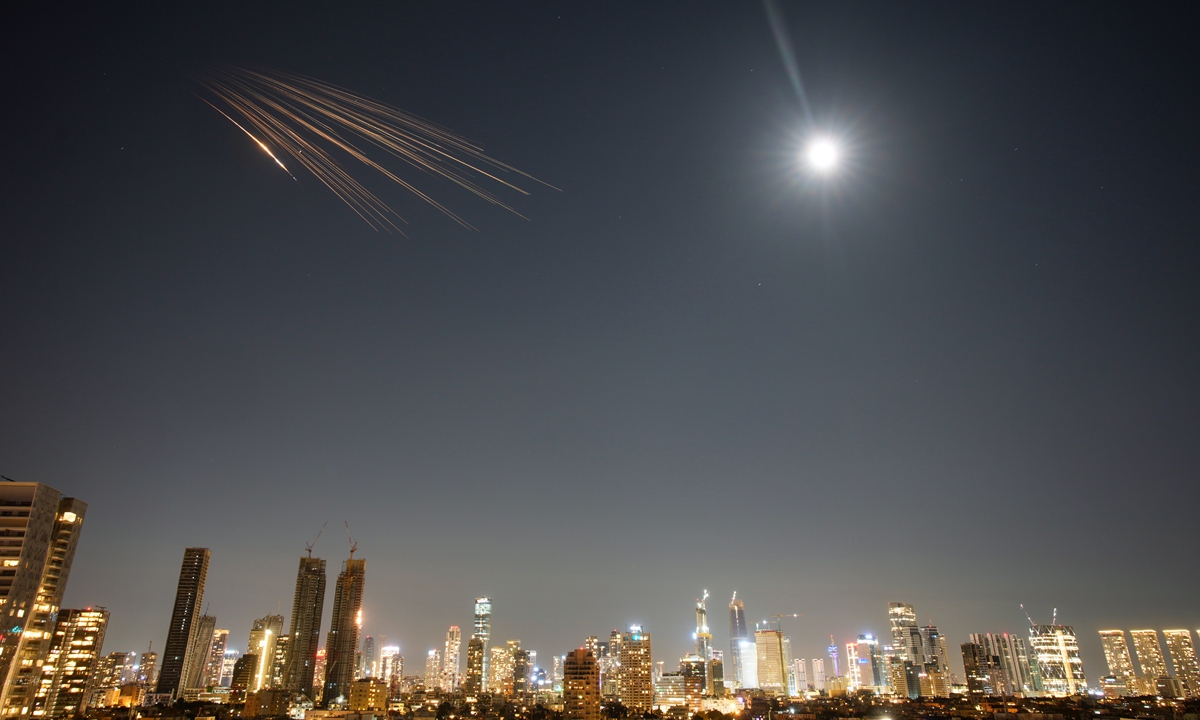
Missiles launched from Iran are seen in the sky over central Israel on March 5, 2026. Photo: VCG
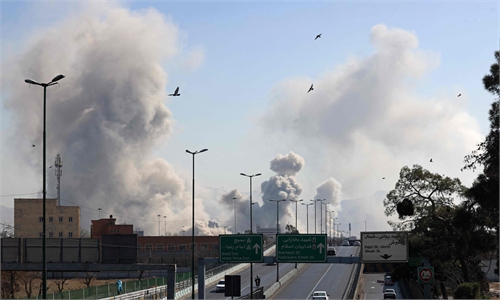
For anyone who closely follows international affairs, a striking pattern has emerged since February 28: each morning, opening the websites of major global news outlets means being met almost instantly by the same unfolding war scene. Homepage banners of international media have been dominated by images of missile launches, fiery explosions and shattered urban landscapes, as the regional exchange of fire triggered by the joint US-Israeli military operation against Iran continues to seize global attention.Over the past week, the confrontation has escalated into far more than a conventional exchange of fire. According to multiple media reports, the US and Israel have employed cruise missiles, fighter-jet bombardments and drones, as well as a submarine to attack on an Iranian warship in international waters, while AI, space and cyber operations have also been incorporated into Washington's military toolbox. Yet despite repeated rounds of attacks by the US and Israel, Iran has shown notable resilience, continuing to launch retaliatory strikes that have inflicted tangible damage on US and allied targets and gradually turned the conflict into a prolonged war of attrition.
As the exchange of fire intensifies, the weapons and tactics employed by both sides have increasingly moved to center stage. Chinese military affairs and foreign affairs experts reached by the Global Times on Friday said that during the past week, the US and Israel have relied more heavily on preemptive strikes aimed at directly crippling Iran's armed forces and leadership. Iran, by contrast, has responded primarily through asymmetric means, relying on ballistic missiles to strike US and Israeli military bases and other targets in the region, in an effort to use force to deter attempts by Washington and Tel Aviv to pursue regime change.
On Thursday, The Iranian Islamic Revolutionary Guard Corps (IRGC) confirmed the launch of Khorramshahr 4 ballistic missile to target Ben Gurion Airport, as well as the Israeli Air Force's 27th Air Base located at the airport. The missile, which notable for its large 30-ton design, and carriage of a warhead weighing 1,500 to 1,800 kilograms, serves as part of the 19th wave of Operation True Promise 4, a coordinated campaign of missile and drone attacks against Israeli and US targets, reported Military Watch Magazine, a media outlet focused on security and defense.
The IRGC also said the US aircraft carrier USS Abraham Lincoln was targeted by drones of its navy, the Xinhua News Agency reported on Friday, citing Iran's semi-official Fars news agency.
At the same time, the US signaled further escalation. US Central Command showed footage of Iranian drone carrier on fire. The US military said early Friday that an Iranian drone carrier was attacked and set ablaze. The message from the US military's Central Command showed black-and-white footage of the carrier ablaze after multiple strikes hit it, the Associated Press reported on Friday.
In the latest regional exchange of fire triggered by the US-Israeli attacks on Iran, Washington and Tel Aviv sought to paralyze Iran's military capabilities and weaken the country's will to resist by targeting its top leadership. However, after the death of Iran's Supreme Leader Ayatollah Ali Khamenei, Iran's military retaliation has proceeded in an orderly manner. Up to now, 22 rounds of counterstrikes have been carried out in a disciplined fashion, Sun Degang, director of the Center for Middle East Studies at Fudan University, told the Global Times on Friday.
Because Iran's air power is relatively weak and its navy has largely been suppressed by the US and Israel, it has mainly relied on ballistic missiles to carry out precision strikes on selected targets, including US military bases in the Gulf, while also seeking to blockade the Strait of Hormuz, thereby sharpening contradictions between Arab states and Washington, Sun said.
Iran's missile launchers, meanwhile, have come under fierce attack from the US and Israel. Israel's military says it has hit hundreds of Iranian missile launchers above ground that could target Israeli cities. The second phase will include bunkers storing ballistic missiles and equipment, according to Reuters, citing said anonymous sources.
Even so, Iran is still believed to retain a sizable ballistic missile arsenal and launch capability. According to Reuters, estimates of Iran's missile stockpile vary widely, from roughly 2,500 before the war, according to Israel's military, to around 6,000 according to other analysts. The extent of what remains could prove critical to how the war develops. Tehran has continued to carry out missile attacks on Israel and across the region.
Beyond ballistic missiles, another major pillar of Iran's response is coordinated retaliation with regional allies. Iran has worked with its regional partners, including Hezbollah in Lebanon and anti-US militias in Iraq, to counter US and Israeli expansion in the region. Hezbollah and anti-US militias have launched attacks on US bases in Iraq and neighboring countries, helping to ease pressure on Iran while also consuming US military resources in the region, Zhang Junshe, a military affairs expert, told the Global Times.
In a statement posted on Telegram on Friday, Hezbollah said that its fighters had targeted Israel's Yoav military camp in the occupied Golan Heights and a navy base in Israel's Haifa port. The group also said that it has attacked a gathering of Israeli army vehicles advancing towards the southern Lebanese town of Khiam, according to Al Jazeera.
Iran-backed militias around the Middle East are intensifying attacks against Israel, the US and their allies in retaliation for the ongoing joint US-Israeli military operation against Iran. Militias in Iraq have launched dozens of attacks since the war began on Saturday, targeting Israel and US bases in Jordan and Iraq itself, according to the Guardian.
Iran has adopted a five-step strategy in resisting US aggression, Zhang said. First, it used underground missile depots in mountainous areas to preserve its forces and survive US-Israeli strikes. Second, it relied on cruise missiles, long-range cruise missiles, ballistic missiles and drones to retaliate. Third, it coordinated with allies to attack US and Israeli targets. Fourth, it moved to blockade the Strait of Hormuz, using disruption to global trade and shipping routes to increase pressure on Washington.
And fifth, its ultimate goal would be to frustrate the US desire for a quick victory, forcing it to halt military operations and withdraw, Zhang said.
Civilians "are bearing the brunt" of US-Israeli attacks, according to Al Jazeera, citing the agency's Mohamed Vall in Iranian capital Tehran.
Facing attacks from the US and Israel, Iran, as the weaker side in conventional military power, can only sustain its resistance by dispersing its forces and continuing strikes against US and Israeli targets. At the same time, Washington and Tel Aviv appear unlikely to achieve their objective of quickly toppling the Iranian government, a dynamic that risks sliding the conflict into a war of attrition, Song Zhongping, another Chinese military affairs expert, told the Global Times on Friday.
The final result of the conflict will still depend on which side can hold out the longest on the battlefield, Song believed.
RELATED ARTICLES