Rumors and denials swirl over potential Kurdish involvement in US’ Iran military operations; expert warns of miscalculation in information warfare
By Published: Mar 05, 2026 10:26 PM

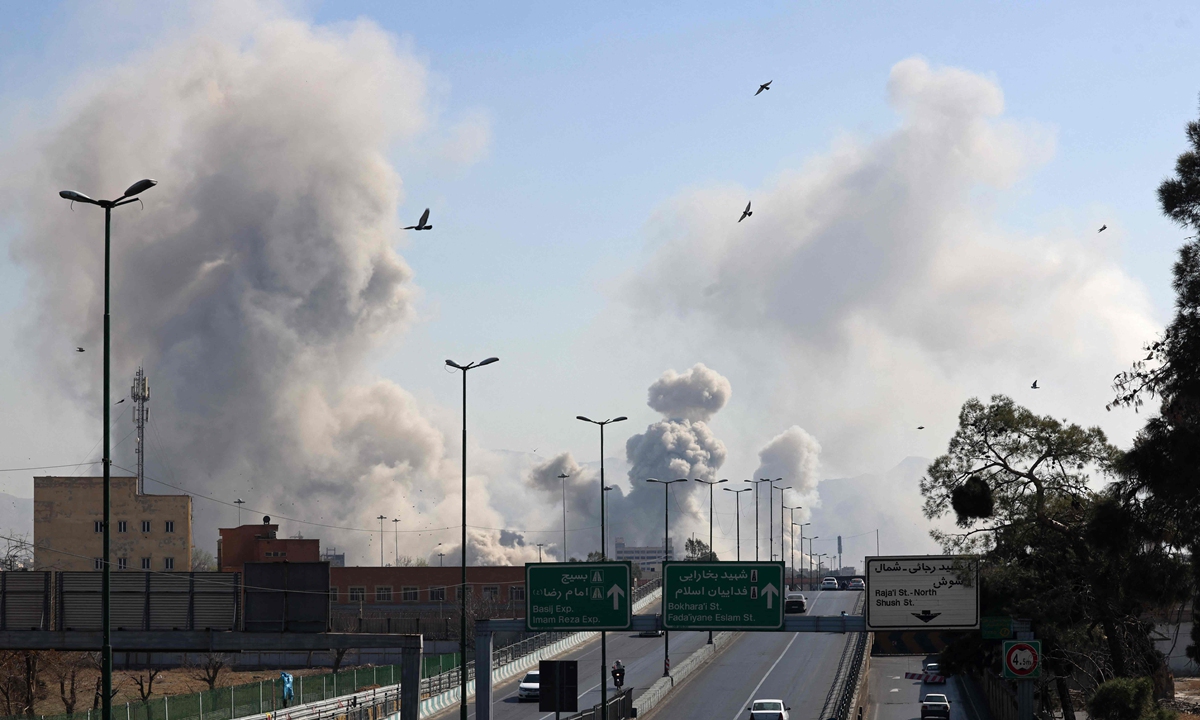
Vehicles drive along an expressway against the backdrop of smoke rising after a strike on the Iranian capital of Tehran on March 5, 2026. Photo: VCG
As the regional exchange of fire triggered by the US-Israeli attacks on Iran enters the sixth day, in the latest episode, rumors and denials surrounding the potential involvement of Iraq's Kurdish region as a proxy force in the conflict with Iran have emerged as a new flashpoint, with heightened attention focused on developments along Iran's western border.On Thursday, Aziz Ahmad, deputy chief of staff to the prime minister of Kurdistan Region of Iraq, took to social media platform X to firmly reject claims of cross-border activity. In his post, Ahmad stated: "Not a single Iraqi Kurd has crossed the border. This is patently false."
He reposted and directly rebutted an earlier Fox News report by correspondent Jennifer Griffin, which cited a US official claiming that "thousands of Iraqi Kurds have launched a ground offensive in Iran."
Also on Thursday, a senior official from the Komala Party of Iranian Kurdistan (Society of Revolutionary Toilers) told Shafaq News that claims circulating about opposition forces moving into Iran were "false and baseless," per the Shafaq News of Iraq.
Meanwhile, Iran's Tasnim news agency quoted an Iranian official as saying the border in its western Ilam province remains "completely secure," accusing the US and Israel of attempting to undermine public morale after failing to achieve battlefield objectives, per the report.
Rumors regarding the involvement of Iraqi Kurds as proxy forces in the conflict against Iran have recently attracted public attention. On Tuesday, CNN cited sources as reporting that the CIA is working to arm Kurdish forces with the aim of fomenting a popular uprising in Iran. It added that the US government has been "in active discussions" with Iranian opposition groups and Kurdish leaders in Iraq about providing them with military support.
But in a briefing on Wednesday, White House press secretary Karoline Leavitt, said related reports that President Trump had agreed to any plan for the Kurds to launch an insurgency in Iran were "completely false," per the New York Times.
Although the US has not reportedly agreed to the plan for Kurdish groups to launch an insurgency in Iran, expert said Washington's willingness to provide military support highly likely exists, Zhu Yongbiao, a Middle East affairs expert with Lanzhou University, told the Global Times on Thursday.
According to Zhu, at present, the issue of Kurdish armed groups is likely more characterized by information warfare between the two sides. However, if the conflict reaches a critical point—such as one week or 10 days from now—and the US-Israeli attacks still fail to deliver a decisive blow to the Iranian regime, while Tehran remains capable of launching effective retaliatory strikes, then it cannot be ruled out that Washington would employ proxy forces as vanguard units to launch ground offensives.
In a Wednesday report, The New York Times mentioned that Washington has a long history of working with Kurdish militia forces in Iraq and Syria, but America also has reputation of abandoning the Kurds. It said people familiar with the planning for any potential Kurdish incursion into Iran voiced a note of caution, emphasizing that "there is no way that any Kurdish force could topple the Iranian government, they say, or even significantly influence who might take power."
According to the Middle East Eyes, Turkey's Dem Party, a political group with ties to Kurds in Iran, has recently criticized the US-Israeli war on Iran, saying it opposed "external designs" on the country.
Zhu stated that countries with significant Kurdish populations or groups, such as Iraq, Turkey, and Syria, will closely monitor developments and potential impact on regional stability. He further noted that any involvement by Kurdish military groups could set off significant chain reactions, exacerbating separatism, terrorism, and extremism across the region. In the long term, Zhu cautioned, the US itself may face the serious risk of blowback from such a strategy.
Zhu added that the overall situation in Middle East remains highly uncertain, with information warfare, intelligence operations, and military operations deeply intertwined. Any miscalculation could rapidly escalate the conflict further.
According to Al Jazeera, Iran's Intelligence Ministry said on Thursday that it worked with the IRGC to preemptively strike against US and Israeli-backed separatist groups who were plotting to breach Iran's western borders and wage "terrorist attacks."
While Iran's IRGC claimed its navy hit a US oil tanker in the northern Gulf, starting a fire on the vessel, explosions have been heard in Tehran and Karaj after Israel announced it was launching a new wave of attacks amid ongoing strikes on the country, according to media reports on Thursday.
While the joint US-Israeli military operation against Iran continues, several countries have responded to and pushed back against Washington's narrative, including Spain. The country's foreign minister, José Manuel Albares, dismissed White House suggestions that Madrid now backed the US's military action, the Guardian reported on Thursday.
"The Spanish government's position on the war in the Middle East, the bombings in Iran, and the use of our bases has not changed one iota," Albares said in an interview with Cadena Ser radio on Wednesday night. "Our 'no to war' stance remains clear and unequivocal … She may be the White House press secretary, but I'm the foreign minister of Spain and I'm telling her that our position hasn't changed at all."
Robles's remarks marked one of the latest expressions of opposition from Spain to the US military action. Spanish Prime Minister Pedro Sánchez on Wednesday compared the growing conflict in the Middle East to playing "Russian roulette with the destiny of millions". In a section of the speech that appeared to directly address Trump's threats to end all trade with Spain, the prime minister said his country would "not be complicit in something that is bad for the world - and that is also contrary to our values and interests - simply out of fear of reprisals from someone," according to the Guardian, reiterating his opposition to the conflict.
French President Emmanuel Macron has also voiced objection about the escalating tensions in the region, according to Politico.eu, on Tuesday, Macron delivered a televised address in which he came close to disapproving of US strikes on Iran. "These were conducted outside international law, which we cannot approve of," he said.
RELATED ARTICLES