The ‘four news’ help the world better understand ‘why China can succeed’: Global Times editorial
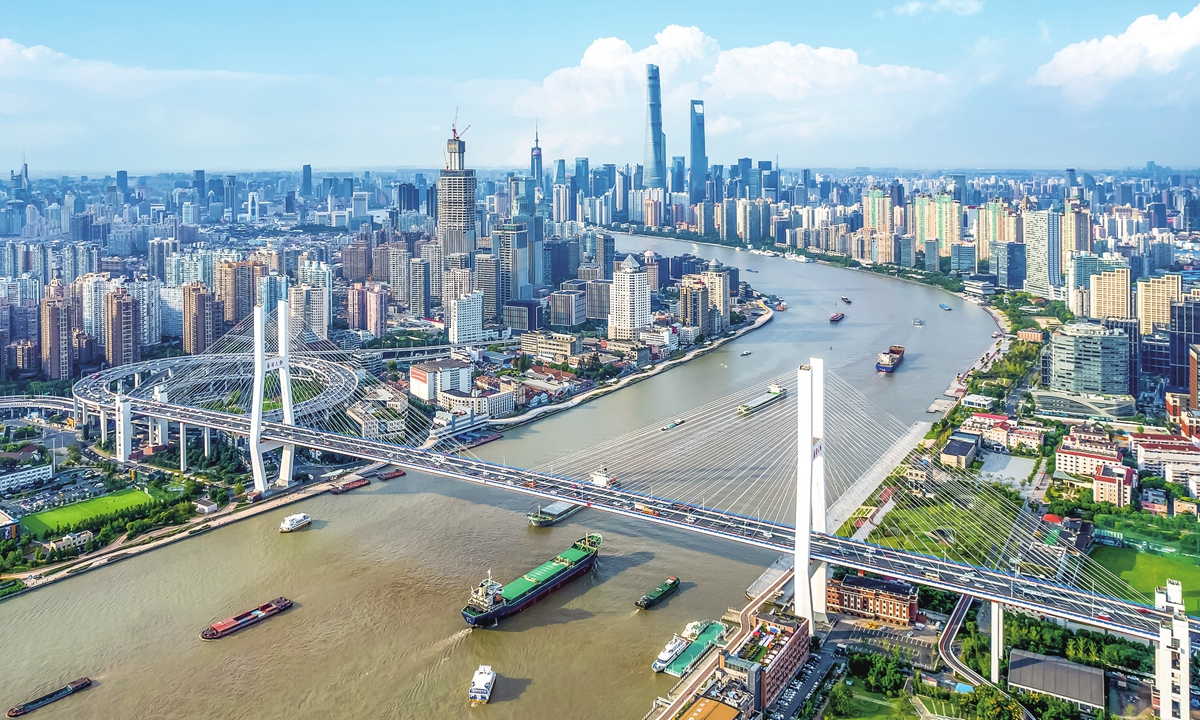
Aerial view of Nanpu Bridge and Huangpu River in Shanghai Photo: VCG
On the afternoon of March 5, Chinese President Xi Jinping, also general secretary of the Communist Party of China Central Committee and chairman of the Central Military Commission, took part in a deliberation with his fellow deputies from the delegation of Jiangsu Province at the fourth session of the 14th National People's Congress (NPC), China's national legislature.
Xi stressed that to fulfill the development goals of the 15th Five-Year Plan period (2026-30), China must navigate a more complex environment and resolve more deep-seated contradictions. Xi outlined, when speaking about developing new quality productive forces and advancing high-quality development, the "four news": achieving new breakthroughs, exploring new pathways, opening up new prospects, and securing new achievements. Through the "four news," the world can gain a deeper understanding and appreciation of China's development approach.
"Achieve new breakthroughs in strengthening original innovation, tackling key core technologies, and seizing strategic scientific and technological heights," - this points the way for China's technological development, aiming to further advance self-reliance and self-strengthening in science and technology. "Explore new pathways to promote the integration of the innovation, industrial, capital and talent chains, and to accelerate the efficient commercialization and application of sci-tech achievements," - this provides a key methodology, creatively solving the global challenge of the disconnect between technology and the economy, and substantially improving the efficiency of research translation. "Opening up new prospects in optimizing and upgrading traditional industries, cultivating and expanding emerging industries, and proactively laying out future-oriented industries," - this represents the planning priorities for China's technology and industrial development, building a modern industrial system as manufacturing continues to upgrade and transform. "Securing new achievements in further deepening reforms and removing institutional and systemic barriers that restrict the development of new quality productive forces," - this demonstrates China's determination and courage to pursue comprehensive reform, revealing the "institutional codes" behind the explosive growth of innovation outcomes.
Since Xi first put forward the concept of "new quality productive forces" during his inspection in Northeast China's Heilongjiang Province in 2023, it has attracted worldwide attention. What are "new quality productive forces"? What development path do they follow? Can China succeed? These have become hot topics internationally. In just two or three years, China has achieved tangible results that have impressed the world. Beyond asking "what breakthroughs has China made," global commentary increasingly asks: why is China the only country that has achieved this?
The "four news" outlined by Xi serve as a "golden key" for the world to understand why China can succeed. Developing new quality productive forces is not only a technological revolution but also a profound adjustment of production relations. China fully understands that to unleash the enormous potential of productive forces, it must tackle entrenched obstacles to innovation, and break through barriers that hinder resource flows and constrain creativity. This demonstrates not only strategic foresight but also strong strategic composure.
In upgrading and improving traditional industries, China does not take the extreme approach of "embracing the new while discarding the old." Instead, it emphasizes empowerment through intelligent technologies, using digitalization and smart transformation to enable its vast manufacturing base to undergo a transformative leap. In fostering and expanding emerging industries, "the deep integration of the four chains" has become a central focus of China's efforts to deepen reform and remove institutional and structural barriers. The goal is to bridge the "last mile" from the laboratory to the marketplace and build a dynamic, system-level ecosystem advantage.
This also represents a "China solution" that benefits the world. Amid a complex and challenging global political and economic environment, China remains "forward-looking," committed to cultivating new frontiers in science and technology and transforming the advantages of its ultra-large market into abundant real-world applications for global industrial innovation. China is a participant in global industrial chains, a sharer of the dividends of frontier technologies and a provider of global public goods. In emerging areas such as artificial intelligence, biomanufacturing, and low-carbon technologies, China is embracing an open approach as it moves toward a future that is more efficient, less resource-intensive, and more resilient. This also demonstrates a responsible commitment to the long-term prosperity of the global economy.
By further deepening reform, China is steadily removing institutional and structural barriers. The world is increasingly recognizing that China's development is open and shared. The Canadian Broadcasting Corporation quoted an expert as saying that China will double down on self-reliance, including with its own technology in AI and the green energy transition. While these initiatives will guide China's own development, they will also generate broad international impact. Helmo Preuss, an economist in South Africa, also noted that China's AI, quantum technology and green energy technologies are continuously bringing new development opportunities for Africa-China cooperation.
During the extraordinary 14th Five-Year Plan (2021-25) period, China's new quality productive forces developed steadily. From "Made in China" to "Intelligent Manufacturing in China," this drive toward the "new" will propel Chinese modernization forward with fresh and solid steps. The 15th Five-Year Plan (2026-30) period will be a critical stage for consolidating the foundations and advancing on all fronts. Promoting the development of new quality productive forces through the "four news" creates a more solid development path and a brighter future for China.
People believe that this force toward the "new" will propel Chinese modernization to new and solid steps. A China with stronger innovation capabilities, deeper reforms, and a broader industrial structure will surely provide the most solid material support for building a community with a shared future for mankind.
RELATED ARTICLES