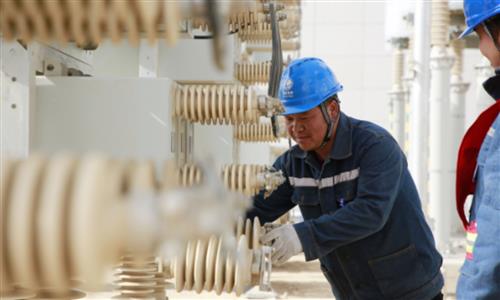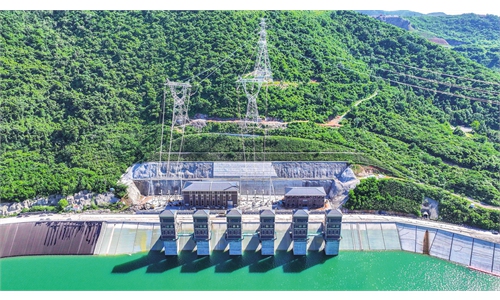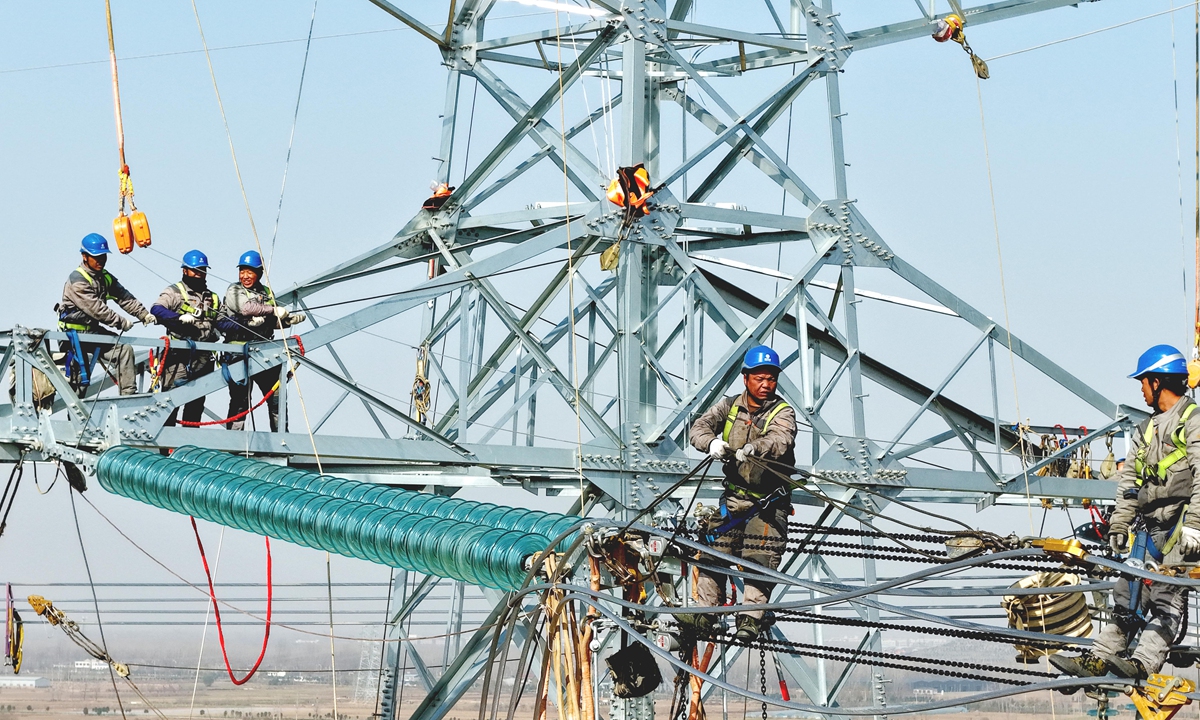
Technicians work on a 500-kilovolt power transmission line in Bozhou, East China's Anhui Province on November 24, 2025. Upon completion, the project will serve as a hub substation, and enhance the power supply capacity and reliability of the Bozhou region, providing a reliable electricity guarantee for Anhui's economic development. Photo: VCG
This year's Government Work Report, for the first time, stated that "we will create new forms of the smart economy" and "we will launch new infrastructure projects on hyperscale intelligent computing clusters and coordinated development of computing capacity and electricity supply." This strategic direction opens vast room for development and lays a robust foundation for a new leap in socioeconomic progress.
Reading this year's Government Work Report alongside two recent developments offers a clearer view of China's core strength.
First, power equipment manufacturers in provinces of Guangdong, Jiangsu and other regions are running at full capacity. With the global demand for computing power growing rapidly, countries around the world are expanding their construction of data centers. China's overseas orders for power equipment are on the rise, echoing what investors say: "The end of AI is electricity."
Second, from February 9 to 15 this year, the volume of calls to Chinese AI models reached 4.12 trillion tokens, surpassing that of the US for the first time. Developers around the world have found that running tasks on Chinese models is much cheaper than on American ones.
AI's demand for electricity is expected to surge. Exporting AI services essentially means turning electricity into computing power and computing power into intelligence. Whoever has cheaper and more stable electricity, and a grid that can be dispatched faster, holds a cost advantage in the AI era. Thus, this has sparked another saying online: "The end of electricity is China."
In fact, a gap emerged between the US and China in the system-level support for AI development. An examination of power infrastructure construction shows that the US power grid is fragmented into three largely independent systems — the Eastern, Western and Texas interconnections. This fragmentation creates a chronical mismatch: Power can't be transmitted where it's needed, nor can shortages be mitigated through dispatch. Consequently, the US lags behind in grid stability, load capacity and infrastructure development.
On March 4, Wang Jian, a member of Chinese People's Political Consultative Conference (CPPCC) National Committee and academician of the Chinese Academy of Engineering, said in an interview that if the US wants to build a power plant, it has to start with the most basic transformers, and "the transformer manufacturing industry is mainly in China."
As a result, tech giants in the US are feeling the pressure. Microsoft, facing delays in power grid access, was forced to build its own gas turbine generator; Google signed a massive power purchase agreement with a nuclear power company. If electricity shortage persists, the resulting burden will be inevitably be borne by the public. Regional grid operators in the states of Michigan and Virginia have announced that electricity bills for 67 million citizens in their service areas will increase by 20 to 30 percent in 2026.
In an energy system centered on capital, no one is willing to pay for long-term investment. If there's not enough electricity, just raise the price — raise it until you can't afford it, and the demand will naturally fall. This purely capital-driven logic often comes at the expense of ordinary people.
China is taking a fundamentally different path.
Consider this figure: In 2025, China's total electricity consumption exceeded 10 trillion kilowatt-hours, ranking No.1 in the world and more than double that of the US. In July and August 2025, electricity consumption exceeded 1 trillion kWh for two consecutive months, setting a new record. Yet, there were no power cuts or price hikes.
How does China actually manage to do this?
China treated electricity as a public good, guided by the principle of "inclusive benefit." The vision is underpinned by 46 ultra-high-voltage transmission projects, which have created major corridors for west-to-east power transmission and north-south power supply.
The "East Data, West Computing" initiative optimizes this model by situating data centers directly in areas rich in green electricity. It transforms the wind and light of the west into computing power, which is then delivered globally via fiber-optic networks. At the same time, breakthroughs have been made in million-kilowatt hydropower stations, advanced nuclear power units and heavy-duty gas turbines in the power reserves.
What's truly remarkable about all this is not just a single line or a single power station, but a system capable of mobilizing resources to accomplish major initiatives. It's not that the US doesn't know its grid needs upgrading; it's that no one in the market is willing to foot the bill or wait for the long-term return.
China pursues a strategy of moderately advanced development — building transmission lines and power stations before power shortages occur to prepare for future needs — guided by a nationwide coordinated approach to promote optimal resource integration across regions.
During China's annual two sessions, many deputies and political advisors turned their attention to the field of energy security. What concerns them is not just whether power supply will be tight in the short term, but how to ensure sustained sufficiency for the next 10 or 20 years.
Last month, the State Grid Corporation of China announced that its fixed asset investment during the 15th Five-Year Plan period (2026-30) is expected to reach 4 trillion yuan ($579.98 billion), a 40 percent increase compared with that of the 14th Five-Year Plan period (2021-25). While others are still struggling with today's electricity supply, China has already made proactive moves, paving the way for high-quality energy development.
RELATED ARTICLES