Illustration: Tang Tengfei/GT
Editor's Note:Currently, China's economy is steadily advancing along the path of high-quality development, even as domestic and international circumstances become increasingly complex. Some Western media, due to misunderstanding or bias, have repeatedly questioned or even distorted China's economic development. Accordingly, the Global Times launches the "Q&A on China's Economy" column to publish opinion pieces to present facts and clarify perceptions.
As China announced its new annual economic growth targets, voices hyping up the "Peak China" rhetoric have resurfaced in some Western public opinion. Such arguments are not only inconsistent with the facts but also show a lack of respect for the logic of China's economic development. At present, the global economic recovery remains weak, and the international landscape is fraught with changes and turbulence. Some Western countries, grappling with deepening internal contradictions and growth pressures, attempt to misinterpret China's measured adjustments during its economic transformation and upgrading as having "peaked" or even "declined." Ultimately, such claims stem either from malicious slander or from a failure to comprehend the fundamental logic that China's economy has entered a stage of high-quality development, resulting in misinterpretations, misjudgments and amateurish remarks.
Are China's growth targets "on a downward trajectory"? In fact, China's growth targets are set in alignment with its developmental foundation, potential growth rate, structural upgrading direction and the long-term vision for 2035. Looking ahead to the 15th Five-Year Plan (2026-30) period and beyond, maintaining an average annual growth rate of 4.17 percent or higher will steadily enable China to meet its goal of reaching the GDP per capita level of a moderately developed country by 2035. This demonstrates that China's economic pursuit is not about achieving short-term, unconstrained surges or superficial prosperity built on strong stimulus. Instead, it seeks medium-to-long-term sustainable growth that aligns with the modernization process and the requirements of high-quality development. The outside world estimated that China will deliver on its 2035 target as scheduled, which means a historic leap by China from "getting rich" to "becoming strong." So, on what basis does the "Peak China" rhetoric stand?
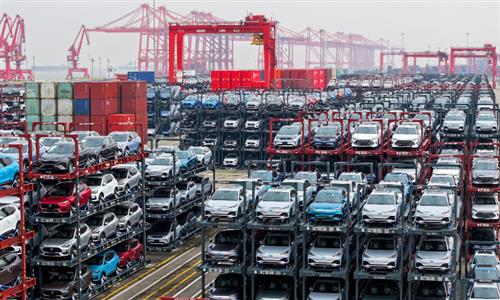
The significance of growth lies not merely in quantity, but far more in quality and substance. Today, China's economic competitiveness increasingly manifests in technological sophistication, systemic capabilities, market potential and institutional efficiency. From the "new three" - electric vehicles, lithium batteries and solar cells - which have swept global markets, to future industries prioritized in the Recommendations of the Central Committee of the Communist Party of China for Formulating the 15th Five-Year Plan for National Economic and Social Development, such as bio-manufacturing, quantum technology and embodied intelligence, the accelerated formation of new quality productive forces is reshaping the global value chain.
The Tianwen-2 mission, large-scale application of BeiDou Navigation Satellite System and domestically developed open-source large models - these breakthroughs are no longer laboratory exhibits but tangible productive forces. The kung fu robots featured in China's Spring Festival Gala this year left foreign netizens marveling that "the West is still in the Middle Ages." An analyst from a renowned British consulting firm predicts the emergence of a "China tech sphere," spanning artificial intelligence, DeepSeek, and electric vehicles, stating, "it's the first time in history that an emerging market economy is at the forefront of science and technology."
The accelerated formation of new quality productive forces also places China's rural revitalization strategy on the eve of a "long-tail effect" breakout. With the great victory in poverty alleviation, the income gap between urban and rural labor in China is expected to narrow gradually. As highly educated farmers from the post-90s and post-00s generations increasingly apply technological innovations to agricultural production, rural landscapes will inevitably undergo a transformative renewal. In the process of urban-rural integration, the potential to drive economic development is undoubtedly enormous.
Some still claim that consumer spending is sluggish. Yet, if you look at the booming cultural tourism market, the thriving ice-and-snow economy and the emerging silver economy, it becomes clear that the Chinese people's consumption upgrade is far from over. Trends like Labubu and China chic have sparked entirely new sectors worth tens of billions of yuan. The pursuit of quality living among the "new elderly" has given rise to new service formats. The explosive growth of new energy vehicles and Chinese beauty brands proves the power of supply-side innovation in turning potential demand into real purchases. In recent years, consumer models and chain brands that took off in big cities have been entering into lower-tier markets. The trend that "those who win the hearts of county residents win the market" speaks volumes about the immense potential hidden in China's "super markets".
Meanwhile, as the "Chinese-style life" trend goes viral on overseas social media platforms, Chinese brands are increasingly finding their way into Western consumers' lives. With Mixue Ice Cream & Tea and Labubu leading the charge, Yunnan Baiyao has now become the latest obsession among young people in the West. Looking ahead, other high-value Chinese brands — such as Kweichow Moutai, Pien Tze Huang and Dong'e Ejiao — are poised to gradually expand their global footprints. It's worth remembering that for much of human history, China was a major exporter of "luxury goods." Traditional blue-and-white porcelain and silk have long been synonymous with premium craftsmanship and exclusivity. As China's soft power continues to rise, its offerings rooted in a 5,000-year-old civilization — such as agarwood, tea and liquor — synonymous with an "elegant way of life," are gaining increasing acceptance in global markets, creating immense potential for brand development as well as production and sales growth.
This multi-layered vitality makes China's economy feel like a vibrant ecosystem — towering trees reaching for the sky, while new shoots constantly sprout from the soil. It should be noted that China's development has gone through all kinds of difficulties and challenges to reach where it stands today. In the past, it did not collapse because of the "China collapse" rhetoric, nor will it peak because of the "Peak China" rhetoric. The "Peak China" rhetoric is merely a variant that emerged after the "China collapse" rhetoric could no longer be sustained. Essentially, it remains a narrative construction with prejudice, and even reflects the gloomy expectations of some people. Today, such voices are also met with considerable skepticism in the West. As The New York Times noted, "skeptics have been predicting China's peak and inevitable fall for years, only to be proved wrong each time."
Against the backdrop of many developed economies falling into governance dysfunction and their economies lingering in prolonged low-growth cycles or even slipping repeatedly into recession, whether a major country can form a development model that is more efficient, more sustainable and more secure is of crucial importance. From this perspective, the Chinese economy has not "peaked"; rather, it is moving toward a higher stage of development. As the 15th Five-Year Plan period is about to commence, the road ahead will not be all plain sailing. There will be headwinds and even rough seas. But we firmly believe that as long as we do our own work well, consolidate the foundations of development, and keep the engine of innovation running strong, the Chinese economy will always remain a vast ocean.
RELATED ARTICLES