China's state news media issues security warning over OpenClaw amid social media frenzy
By Published: Mar 08, 2026 09:03 PM

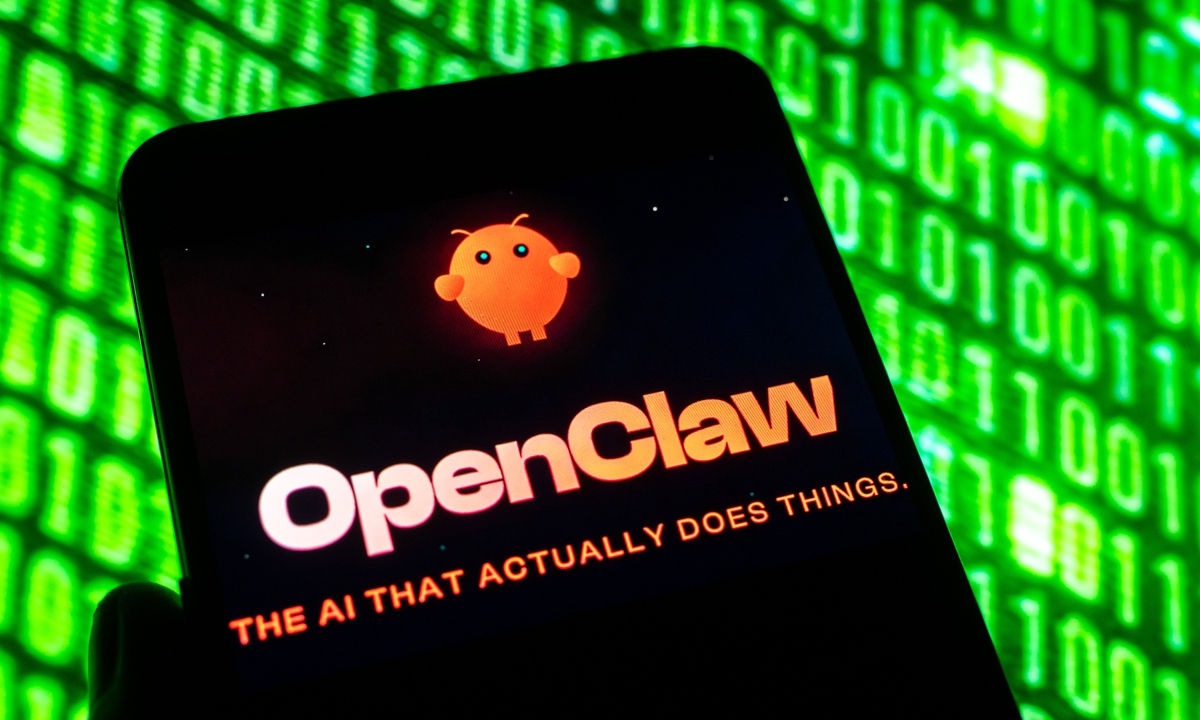
Photo: VCG
The Xinhua News Agency, on its official WeChat account, published a piece on Sunday introducing OpenClaw — along with a risk warning.
The move by the state-run news agency came as the buzzword "raising crayfish" gained Chinese netizens' attention on Sunday, with related topics being some of the most discussed on Chinese social media platform Sina Weibo, the Global Times learned.
Commenting on the move, ratsxp, an X user with more than 17,000 followers, wrote that "China's enthusiasm for technology, and even its belief in it, runs deeper than anywhere else in the world."
"Raising crayfish" refers to the OpenClaw autonomous artificial intelligence (AI) agent, due to its logo resembling a crayfish. The agent integrates multi-channel communication capabilities with large-language models (LLMs) to build customized AI assistants equipped with persistent memory and proactive task execution. It can also be deployed locally in private environments.
Unlike traditional conversational AI systems such as ChatGPT, OpenClaw is positioned to "get things done" rather than simply "chat." However, this functional orientation means it must obtain extensive system permissions to manipulate local files and applications.
The topic "DeepSeek suggests average users adopt a wait-and-see tactic before installing OpenClaw" was also one of the trending topics on Sina Weibo on Sunday.
Kevin Lin, a tech enthusiast who managed to install OpenClaw recently, told the Global Times on Sunday that the installation of OpenClaw has brought surprises to his work and life.
OpenClaw has connected several instant messaging apps and management tools, "so that even if I don't have a laptop with me, I can still let AI do things I wanted to do," Lin said.
However, Lin said that at present, the capability of OpenClaw greatly relies on the LLM it is based on.
In recent days, Chinese tech giants Tencent and Xiaomi rolled out installation programs for a small group of users for testing purposes.
On Friday, Xiaomi said on its Sina Weibo account that it had started a small-scale closed test for its Xiaomi miclaw agent based on its MiMo LLM. Due to its experimental nature, the company said that the closed beta test is by invitation only and will not be open to the public. Tech enthusiasts and heavy AI users are advised to back up their data securely beforehand and test and experience the product in a controlled environment.
On Friday, nearly 1,000 content developers and AI enthusiasts lined up at Tencent's headquarters to get OpenClaw installed with the help of Tencent engineers, domestic news portal thepaper.cn reported on Saturday. There were even cases when tech enthusiasts charged others a fee for installation service.
Liu Dingding, a veteran industry analyst, told the Global Times on Sunday that the internet giants are enthusiastic about OpenClaw, as the rise of the new service will provide a great market opportunity for their cloud services or ecosystems.
The trend of "raising crayfish" is a boon for the services offered by Chinese tech giants, Liu said.
Liu agreed that there are potential risks from the new technology, but noted that homegrown alternatives in the future could serve to address some of the risks.
The attention gained by the AI tool has come amid warnings by Chinese authorities about its potential risks.
Last week, an account affiliated with the National Administration of State Secrets Protection warned of the security risks of the open-source project OpenClaw and urged government agencies to exercise extreme caution, given its rapidly rising downloads from Chinese IP addresses and the fact that views of Chinese-language documents have exceeded those of all other non-English languages since January.
On February 5, the Ministry of Industry and Information Technology issued a security alert warning of risks related to OpenClaw. The alert stated that monitoring had found certain OpenClaw deployments, under default or improper configurations, triggered relatively high security risks, making them highly susceptible to cyberattacks and information leakage.
Still, the potential opportunities brought by the OpenClaw did not go unnoticed by some Chinese localities.
South China technology hub Shenzhen's Longgang district government recently rolled out a draft action plan on supporting the development of OpenClaw, seeking public input. The proposed encouraging measures include cash awards of up to 2 million yuan ($289,960) to developers who successfully contributed key codes in mainstream developer communities.
RELATED ARTICLES