Khamenei’s son named as supreme leader, signaling Tehran’s unity; confrontation with US, Israel may expand: Chinese expert
By Published: Mar 09, 2026 01:38 PM

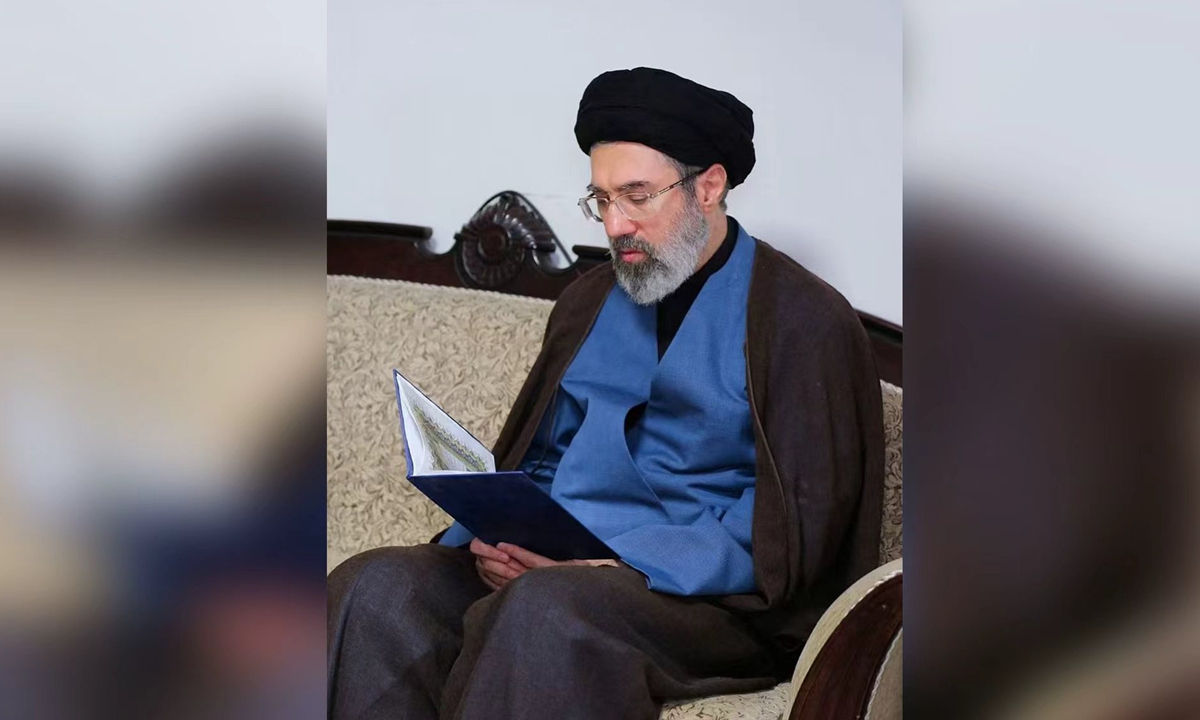
Mojtaba Khamenei, a son of Iran's late supreme leader Ali Khamenei, has been named as the Islamic Republic's next ruler, authorities announced on March 9, 2026. Photo: Tehran Times
Iran has named Mojtaba Khamenei, the second son of late supreme leader Ayatollah Ali Khamenei who was killed in a US-Israeli military operation against Iran, as the country's new supreme leader, Iranian state television reported early Monday. The appointment came despite earlier remarks by US President Donald Trump claiming Khamenei's son as "unacceptable." Chinese expert said that the move signals Tehran's unity and determination to continue confronting the US and Israel, with Iran likely to rely on asymmetric tactics while Washington may expand its strikes to increase pressure.On Sunday, Iran's Assembly of Experts appointed Mojtaba Khamenei as the new supreme leader. The decision, announced on State TV, was described as having secured "strong" votes, with an urgent call for the national unity behind him. The station broadcast scenes of people celebrating in parts of Tehran, according to a report from the Associated Press (AP).
The 56-year-old will serve as commander-in-chief of the military and powerful paramilitary Revolutionary Guard. There has been only one other transfer of power in the office of supreme leader since the Islamic Revolution almost a half-century ago, per AP.
According to a BBC report, born on September 8, 1969 in the northeastern city of Mashhad, Mojtaba Khamenei is the second of Ali Khamenei's six children. He received his secondary education at the religious Alavi School in Tehran. At age 17, Mojtaba Khamenei served in the military for several short periods during the Iran-Iraq War. In 1999, Mojtaba Khamenei went to Qom, a holy city which is considered an important center of Shia theology, to continue his religious studies, per BBC.
A report from Al Jazeera noted that Mojtaba Khamenei has never run for office or been subjected to a public vote, but has for decades been a highly influential figure in the inner circle of the previous supreme leader, cultivating deep ties to the paramilitary Islamic Revolutionary Guard Corps (IRGC). In recent years, he had increasingly been touted as a top potential replacement for his father.
The report also noted that "The younger Khamenei's ascension is a clear sign that more hardline factions in Iran's establishment retain power, and could indicate that the government has little desire to agree to a deal or negotiations in the short term."
Mojtaba Khamenei's ascension highlights Tehran's unity under current circumstances. A longtime figure in the Supreme Leader's office with influence over the Basij militia, Mojtaba Khamenei is viewed by many insiders as a pragmatic leader capable of maintaining stability during a highly sensitive transition. Also, as the US-Israeli targeted strikes had taken his father, mother and wife, sympathy within Iran's political establishment toward Mojtaba Khamenei has grown, further consolidating support for him, Sun Degang, director of the Center for Middle East Studies at Fudan University, told the Global Times.
Mojtaba's mother, wife, and one of his sisters were killed in the strike that killed his father, but the younger Khamenei was reportedly not present and has so far survived the intense bombing of Iran, per Al Jazeera.
Iran's political system operates through a triangular power structure composed of the clerical establishment, the military — especially the IRGC — and the political bureaucracy. These factions have largely reached a consensus that Mojtaba Khamenei is the most suitable figure to take over the position, said Sun, noting that despite continued threats from the US and Israel that any new Iranian leader could face similar targeted attacks, Mojtaba's willingness to step forward and assume the role is interpreted by supporters as a sign of political resolve and responsibility at a moment of national crisis.
According to Al Jazeera, after the announcement of the appointment on Sunday, key leaders, Iran's IRGC, and the armed forces were quick to pledge their backing to the new leader. Ali Larijani, secretary of the Supreme National Security Council, who has been tasked with steering Iran's security strategy since the US and Israel launched their all-out offensive, called for unity around the new supreme leader. Parliament Speaker Mohammad Bagher Ghalibaf welcomed the choice, saying that following the new supreme leader was a "religious and national duty."
Sun noted that the Khamenei family has long maintained a consistent ideological stance against Israel, but Mojtaba Khamenei appears to show a stronger determination in confronting both Israel and the US. A comparison with the "12-day war" in June 2025, when the US and Israel launched attacks on Iran, highlights the shift. Under Supreme Leader Ali Khamenei, Iran largely adopted a strategy of defensive restraint and limited retaliation, seeking to avoid further escalation.
This time, however, Iran's response appears more assertive. The scope and intensity of its actions have expanded, reflecting a stronger willingness to engage in confrontation. While the ideological opposition to the US and Israel remains unchanged, the methods of confrontation under Mojtaba's influence appear noticeably more resolute, said Sun.
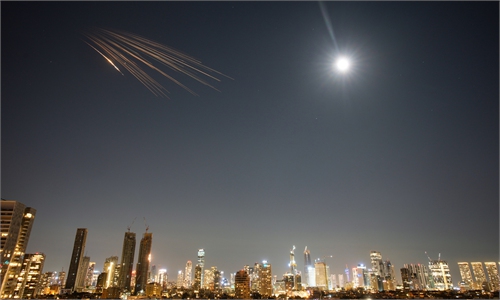
Iran fired missiles at Israel early Monday in the name of the Islamic republic's new leader, Mojtaba Khamenei, according to CBS 19News.
During a phone interview with The Times of Israel shortly after the announcement of Iran's new supreme leader, President Trump refused to comment on the appointment, saying only, "We'll see what happens." According to the Israeli outlet, Trump said the decision on when to end the war with Iran would be a "mutual" one made together with Israeli Prime Minister Benjamin Netanyahu.
While in an interview with Axios last week, Trump claimed that "Khamenei's son is unacceptable to me. We want someone that will bring harmony and peace to Iran." "They are wasting their time. Khamenei's son is a lightweight. I have to be involved in the appointment, like with Delcy [Rodriguez] in Venezuela," Trump said. He also claimed that he refuses to accept a new Iranian leader who would continue Khamenei's policies, which he said would force the US back to war "in five years."
Israel's military said early Monday that its air force had begun an "additional wave" of strikes against unspecified "regime infrastructure" in central Iran. Israel has said that anyone named to the role of supreme leader would become a target for assassination, according to DW.
Despite opposition from the US, Iran's clerical establishment has selected the late supreme leader's son as the country's new supreme leader, a move that underscores the deep and likely irreconcilable tensions between Washington and Tehran. The decision may further harden the new leader's resolve in confronting the US and Israel, said Sun.
Meanwhile, the US appears to be signaling a possible escalation. Previously, US strikes focused mainly on weakening Iran's military capabilities, but if the conflict intensifies, potential targets could expand to include government facilities and other critical civilian assets. The ultimate objective could be to cripple Iran's governing system and create conditions for deeper intervention, potentially including ground operations aimed at regime change, said the expert.
Sun said that in the immediate period following the announcement of Iran's new leader, Tehran may still rely on asymmetric strategies, including maintaining control of the Strait of Hormuz. Such moves could drive up global oil prices, increase economic pressure, draw greater international attention to the Gulf crisis, and place additional pressure on Washington and its allies to de-escalate.
By affecting global energy supply and potentially fueling anti-war sentiment in the US —particularly in an election year—Iran may also seek to raise the political cost of continued military action.
French President Emmanuel Macron said on Sunday that a diplomatic solution is "more necessary than ever" to put an end to the escalation and preserve peace. Macron made the remarks in a post on social media platform X after speaking with Iranian President Masoud Pezeshkian over phone.
French news channel BFMTV reported that Macron also held a phone conversation with US President Trump on Sunday. No details of the call were disclosed for the moment, according to Xinhua.
RELATED ARTICLES