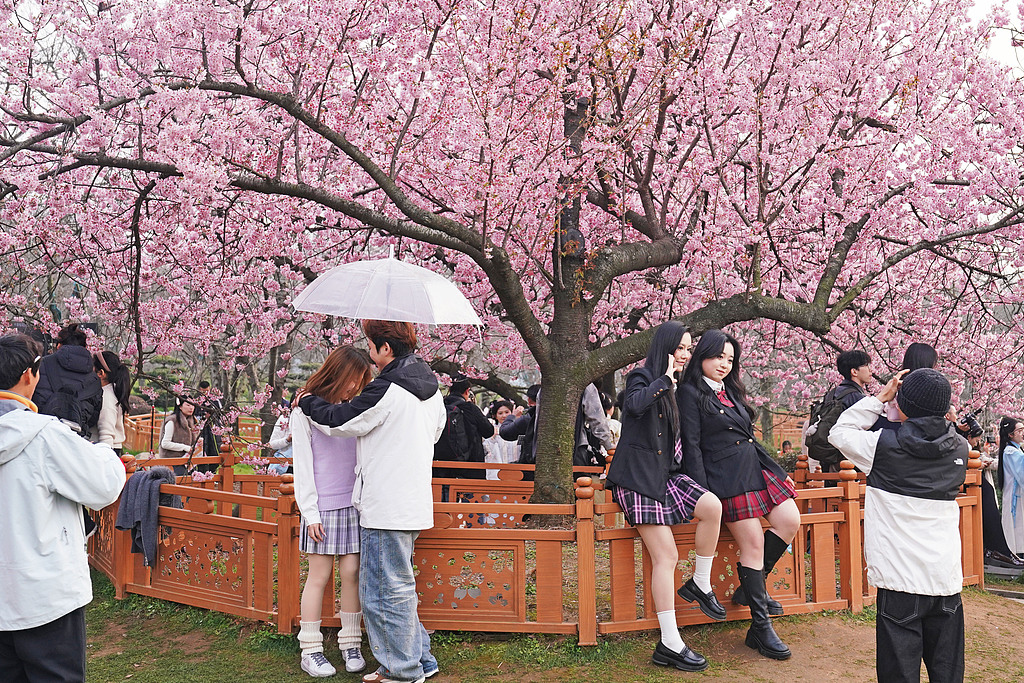
Visitors enjoy early-blooming cherry blossoms in the 550-acre East Lake Cherry Blossom Garden in Wuhan, Central China's Hubei Province, on March 6, 2026. Photo: VCG
Tourist sites across China have rolled out many themed performances and immersive activities, to enrich spring cultural and tourism offerings and energizing the market.
Data from online travel platforms indicate that China's spring consumption market will likely heat up and people's consumption potential will be released at an accelerated pace.
According to a report the travel platform Tongcheng.com sent to the Global Times on Monday, searches and bookings for hotels and attraction tickets as of March 4 were up by more than 10 percent than the same period last year. Some popular tourist attractions saw month‑on‑month search increases of up to 2.6 fold.
Meanwhile, searches over the past week for "free scenic tickets" and "off‑peak travel" went up sharply last week — up by 358 percent — with Yuntai Mountain, the Shenyang Imperial Palace, Lushan Mountain, Tianji Longmen Scenic Area and Qingtian River among the sites registering the fastest rises, Tongcheng.com said.
With warming weather, searches for "flower viewing" and "spring outings" on Tongcheng.com rose by more than 110 percent week-on-week, and industry analysts expect a new travel peak in late March.
And, data from another travel platform, Qunar.com, showed that early spring breaks are driving up spring outings, particularly ahead of the Qingming Festival holiday which falls on April 4-6.
According to domestic news site scol.com.cn, multiple schools in Chengdu, Southwest China's Sichuan Province, have scheduled spring break from April 1 to April 3. With the Qingming Festival holiday approaching, many families will enjoy a six-day-long holiday, prompting strong travel market demand and a surge in hotel and flight bookings, Qunar.com told the Global Times on Monday.
Qunar.com data showed that the most popular destinations during the spring break include Shanghai, Beijing, Sanya, Guangzhou, Hangzhou, Zhuhai, Qingdao, Wuhan, Haikou and Jieyang.
Other platforms listed domestic hot spots including Sanya, Chengdu, Kunming, Guangzhou and Nyingchi; outbound travel sites include Hong Kong, Macau, Bangkok, Chiang Mai and Singapore, according to chinanews.com.cn.
The post-Spring Festival travel market is showing good momentum, as many attractions have launched free-admission promotions. And, office workers and seniors are choosing to travel off-peak after the holiday. Together, these trends are keeping travel market very resilient, according to an analysis by the Tongcheng Research Institute.
Scenic spots across China have rolled out themed performances and immersive activities, broadening tourism product offerings and turning seasonal visitor flows into sustained spending.
For example, in Wuhan, Central China's Hubei Province, local operators are combining flower blossoms with camping and cultural offerings to extend tourist spending. For example, the East Lake Cherry Blossom Garden opened on March 1, kicking off the annual cherry blossom season. Local operators are combining floral displays with tech-led immersive scenes, transforming the traditional "flower-viewing" economy into a composite consumption experience, local media reported.
At the garden, Alipay's digital tourism site debuted an AI character called "Chu Xiaoying," which visitors can awaken at entry points and designated spots via interactive devices to receive intelligent tour guidance. AI photo booths, robot dogs that guide and interact with visitors, and robots performing with live bands are being used to create new immersive, tech‑augmented experiences that combine sights, sounds, and interaction.
"Spring tourism's warming reflects a strong demand for higher-quality and more personalized cultural and travel products, and provides a solid foundation for tourism recovery throughout the year," Jiang Yiyi, a tourism and sports expert at Beijing Sport University, told the Global Times on Monday.
"This spring tourism market shows three new characteristics: new products — a shift from simple sightseeing to immersive experiences; new scenes — deep integration of digital technology with natural ecosystems; and new consumption — a move from a ticket-only economy toward a broader, ecosystem-style spending model that includes food, retail, accommodation and tech-enabled services," Jiang said.
According to Jiang, the combination of free or discounted access, shorter but more frequent trips, school and family spring-break travel and immersive offerings suggests the spring travel surge may translate into longer-term gains for China's tourism market. The expert said spring tourism is expected to sustain its momentum into the second quarter and help underpin a broader domestic consumption recovery through 2026.
RELATED ARTICLES