ARTS / CULTURE & LEISURE
Feeling enduring power of ancient classics through reading
By Published: Mar 09, 2026 10:24 PM

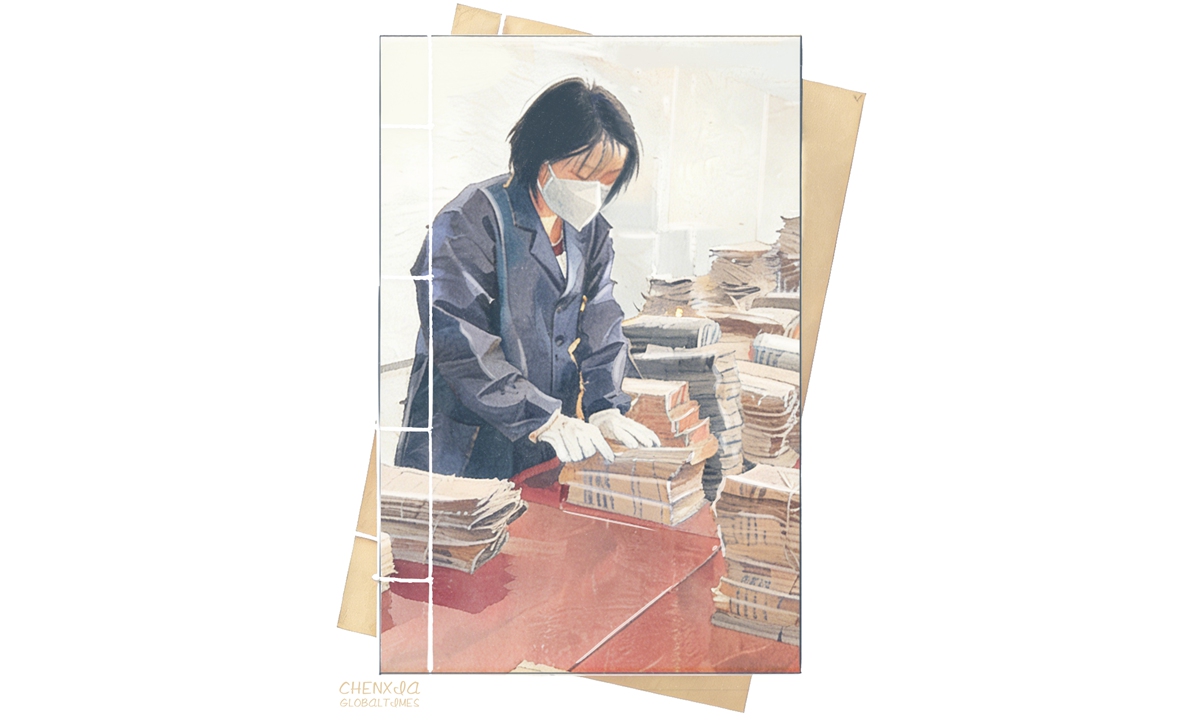
Illustration: Chen Xia/GT
Recently, the ancient books repository of the Commercial Press reclaimed its old name, Hanfenlou, and - after 77 years - opened its door to the public once more. For the first time in generations, centuries-old texts, once considered treasures reserved for scholars, have been arranged on shelves and are being preserved with advanced technology. More than 30,000 volumes are awaiting rediscovery by curious minds, including some of China's most valued classics like The Records of the Three Kingdoms."Hanfen" means "the cultivation of scholarly perfume," bringing to mind an atmosphere steeped in the fragrance of ink and learning, according to the Beijing Daily. Founded in 1910, Hanfenlou quickly became a prestigious public library after an expansion in 1924, shaping a generation of writers, thinkers, and young minds. But tragedy struck in 1932, when the Japanese army's bombings ruined Hanfenlou and tens of thousands of precious ancient books with it. So for nearly a century, Hanfenlou survived only as a memory.
Now the door is open again, and the bookcases stand ready. But a question confronts readers: Are ancient books still relevant today, or are they doomed to remain "paper relics" that only the bold or scholarly dare to approach?
Many people practically live online nowadays. E-books, fast news, bite-sized information dominate almost every day. E-reading does offer efficiency, but holding and reading ancient books is a kind of cultural immersion and a sense of ritual that screens cannot replicate, noted Zhang Peng, a cultural researcher and associate professor at Nanjing Normal University, emphasizing the irreplaceable value of ancient texts.
Zhang told the Global Times that under the premise of full protection, reading ancient books is an active spiritual journey. It requires readers to mobilize multiple abilities such as textual research and historical imagination. When the public touches paper pages that have endured history with their own hands and have a dialogue across time with other readers from hundreds of years ago, cultural inheritance is transformed into a concrete and warm life experience.
In an era of rampant AI-generated content, ancient books, as irreplaceable originals, offer a definite cultural reference point. They enable the public to understand that we are not only pursuers of the future but also inheritors of tradition. This sense of identity is the foundation for building cultural confidence.
Lu Wei, deputy editor-in-chief of Zhejiang Ancient Books Press, told the Global Times that reading ancient books not only satisfies intellectual curiosity but also meets emotional needs. Young readers are drawn to the sense of history and passage of time, relish conversing with strangers through inscriptions, and savor the slow, empathetic connection this brings.
The conservation of these ancient books has been given due attention at the ancient books repository of the Commercial Press. The place is equipped with a constant temperature and humidity control system and professional protection facilities, providing a stable environment for the preservation of ancient books. To organize these books, the staff first had to carefully remove the original hemp ropes tied around them, then cleaned off the dust, and counted them according to their categories and placed them in the bookcases one by one, the Beijing Daily reported.
But preservation alone is not enough. Ancient texts should also "come alive" for new generations in new ways. Digitalization has already made it possible to view rare manuscripts online, letting anyone with a phone or computer explore ink-stained pages that might otherwise be locked away for their protection. Livestreams of professional book restoration, once a niche interest, have taken off, inviting viewers to witness the delicate work that keeps fragile volumes from turning to dust. Pop-up markets focused on ancient books and photorealistic reprints make it possible for ordinary readers to actually touch and own echoes of the past.
For example, the full-color collection of Dunhuang manuscripts, spanning from the 4th to the 11th century, contains over 100 volumes, presenting reproductions of significant manuscripts from 11 institutions in Northwest China's Gansu Province, the National Library of China and the French National Library, state broadcaster CCTV reported.
Previously, technical constraints meant these manuscripts were primarily published in black and white. The current full-color edition seeks to overcome this limitation by offering high-definition, comprehensive reproductions that assemble scattered manuscripts from around the world. The higher quality can attract more people to appreciate these texts.
Ancient books should never be locked away or made objects of mere reverence. They are conversation partners, reminders, and guides. In a world changing as fast as it is today, people need the steadiness of these shared texts more than ever.
The author is a reporter with the Global Times. life@globaltimes.com.cn
RELATED ARTICLES